


























Views
Downloads

Printable Dihybrid Cross Worksheet | Grade 9-11 Biology
Paste this activity's link or code into your existing LMS (Google Classroom, Canvas, Teams, Schoology, Moodle, etc.).
Students can open and work on the activity right away, with no student login required.
You'll still be able to track student progress and results from your teacher account.
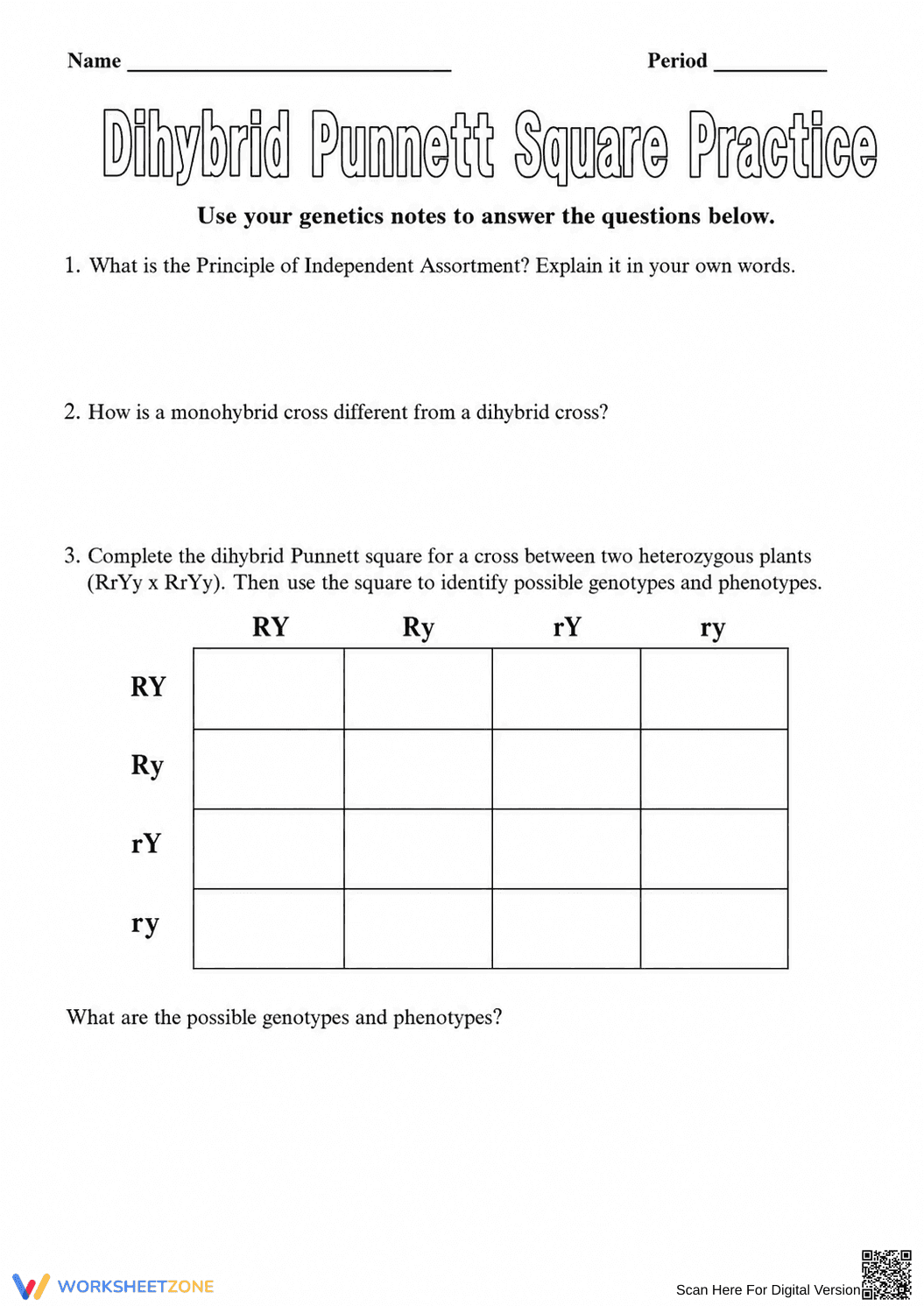
This high school biology worksheet provides targeted practice with dihybrid crosses and the Principle of Independent Assortment. Students will construct 4x4 Punnett squares, determine allele combinations, and calculate phenotypic ratios to predict offspring traits. This resource bridges foundational genetics concepts with complex probability applications.
At a Glance
- Grade: 9-11 · Subject: Biology
- Standard:
HS-LS3-3— Apply probability concepts to explain trait variation and distribution.- Skill Focus: Dihybrid crosses and phenotypic ratios
- Format: 2 pages · 5 problems · Answer key included · PDF
- Best For: Independent practice and skill reinforcement
- Time: 25–35 minutes
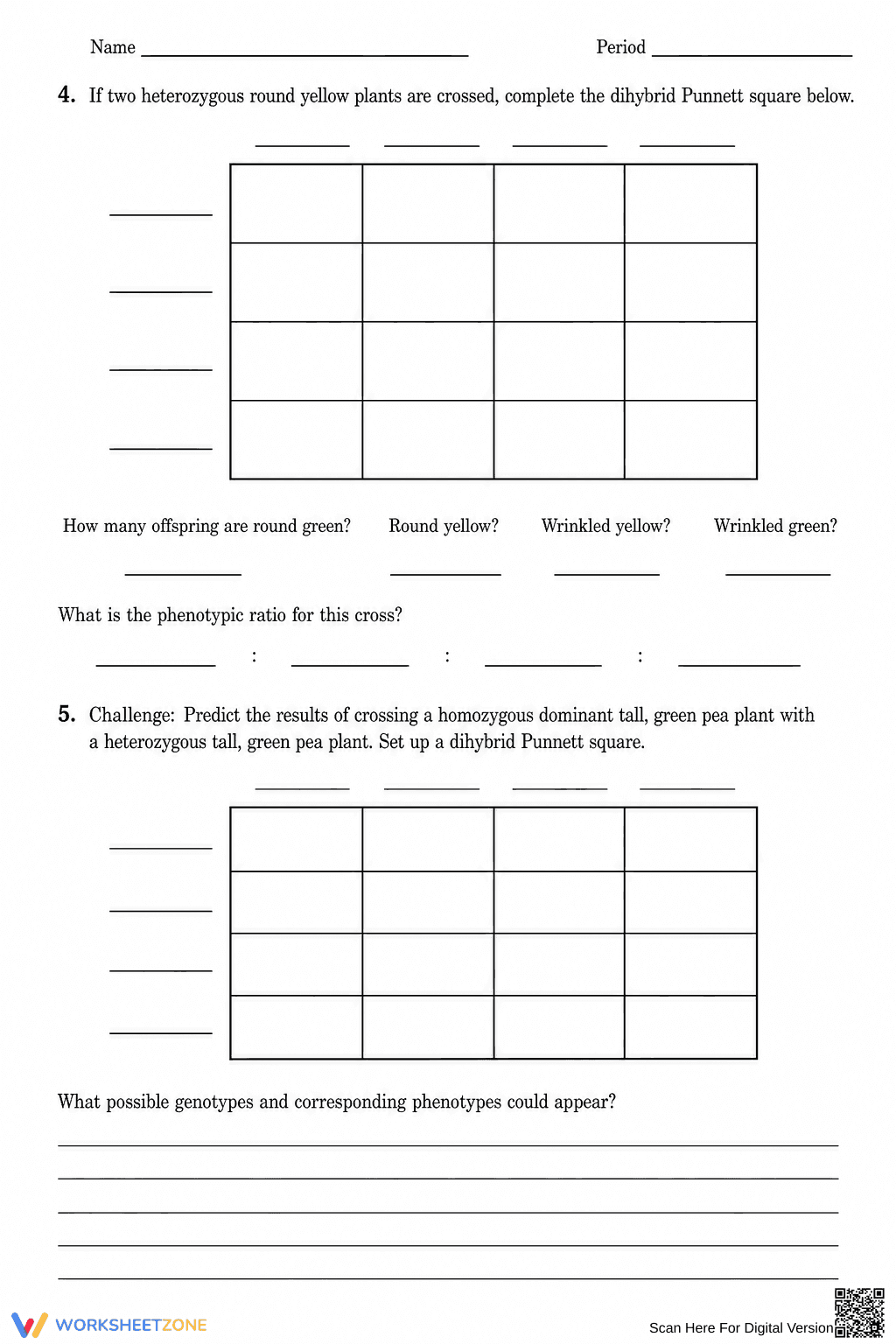
This two-page resource features five comprehensive tasks that guide students through the mechanics of two-trait inheritance. The layout includes short-answer questions to review key vocabulary, followed by three large 4x4 Punnett square grids. Students are prompted to identify parent genotypes, fill in the 16-box squares, and extract specific phenotypic ratios. A final challenge question introduces homozygous and heterozygous combinations for advanced application.
- Guided practice: The first two questions review the Principle of Independent Assortment and distinguish between monohybrid and dihybrid crosses, ensuring foundational understanding.
- Supported practice: Students complete a partially set-up Punnett square for a standard heterozygous cross, identifying all possible genotypes and phenotypes.
- Independent practice: The final tasks require students to set up their own dihybrid squares from word problems, calculate exact phenotypic ratios, and tackle a challenge scenario. This follows a clear gradual-release model.
Aligned to primary standard HS-LS3-3: Apply concepts of statistics and probability to explain the variation and distribution of expressed traits in a population. By calculating phenotypic ratios from 16-box Punnett squares, students directly apply statistical probability to genetic inheritance. Both standard codes can be copied directly into lesson plans, IEP goals, or district curriculum mapping tools.
Deploy this worksheet immediately following direct instruction on Mendel's laws and two-trait crosses. It serves perfectly as an in-class independent assignment or a structured homework task. As students work, circulate and check their initial allele setups along the top and side of the grids; correcting errors here prevents cascading mistakes inside the Punnett square. Expected completion time is 25 to 35 minutes.
This resource is designed for high school biology students mastering Mendelian genetics. The clear progression makes it accessible for on-level learners, while the final challenge question provides differentiation for advanced students who finish early. Pair this worksheet with a visual anchor chart demonstrating the FOIL method for determining parent gametes.
Mastering complex inheritance patterns requires repeated, structured application of probability rules. Standard HS-LS3-3 requires students to apply probability concepts to explain trait variation and distribution. According to Fisher & Frey (2014), utilizing a gradual release of responsibility framework significantly improves student retention of multi-step procedures like those found in genetics. By moving from definitional questions to fully independent 16-box Punnett squares, this worksheet builds the cognitive stamina necessary for advanced biological sciences. Explicit practice with dihybrid crosses ensures students can accurately predict phenotypic ratios and understand the mathematical foundations of genetic diversity. This targeted approach minimizes cognitive overload while maximizing skill acquisition, preparing high school learners for subsequent units on non-Mendelian inheritance and population genetics.


