




























Views
Downloads

Printable Punnett Square Worksheet | Grade 9-12 Biology

Paste this activity's link or code into your existing LMS (Google Classroom, Canvas, Teams, Schoology, Moodle, etc.).
Students can open and work on the activity right away, with no student login required.
You'll still be able to track student progress and results from your teacher account.
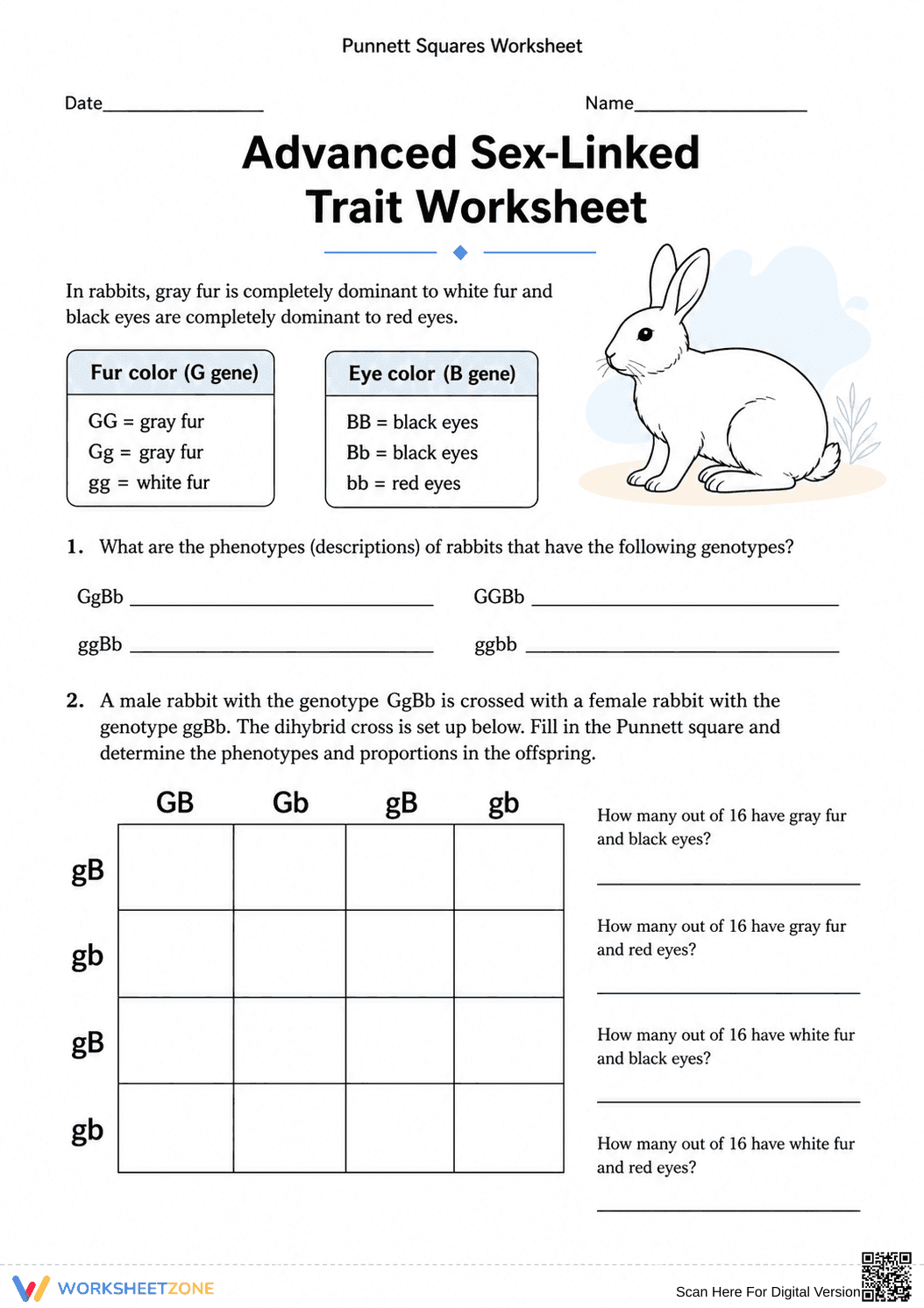
This high school biology worksheet gives students targeted practice with dihybrid crosses and genetic probability. By completing a complex Punnett square, learners predict the phenotypic outcomes of two distinct traits in rabbits. This resource builds essential problem-solving skills for understanding dominant and recessive inheritance patterns.
At a Glance
- Grade: 9-12 · Subject: Biology
- Standard:
HS-LS3-3— Apply probability to explain the variation of expressed traits.- Skill Focus: Dihybrid crosses and Punnett squares
- Format: 1 page · 9 problems · Answer key included · PDF
- Best For: Independent practice and review
- Time: 15–20 minutes
This single-page resource features a clear reference table for rabbit fur and eye color genetics. Students first tackle four short-answer questions requiring them to translate specific genotypes into physical phenotypes. The core activity is a 16-box dihybrid Punnett square, followed by four calculation prompts where students determine the exact phenotypic ratios of the resulting offspring. A complete answer key is provided for quick grading.
Zero-Prep Workflow
This resource is designed for immediate classroom implementation with under two minutes of teacher preparation.
- Print (1 minute): Generate copies of the single-page PDF for your biology roster.
- Distribute (1 minute): Hand out the assignment after introducing dihybrid crosses. The built-in reference tables mean students can start immediately.
- Review (3 minutes): Display the answer key on the board for rapid self-correction or peer grading.
Because the instructions are completely self-contained, this worksheet serves as an excellent, reliable activity for a substitute teacher plan.
Standards Alignment
This practice activity aligns with HS-LS3-3: Apply concepts of statistics and probability to explain the variation and distribution of expressed traits in a population. Students directly apply statistical probability by calculating the 16-part ratios of a dihybrid cross. Both standard codes can be copied directly into lesson plans, IEP goals, or district curriculum mapping tools.
How to Use It
Assign this worksheet during direct instruction as a guided application activity, or use it as independent homework after teaching dihybrid crosses. It typically takes students 15 to 20 minutes to complete. As a formative assessment tip, walk the room while students fill in the 16-box grid; watch for common errors in distributing the alleles across the top and side of the Punnett square before they calculate their final ratios.
Who It's For
This assignment is designed for high school biology students mastering Mendelian genetics. To support learners who struggle with visual tracking, encourage them to use two different colored highlighters for the fur and eye color alleles. Pair this worksheet with a foundational anchor chart detailing the steps for setting up a dihybrid cross to maximize student success.
Mastering genetic probability requires repeated, structured practice with visual models. When students engage with HS-LS3-3 to apply probability to explain the variation of expressed traits, they move beyond rote memorization into applied mathematical reasoning. According to EdReports 2024, high-quality science instructional materials must provide explicit opportunities for students to integrate mathematical concepts, such as ratios and probability, directly into biological contexts. By calculating the specific phenotypic outcomes of a dihybrid cross, learners solidify their understanding of independent assortment and genetic variation. This targeted exercise ensures that students can accurately predict inheritance patterns using standard scientific models. Utilizing clear, scaffolded Punnett square activities helps bridge the gap between abstract genetic theories and observable physical traits, building a stronger foundation for advanced biological studies and standardized assessments.


