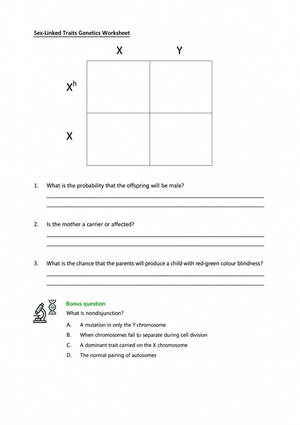
These sexlinked traits worksheets for 10th grade give biology teachers a focused set of resources for one of the trickiest corners of Mendelian genetics — the moment students discover that inheritance patterns change when a gene lives on a sex chromosome rather than an autosome. The set covers X-linked Punnett squares, hemizygosity, carrier identification, and multi-generation pedigree analysis, moving students from notation mechanics toward the evidence-based reasoning NGSS expects at the high school level.
Skills These Worksheets Build
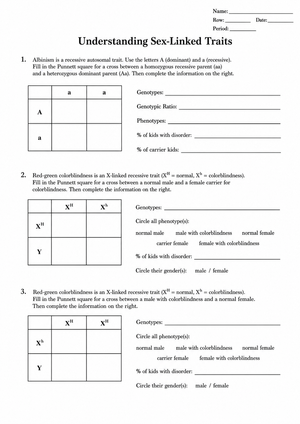
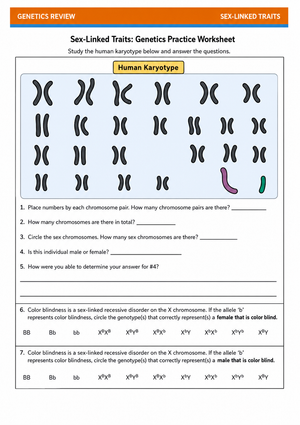
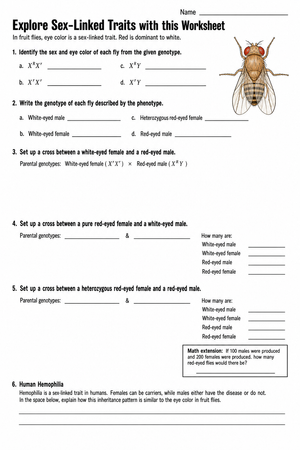
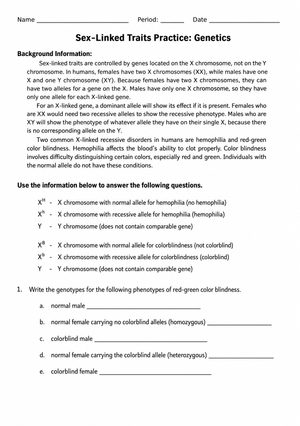
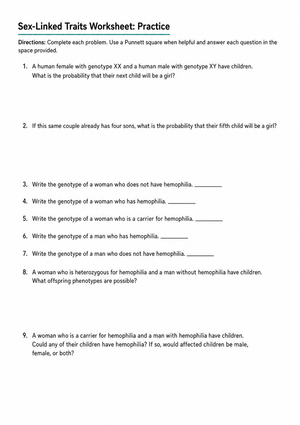
The resources move through a deliberate sequence. Early worksheets establish the superscript notation — students write X^B X^b for a carrier female and X^b Y for an affected male, then place those genotypes into Punnett squares before they ever touch a pedigree chart. Later worksheets shift to family-history problems where students must assign genotypes to individuals whose phenotype alone doesn't settle the question.
- Writing sex-linked genotypes in correct superscript notation across all four female possibilities and both male possibilities
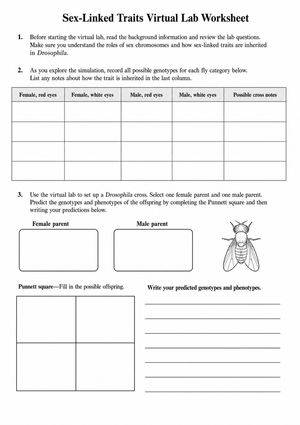
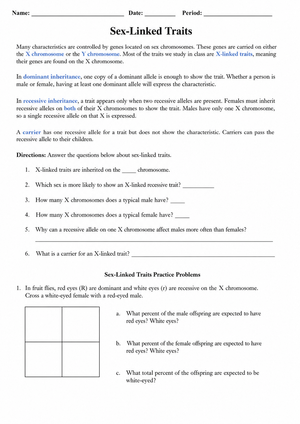
- Completing X-linked Punnett squares and reading phenotype ratios separately for male and female offspring
- Explaining hemizygosity and connecting it to why males express X-linked recessive traits more often than females do
- Reading pedigree charts to determine whether a trait is X-linked recessive or autosomal recessive
- Identifying carriers from pedigree evidence alone, without a stated genotype
- Applying cross results to known examples: red-green color blindness, hemophilia, Duchenne muscular dystrophy
That last skill is where the genetics becomes real for most students. When a student works out that an unaffected woman must be a carrier because her father was color blind, she is no longer filling in a chart — she is constructing an argument from pedigree evidence. That shift from mechanical calculation to deductive reasoning is what separates students who genuinely understand sex linkage from those who memorized the notation steps.
The Notation Barrier in X-Linked Genetics
The jump from standard Mendelian notation to sex-linked notation is the most common stall point in 10th grade genetics. In autosomal crosses, students are comfortable writing Bb for a heterozygote. Sex-linked problems force them to track two variables simultaneously — which chromosome carries the allele — and many students freeze before they've even set up the cross.
Each worksheet in the set labels the chromosome axes explicitly, showing X^B and X^b as distinct objects being combined rather than abstract allele variables. This keeps working memory free for the reasoning. When students can see the chromosome structure directly in the layout instead of reconstructing it from memory, the hemizygous male — that X^b Y genotype with nowhere to hide the recessive allele — finally makes intuitive sense. The format applies the cognitive load principle directly: reducing what students have to hold in their heads so they can focus on the biological logic.
Pedigree Analysis: The Harder Half
Pedigree work is where 10th graders either consolidate their understanding or reveal that they've been proceeding on incomplete logic. The diagnostic problem that separates the two groups: show a pedigree where every affected individual is male, and ask students to name the mode of inheritance. Students who have genuinely internalized hemizygosity flag X-linked recessive immediately. Students who haven't tend to write "autosomal recessive" because that's what they learned first and the data technically doesn't rule it out.
Several worksheets in the set use pedigrees with deliberate ambiguity — cases where X-linked recessive and autosomal recessive are both consistent with the chart, and students must identify what additional information would resolve the question. That's a harder task than pattern recognition, and it's closer to what actual genetic analysis involves. The "criss-cross" signal — affected fathers whose sons are unaffected but whose daughters all become carriers — recurs across enough problems that students begin recognizing it without prompting.
Lesson-Planning Strategies for Getting the Most From This Set
These resources fit naturally in the week or two most teachers spend on sex-linked inheritance, after students have finished basic Mendelian crosses. The notation worksheets work best as guided practice the day after direct instruction on hemizygosity — not as independent work yet, because students still need to ask notation questions before they can reliably handle problems on their own. By day two or three, the pedigree worksheets hold up as genuine independent or small-group tasks.
The mystery-pedigree problems — where mode of inheritance is unlabeled — make a strong formative exit ticket near the end of the unit. Five to eight minutes before the bell is enough time for students to commit to a mode of inheritance and write one sentence of justification. That quick check tells you exactly which students are still conflating carriers with affected individuals, which is the most persistent confusion in this unit, and it requires no grading time beyond a fast scan.
Assigning sexlinked traits worksheets for 10th grade in that order — notation first, single-generation crosses second, multi-generation pedigrees last — lets you assess procedural and analytical skills separately rather than blurring them into a single genetics grade. Standards-based grading systems benefit especially from this sequencing because the two skill types align to different performance expectations.
Frequent Student Errors Worth Watching For
The error that appears most reliably in student work is placing a recessive allele on the Y chromosome. A student writes X^B Y^b for a color-blind male, runs the cross, and produces offspring that include "affected females" who inherited the Y^b from their father — biologically impossible. This happens because students learned early that males are XY and that both letters carry alleles in standard Mendelian notation. The cross produces obviously wrong results when this mistake is made, which makes it a useful self-correction moment if you catch it during guided practice rather than on the unit test.
A subtler problem: students who correctly label carrier females as X^B X^b will mark them as "unaffected" in a pedigree and move on — then, four problems later, fail to recognize those same carriers as the source of the trait in the next generation. They understand carrier status as a descriptor, not a transmission mechanism. Any worksheet that traces an allele across two generations rather than one surfaces this gap quickly.
There's also a persistent conceptual confusion worth disrupting before it costs students points on the unit exam: many students read that hemophilia is more common in males and conclude females simply cannot have it. A problem showing an affected female — with a color-blind father and a carrier mother — makes clear that females can express X-linked recessive traits, just at much lower frequency. Presenting that scenario early prevents it from calcifying into a rule students apply incorrectly on assessments.
Standard Alignment
The sexlinked traits worksheets for 10th grade in this set align directly with NGSS HS-LS3-3, which asks students to apply statistical and probability concepts to explain the variation and distribution of expressed traits in a population. Sex-linked inheritance is one of the clearest instructional vehicles for this standard because the unequal phenotype ratios between males and females make the probability work visible in a way that autosomal crosses often don't. When students calculate that sons of a carrier mother have a 50% chance of being affected while daughters have a 0% chance of expressing the trait — though a 50% chance of carrying it — they are working directly inside HS-LS3-3's core demand, not as an extension activity.
The pedigree analysis tasks also align with the NGSS science practice of constructing explanations from data. Students are not filling in genotypes; they are building a case for why a particular inheritance pattern fits the family history shown in the chart, which is the kind of evidence-based argumentation the performance expectations require.
Differentiating the Set for a Range of Learners
Students who are still unsteady with basic Mendelian crosses have a manageable entry point in the notation and single-generation Punnett square worksheets. These students benefit from a reference card listing all six sex-linked genotypes — the two male possibilities (X^B Y and X^b Y) alongside the four female possibilities — while they work through early problems. That card keeps working memory free for the reasoning rather than symbol recall. Once the notation becomes automatic, the card comes away; it's a temporary support structure, not a permanent accommodation.
Students who move quickly through the procedural problems are ready for the open-ended pedigree tasks, which don't have a single correct genotype for every individual in the chart. These problems ask students to explain what the pedigree rules out, not just what it confirms — a meaningfully harder analytical step. A further extension for students who need a genuine challenge: ask them to construct their own pedigree that is consistent with X-linked recessive inheritance but could not be explained by autosomal recessive. Building a problem from the ground up requires a depth of understanding that answering problems alone rarely reveals.
For students who stall specifically on the carrier concept — where phenotype gives no information about genotype — a two-column organizer works well: one column for phenotype, one for all possible genotypes that phenotype allows. Once they see that an unaffected female could be X^B X^B or X^B X^b, and that pedigree context is what narrows the options, the deductive logic tends to click faster than additional Punnett square practice would accomplish.
Frequently Asked Questions
Why are males affected by X-linked recessive conditions far more often than females?
Males carry only one X chromosome. Any recessive allele on that chromosome is expressed directly in the phenotype — there is no second X to supply a dominant allele that might mask it. This is hemizygosity. Females need two copies of the recessive allele, one from each parent, before the trait appears, which is a much lower-probability event. Red-green color blindness, for example, affects roughly 8% of males but less than 1% of females in most studied populations.
Can an affected father pass an X-linked trait directly to his son?
No. A father contributes a Y chromosome to each son, so his X chromosome — and any allele riding on it — passes only to his daughters, making each daughter at minimum a carrier. Students who internalize this rule can immediately eliminate father-to-son transmission as evidence for X-linked inheritance when reading any pedigree. That's a fast, reliable diagnostic move worth drilling before the pedigree worksheets begin.
What notation system should students use for sex-linked problems?
The standard high school convention writes alleles as superscripts attached to the X chromosome — X^B for dominant, X^b for recessive — while the Y chromosome carries no superscript because it doesn't bear a corresponding allele for these traits. Textbooks vary slightly in symbol choice, but the superscript-on-X convention is what appears on most state assessments and NGSS-aligned resources, so it's worth establishing early and keeping consistent across the entire unit.
How do students distinguish an X-linked recessive pedigree from an autosomal recessive one?
The clearest signals are the sex ratio among affected individuals and what happens with affected fathers. In an X-linked recessive pedigree, affected individuals are predominantly male, and an affected father never passes the trait to his sons — though all his daughters carry the allele. In an autosomal recessive pedigree, affected individuals appear in roughly equal numbers across sexes, and a father can pass the allele to sons just as readily as to daughters. If a student is using sexlinked traits worksheets for 10th grade that pair both inheritance patterns in the same problem set, that contrast becomes far easier to internalize than studying each pattern in isolation ever allows.
Where in the genetics unit do these worksheets fit best?
After students are steady with basic Mendelian notation and have completed at least a few standard Punnett squares. Introducing sex-linked notation before students have those mechanics is a reliable path to confusion. Most teachers place this material in the second half of the genetics unit, once dominance, recessiveness, and basic probability ratios are no longer new concepts — usually two to three weeks into genetics instruction.