


























Views
Downloads

Dihybrid Cross Genetics Worksheet | Grade 9-11 Printable
Paste this activity's link or code into your existing LMS (Google Classroom, Canvas, Teams, Schoology, Moodle, etc.).
Students can open and work on the activity right away, with no student login required.
You'll still be able to track student progress and results from your teacher account.
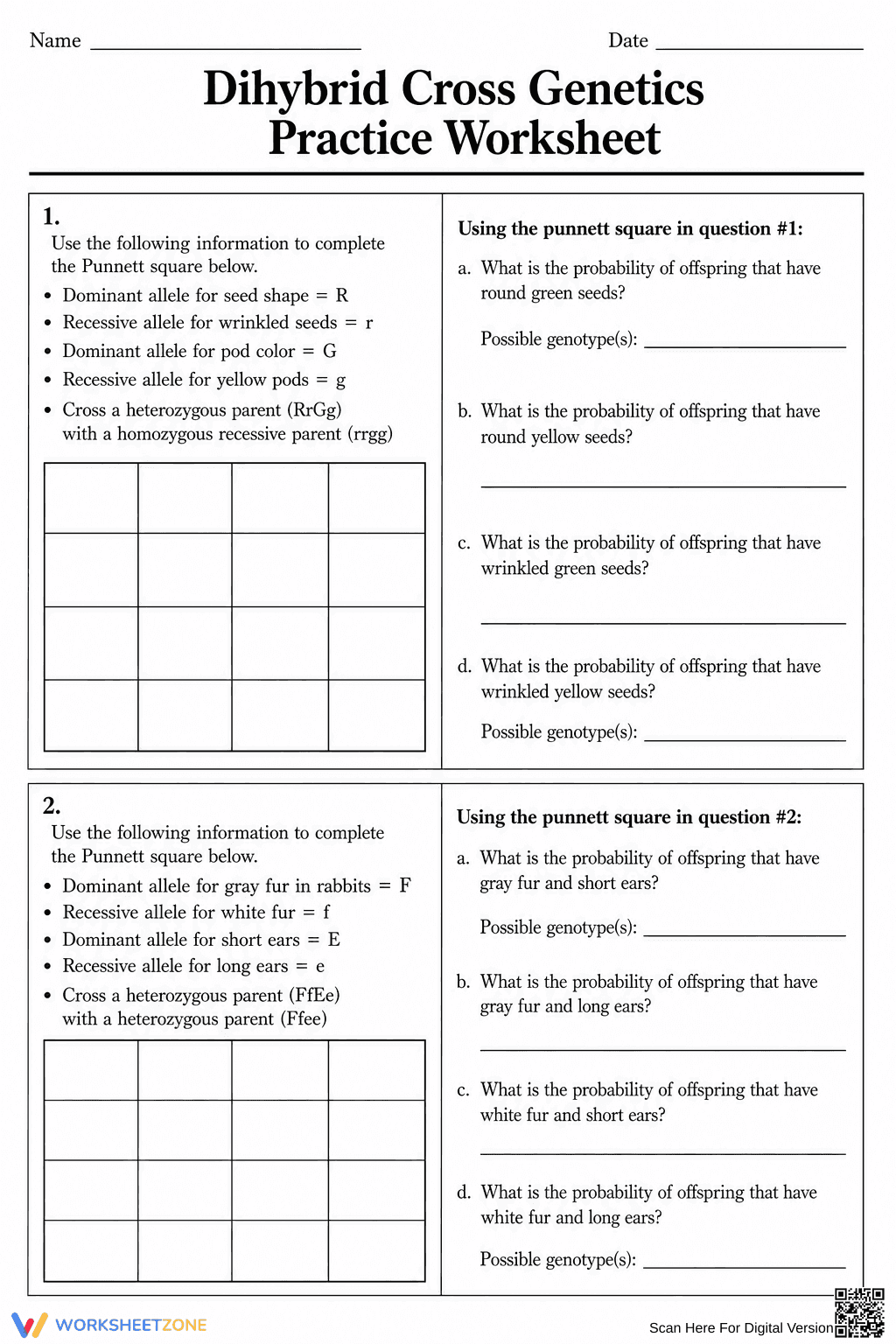
This high school biology worksheet gives students targeted practice with dihybrid crosses to predict offspring genotypes and phenotypes. By completing 4x4 Punnett squares and calculating trait probabilities, learners solidify their understanding of Mendelian genetics and independent assortment in a clear, structured format.
At a Glance
- Grade: 9-11 · Subject: Biology
- Standard:
HS-LS3-3— Apply probability concepts to explain trait variation- Skill Focus: Dihybrid Crosses & Probability
- Format: 1 page · 2 problems · Answer key included · PDF
- Best For: Independent practice
- Time: 15–20 minutes
This single-page resource features two comprehensive dihybrid cross scenarios. The first problem focuses on plant traits, while the second examines animal traits. Each section provides explicit allele keys, parent genotypes, a blank 16-box Punnett square, and four probability questions requiring students to identify phenotypic outcomes. A complete answer key is included.
Zero-Prep Workflow
- Print (1 minute): Simply download the PDF and print a class set. The clean layout ensures crisp copies without draining printer ink.
- Distribute (1 minute): Hand out the worksheet after your initial lesson on independent assortment and two-trait crosses. No additional materials are required.
- Review (5 minutes): Use the included answer key to quickly check student work or project it on the board for self-correction.
With prep time under two minutes, it is perfect for immediate use or a reliable biology sub plan.
Standards Alignment
This resource aligns with HS-LS3-3: Apply concepts of statistics and probability to explain the variation and distribution of expressed traits in a population. By calculating the specific mathematical likelihood of offspring inheriting combined traits, students directly apply statistical reasoning to biological inheritance. Both standard codes can be copied directly into lesson plans, IEP goals, or district curriculum mapping tools.
How to Use It
Deploy this worksheet during direct instruction as a guided practice activity, or assign it as independent homework after teaching the steps for setting up a 16-box Punnett square. As a formative assessment tip, observe how students determine the gamete combinations before they fill in the grid; errors here often cascade into the probability answers. Expected completion time ranges from 15 to 20 minutes depending on the student's fluency with genetic terminology.
Who It's For
This practice sheet is designed for high school biology students in grades 9 through 11. It serves as an excellent reinforcement tool for learners who need structured, step-by-step repetition to master complex genetic crosses. Pair this worksheet with a visual anchor chart demonstrating the FOIL method for finding gametes to support students who struggle with the initial setup.
Mastering the mechanics of genetic inheritance requires repeated, structured application of statistical concepts. Aligned with HS-LS3-3, this resource requires students to apply probability concepts to explain trait variation through the use of dihybrid crosses. According to ScienceDirect TpT Analysis, providing clear, scaffolded problem sets that integrate mathematical reasoning with biological principles significantly improves students' ability to predict complex inheritance patterns. By requiring learners to map out gamete combinations and calculate phenotypic ratios, this worksheet bridges the gap between abstract Mendelian theories and concrete statistical outcomes. The structured format reduces cognitive overload, allowing students to focus on the mechanics of independent assortment rather than formatting grids, leading to higher retention of core genetics concepts.


