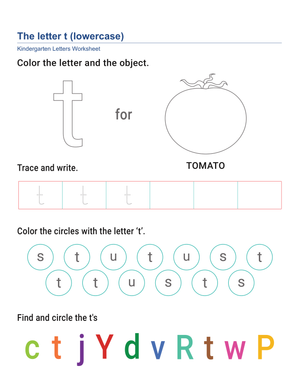
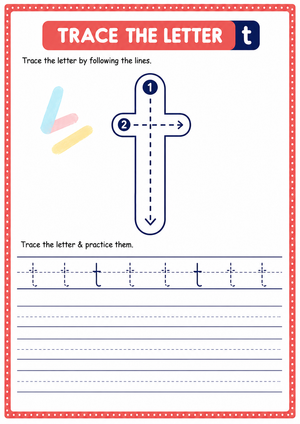
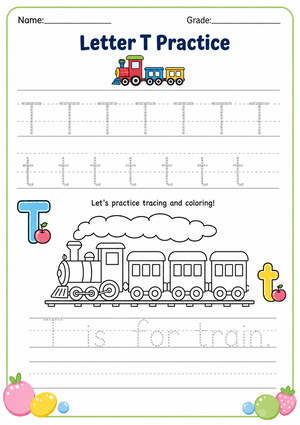
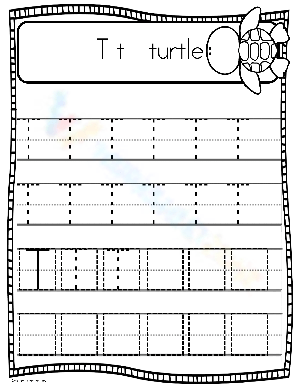
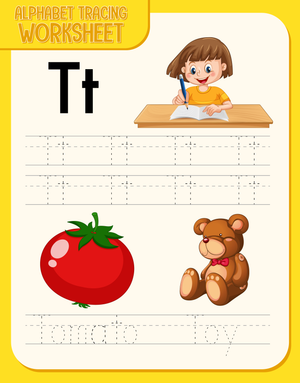
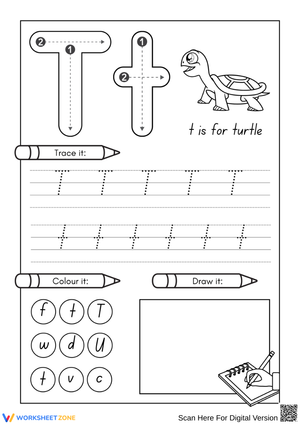
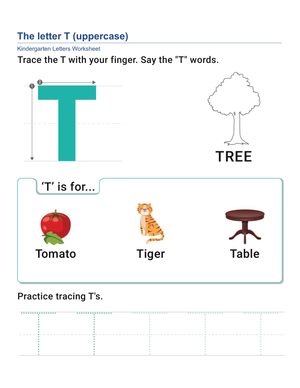
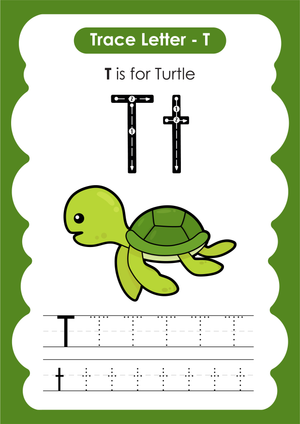
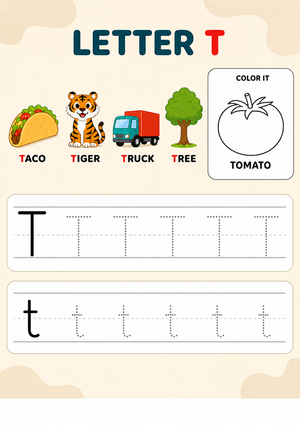
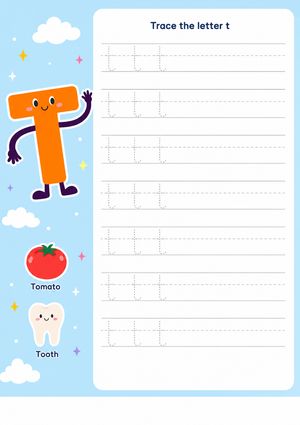
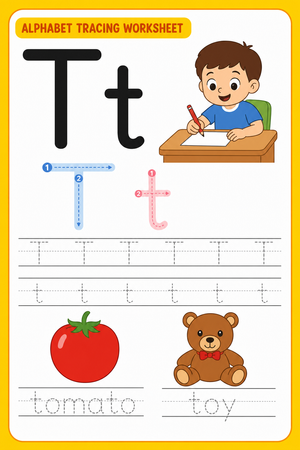
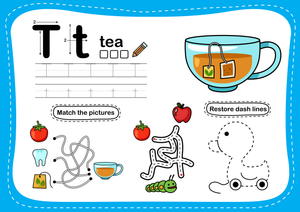
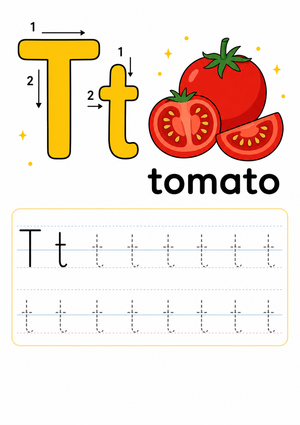
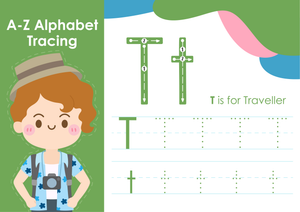
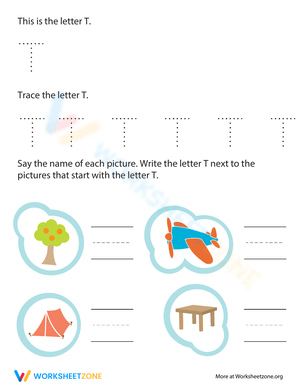
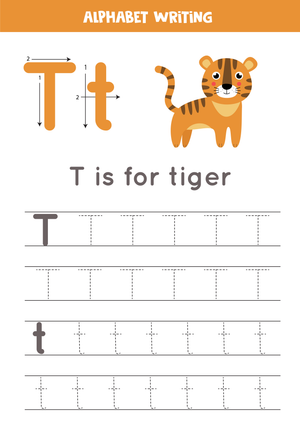
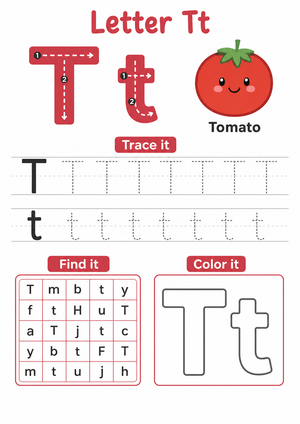
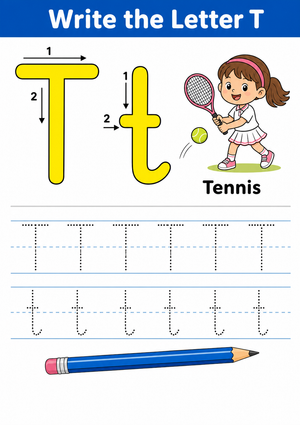
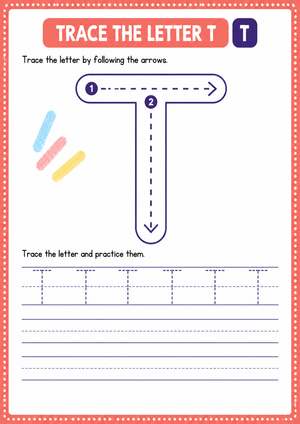
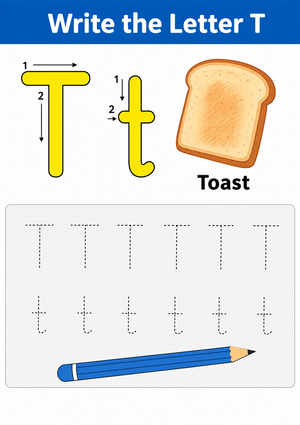
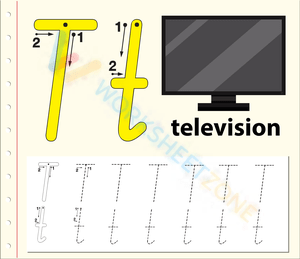
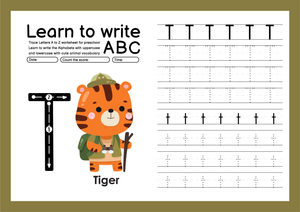
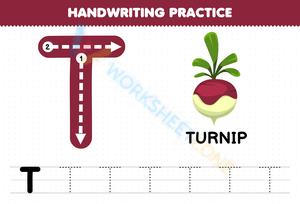
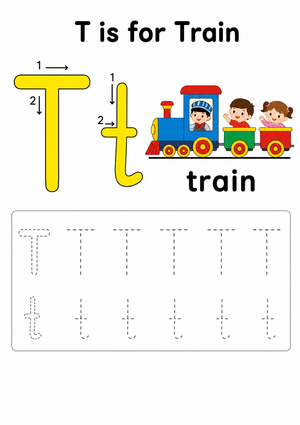
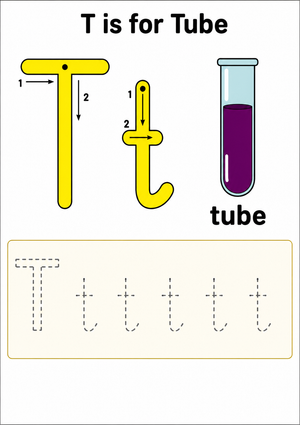
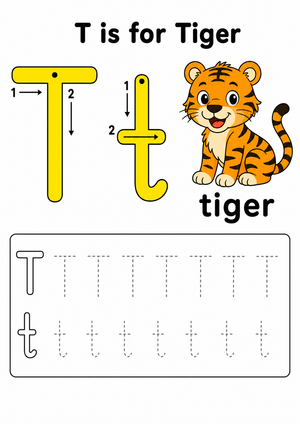
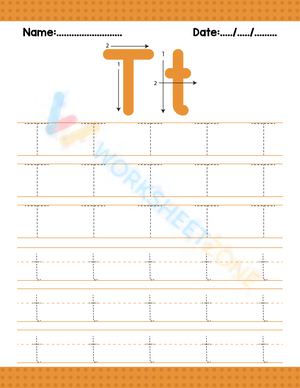
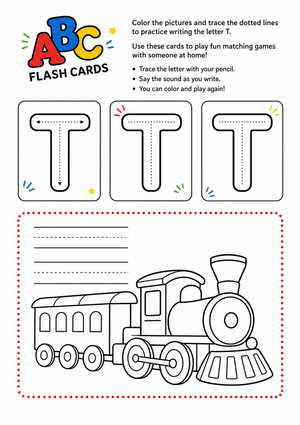
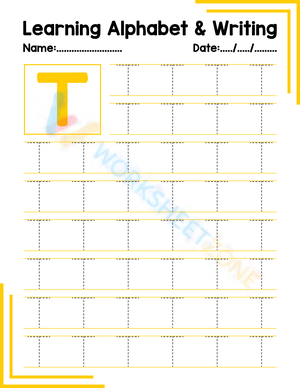
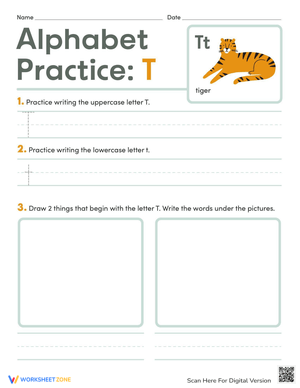
These kindergarten letter t tracing handwriting printable worksheets give teachers a ready collection of focused, developmental practice resources for one of the first true two-stroke consonants students encounter. Each worksheet targets either the uppercase T, the lowercase t, or both in combination — covering stroke order, letter height, and crossbar placement through guided tracing that builds toward independent letterform production.
What Students Practice Across the Set
Each worksheet walks students through the specific movements that make both forms of T distinct from every other letter in the alphabet. The T is one of the few letters that requires a deliberate pencil lift between strokes — a habit that has to be taught explicitly, not assumed.
- Uppercase T stroke sequence: Vertical downstroke from top line to baseline, pencil lift, then a horizontal crossbar pulled left to right along the top line.
- Lowercase t stroke sequence: Vertical downstroke from the top line through the baseline, pencil lift, then a crossbar placed on the midline — not the top line.
- Letter height discrimination: Recognizing that the lowercase t is still an ascender, reaching the top line even though it's the lowercase form.
- Phonics connection: Worksheets include T-word illustrations — items like turtle, tent, and top — so students anchor the written form to the /t/ sound before and after tracing.
- Gradual release to independence: Each worksheet moves from fully guided dotted tracing to trace-then-copy rows, then to blank primary lines for unassisted attempts.
Errors Students Make That These Worksheets Help You Catch
The lowercase t is genuinely one of the trickiest early letters, and the error we see most consistently in kindergarten is crossbar placement. Students who have just learned the uppercase T — where the crossbar sits at the very top — often carry that habit directly into the lowercase, producing a letter that looks exactly like a smaller uppercase T. The opposite error shows up too: the crossbar drifts down to the center of the vertical stroke, and the result reads as a plus sign rather than a letter. Both problems come from the same source: students have not yet internalized where the midline lives in relation to the top line.
Stroke direction is the other recurring problem. Some students draw the vertical stroke upward from the baseline rather than pulling down from the top. It feels natural — it mirrors the motion of drawing a line up from the table — but it creates a slower, less controlled movement that becomes harder to correct once it's habitual. Worksheets that include directional arrows directly on each tracing prompt make the correct downward pull visible before the bad habit takes root. A third, subtler error: students who trace accurately but then skip the pencil lift, connecting the vertical stroke to the crossbar in a single diagonal swipe. The letter looks like a T from a distance but lacks the perpendicular precision that makes it readable in context. Naming the lift explicitly during instruction — "pencil up, now crossbar" — and repeating it during the tracing rows catches this before it disappears into fast, careless practice.
Standard Alignment
These resources connect most directly to RF.K.1.D (Common Core ELA-Literacy), which asks kindergarteners to recognize and name all upper- and lowercase letters of the alphabet. Handwriting practice is the mechanism through which letter recognition becomes automatic: students who trace a letter repeatedly while saying its name aloud build a faster, more durable visual-motor memory of the form than students who only see it in print. The tracing-to-copy progression in each worksheet supports this automaticity without demanding independent writing before the student is ready for it.
Working These Worksheets Into Your Weekly Lessons
Most teachers introduce a new letter in a shared writing or phonics block and then want follow-up activities that don't require re-teaching every time. These worksheets fit cleanly into that practice phase. After the initial whole-group letter introduction, one worksheet assigned as morning work gives students 10 to 12 minutes of focused, independent practice while the teacher handles attendance, take-home folders, and the first check-ins of the day.
Literacy centers are the other obvious home for this work. Laminate each worksheet and slot it into a dry-erase pocket — students trace with a marker, wipe it clean, and cycle through the tracing sequence two or three times before rotating to the next station. This extends the life of the printable and adds a tactile dimension that many five-year-olds find more engaging than pencil-on-paper repetition. For homework, the kindergarten letter t tracing handwriting printable worksheets send a clear, visible message to families about what's being practiced in class — and parents can reinforce the letter name and sound without needing any preparation beyond what they see on the worksheet itself.
Adjusting the Set for a Range of Learners
Fine motor development in kindergarten varies widely — sometimes by the equivalent of a full year within a single class. Students who are still building hand strength and pencil control benefit from starting with large-scale letter formation before working at the primary-line level. Have them trace a giant T in the air with an extended arm, or form it on a whiteboard using wide, sweeping movements. The stroke pattern is identical; the scale makes it physically accessible. Once the movement feels automatic at that size, the same student can sit down with a standard worksheet and produce the letter with far more control than if they'd started there cold.
For students who move through the guided tracing quickly and accurately, remove the dotted-line support and offer worksheets with only the baseline and midline visible. These students trace a faint gray model or copy from a single reference letter at the top of the worksheet — a meaningful step toward writing without assistance. Students in the middle of the range, those who trace well but fall apart on independent rows, often do well when the teacher adds a bright highlight to the midline on the lowercase t worksheet. "Cross on the yellow line" is concrete and memorable in a way that "in the middle" simply isn't at age five.
One honest constraint: students with significant fine motor delays, or those who are just beginning to hold a pencil with control, may find the standard primary-line format more frustrating than productive. For those students, pair the kindergarten letter t tracing handwriting printable worksheets with isolated stroke practice first — vertical lines, then horizontal lines — before asking them to combine both movements into a letter with a specific crossbar placement.
Frequently Asked Questions
What stroke order should I teach for the uppercase T?
Vertical downstroke first — top line to baseline — then pencil up, then a horizontal crossbar pulled from left to right along the top line. The directional arrows printed on each worksheet make this sequence clear without requiring teacher narration every time a student sits down to practice.
How is the lowercase t different from the uppercase T in terms of what students need to understand?
Two distinctions matter most at this age. First, the crossbar on the lowercase t lands on the midline, not the top line — a placement difference that has to be taught directly and practiced until it's automatic. Second, the lowercase t is still an ascender, meaning its vertical stroke reaches the top line just like the uppercase version. Students who assume all lowercase letters are shorter than their uppercase counterparts get thrown by this and often draw the lowercase t too short. The side-by-side uppercase and lowercase comparison rows on several worksheets in the set address this confusion directly, giving students a visual reference for the height relationship.
How many practice repetitions does a kindergartener need before writing the letter independently?
There is no fixed count, and the kindergarten letter t tracing handwriting printable worksheets are not built around one. What matters is accuracy and consistency of stroke sequence. A student who traces six T's using the correct downstroke-lift-crossbar pattern is better prepared for independent writing than one who fills an entire row using a random sequence. Once a student produces three accurate, consistent letters in a row without rushing, that's a reasonable signal to shift to unassisted writing on blank primary lines.
Can students use these independently in a center without direct supervision?
Yes. The numbered stroke indicators and directional arrows give students enough information to self-direct their tracing. The most useful preparation is posting a correctly formed uppercase T and lowercase t somewhere visible in the center — a laminated anchor card mounted at seated eye-level for a five-year-old works well — so students have a reference point when they're unsure whether their letter looks right.