




























Views
Downloads
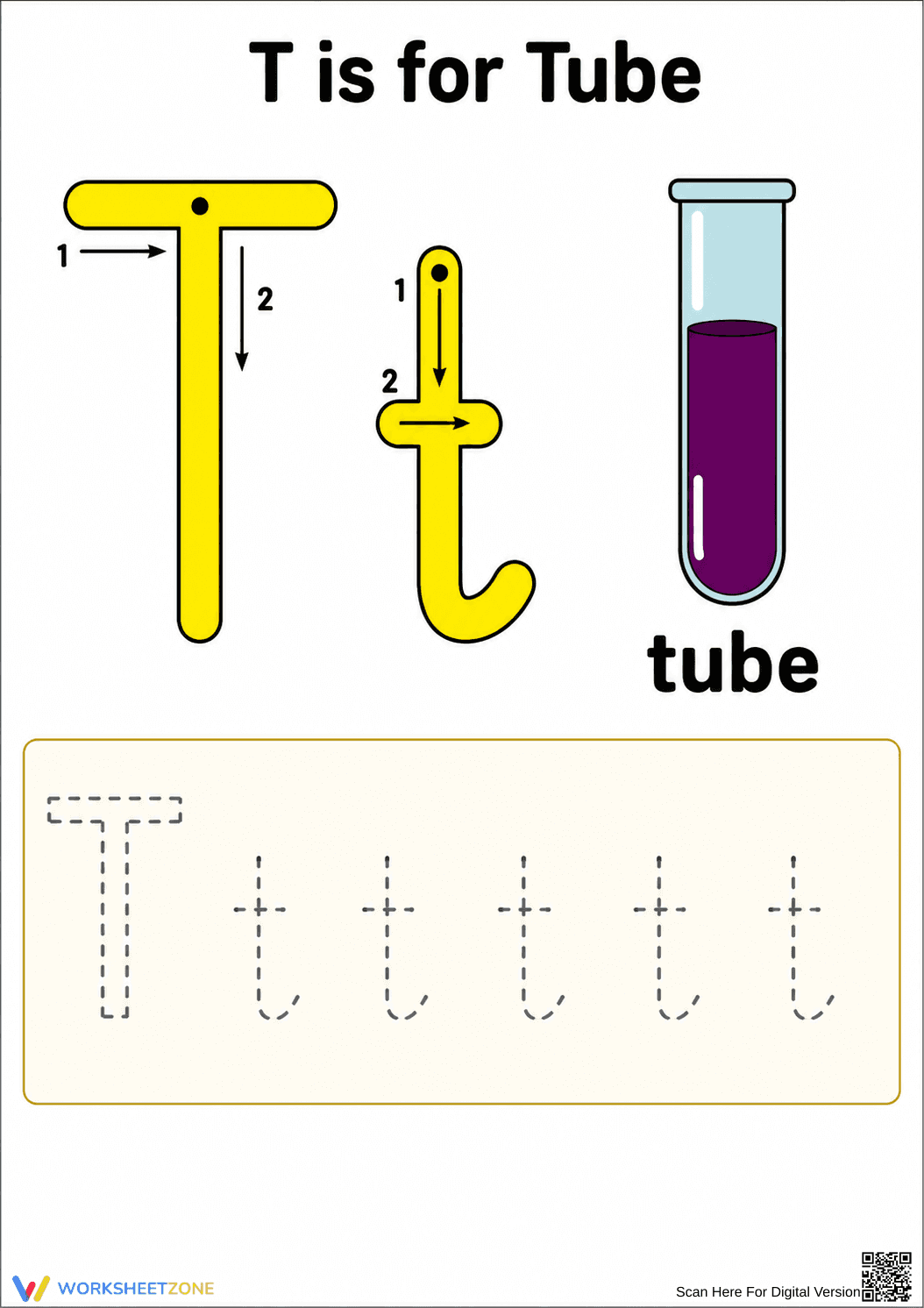

Letter T Tracing Worksheet | Printable Grade K-1 Practice

Paste this activity's link or code into your existing LMS (Google Classroom, Canvas, Teams, Schoology, Moodle, etc.).
Students can open and work on the activity right away, with no student login required.
You'll still be able to track student progress and results from your teacher account.
This printable letter T tracing worksheet helps early learners develop fine motor skills and proper letter formation. By practicing uppercase and lowercase strokes, students build foundational handwriting abilities. Visual cues guide correct pencil movement, ensuring young writers establish strong habits.
At a Glance
- Grade: K · Subject: ELA
- Standard:
CCSS.ELA-LITERACY.L.K.1.A— Print many upper- and lowercase letters- Skill Focus: Letter T Formation and Tracing
- Format: 1 page · 6 problems · No answer key needed · PDF
- Best For: Independent practice and centers
- Time: 5–10 minutes
Inside this single-page resource, educators will find a clear layout designed for early childhood learners. The top section features large examples of uppercase and lowercase letter T, with numbered directional arrows modeling proper stroke sequence. A vocabulary image of a "tube" reinforces the beginning sound. The bottom section provides six dashed tracing tasks, giving students immediate application of the modeled forms.
This resource offers a zero-prep workflow, ideal for any early literacy block.
- Print (1 minute): Download the PDF and print. The high-contrast design ensures clear dashed lines.
- Distribute (1 minute): Hand out worksheets with pencils. Visual instructions allow students to begin immediately.
- Review (1 minute): Quickly scan work to check stroke direction.
With teacher prep under two minutes, this is suitable for sub plans or morning work.
This worksheet aligns to CCSS.ELA-LITERACY.L.K.1.A, requiring students to print many upper- and lowercase letters. It supports foundational phonics by pairing letter formation with a beginning sound visual. Both standard codes can be copied directly into lesson plans, IEP goals, or district curriculum mapping tools.
Teachers can utilize this during small group centers after a direct instruction mini-lesson. As students trace, teachers have an opportunity for formative assessment; observe whether students start strokes from the top down. Alternatively, it serves as an effective morning work activity for independent completion. Expected completion time is 5 to 10 minutes.
This resource is designed for Kindergarten students mastering basic handwriting. It benefits occupational therapy sessions or special education students needing fine motor practice. For differentiation, teachers can provide textured materials for tactile tracing. It pairs perfectly with a classroom anchor chart displaying T-vocabulary words.
Mastering the physical act of writing is a critical stepping stone in early literacy development that requires consistent, guided repetition. Aligned with CCSS.ELA-LITERACY.L.K.1.A, this resource helps students print many upper- and lowercase letters with accuracy and confidence. According to Fisher & Frey (2014), providing explicit modeling followed by structured, independent practice significantly improves student retention of foundational skills. The numbered directional arrows on this worksheet serve as that explicit model, guiding the cognitive and motor pathways required for fluent handwriting. By combining visual vocabulary cues with targeted tracing tasks, educators can effectively bridge the gap between letter recognition and physical letter production. This targeted approach ensures that young learners build the automaticity needed to focus on higher-order writing tasks as they progress through their primary education. Consistent practice with proper stroke sequence reduces letter reversal and improves overall legibility.


