


























Views
Downloads
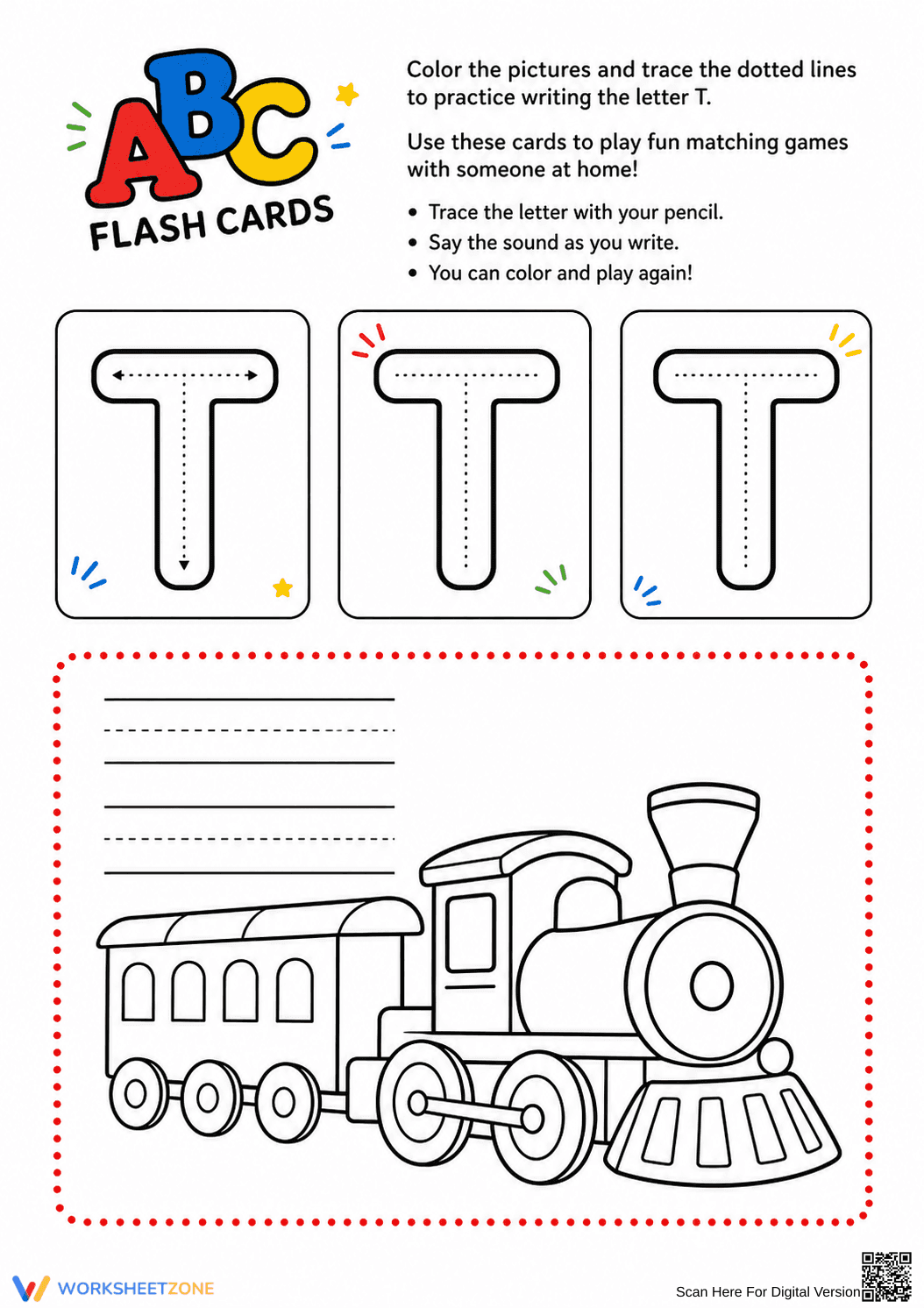

Essential Letter T Handwriting & Phonics Worksheet
Paste this activity's link or code into your existing LMS (Google Classroom, Canvas, Teams, Schoology, Moodle, etc.).
Students can open and work on the activity right away, with no student login required.
You'll still be able to track student progress and results from your teacher account.
This foundational literacy resource helps early learners master the letter T through a multi-sensory approach. By combining visual recognition, tactile tracing, and auditory reinforcement, students build the muscle memory and phonemic awareness necessary for reading success. This worksheet ensures students can identify and produce the letter T with confidence.
At a Glance
- Grade: Kindergarten · Subject: ELA
- Standard:
RF.K.1.D— Recognize and name all upper- and lowercase letters of the alphabet- Skill Focus: Letter T formation and beginning sounds
- Format: 1 page · 4 tasks · Answer key included · PDF
- Best For: Early literacy centers and morning work
- Time: 10–15 minutes
What's Inside: The worksheet features three large-format flashcards designed for initial tracing practice with directional arrows. Below the cards, a dedicated handwriting section provides dotted lines for independent letter formation. To reinforce the beginning sound /t/, a detailed train illustration is included for coloring, providing a visual anchor for the phonics lesson and engaging fine motor skills.
Zero-Prep Workflow: This resource is designed for immediate classroom implementation. First, print the single-page PDF (30 seconds). Next, distribute the sheets to students during your literacy block or as a transition activity (1 minute). Finally, review the letter sound and formation as a whole group to check for understanding (2 minutes). It is an ideal sub-plan component or homework assignment.
Standards Alignment: This activity aligns with `RF.K.1.D`, which requires students to recognize and name all upper- and lowercase letters. It also supports `RF.K.3.A` by connecting the letter T to its primary consonant sound through the train keyword. Both standard codes can be copied directly into lesson plans, IEP goals, or district curriculum mapping tools.
How to Use It: Use this worksheet during small-group direct instruction to model proper stroke order. As a formative assessment, observe students as they trace the flashcards to ensure they are starting from the top-down. It also serves as an excellent quiet-time activity for students who finish their primary tasks early, allowing them to color the train while practicing their sounds.
Who It's For: This resource is tailored for Kindergarten and Grade 1 students, as well as preschoolers ready for formal handwriting. It pairs naturally with an alphabet anchor chart or a read-aloud book focusing on the letter T. It is also suitable for English Language Learners (ELL) who need visual support for beginning sounds.
Research by Fisher & Frey (2014) emphasizes the importance of the gradual release of responsibility in early literacy, moving from guided tracing to independent production. This worksheet facilitates that transition by providing high-contrast visual cues and repetitive motor practice. Mastery of letter-sound correspondence, specifically the standard RF.K.1.D, is a significant predictor of future reading fluency. By integrating coloring and tracing, the resource engages multiple cognitive pathways, ensuring that the letter T is encoded into long-term memory. This structured approach to phonics and handwriting is consistent with evidence-based practices identified in recent NAEP reports regarding foundational reading skills. Educators can utilize this tool to provide the high-frequency practice required for automaticity in letter recognition and formation, which is essential for reducing cognitive load during later writing tasks.


