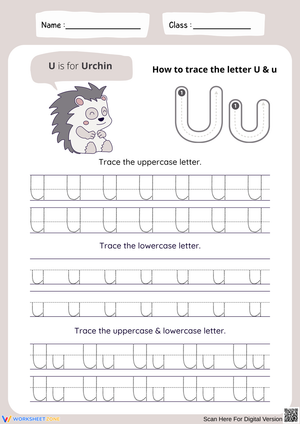
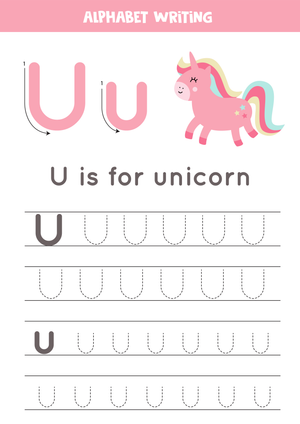
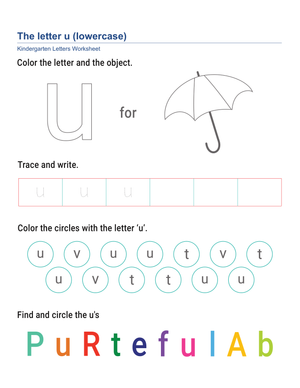
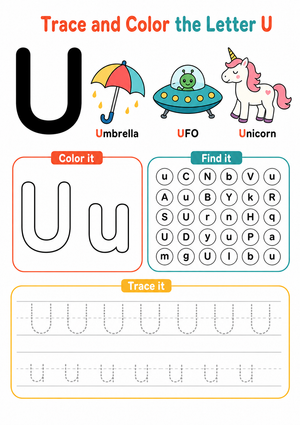
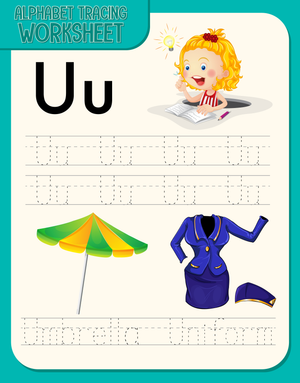
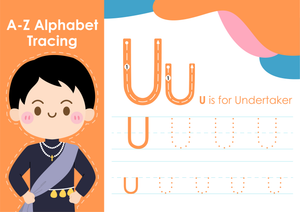
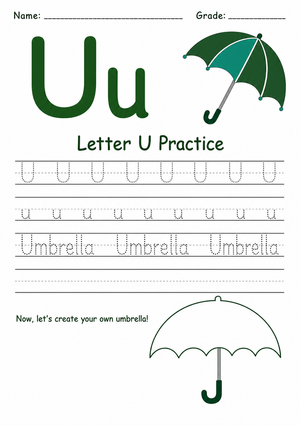
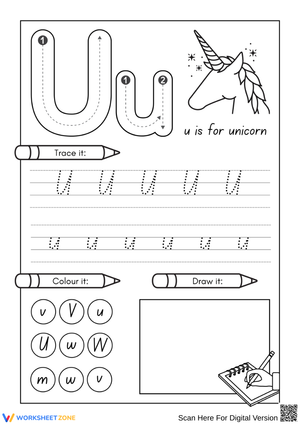
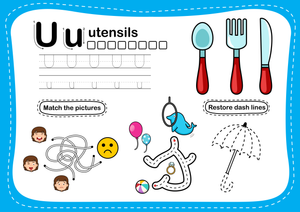
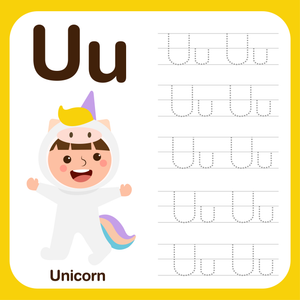
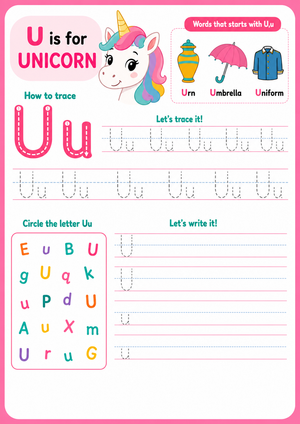
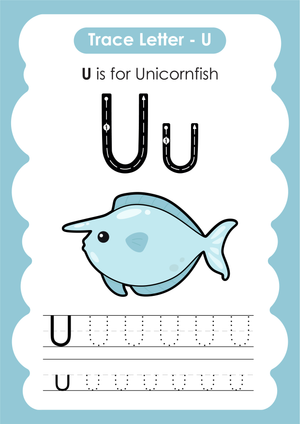
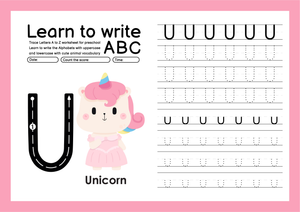
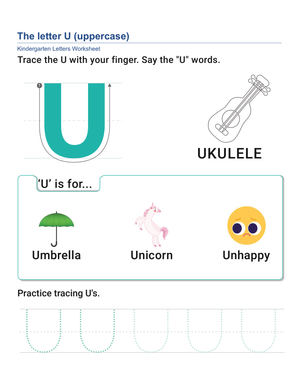
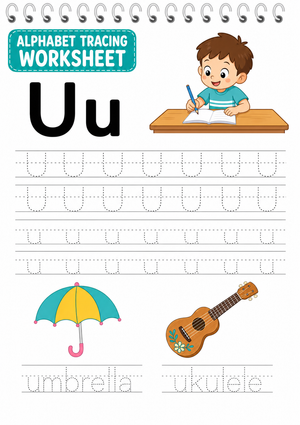
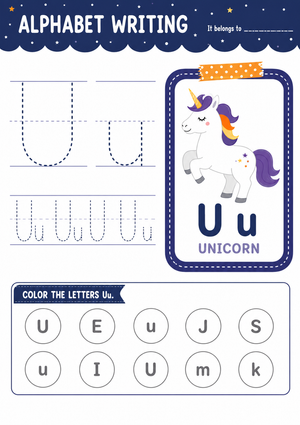
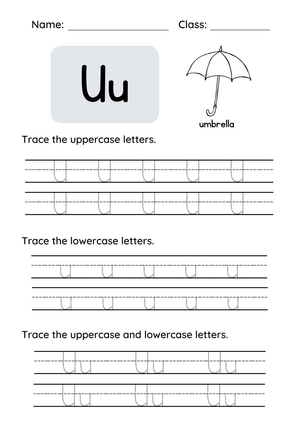
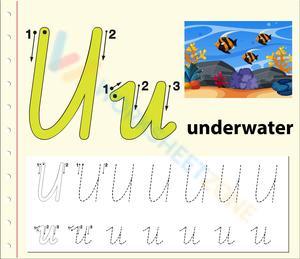
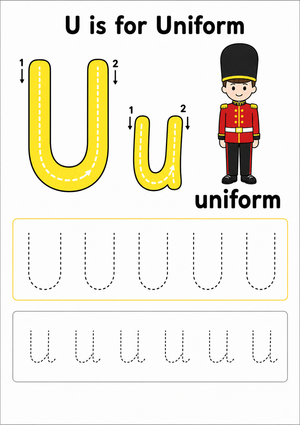
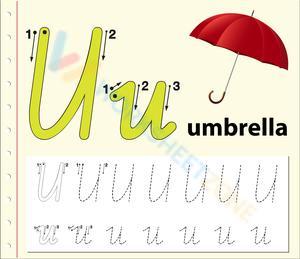
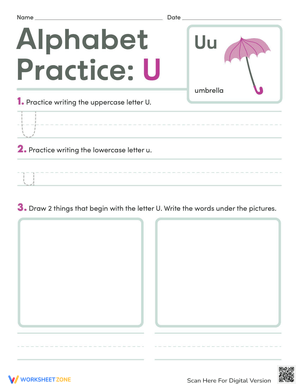
Kindergarten letter u tracing handwriting printable worksheets give early writing instruction a concrete anchor — something five-year-olds can pick up, trace through, and return to repeatedly without elaborate setup. Each worksheet covers both uppercase U and lowercase u, which matters because children who can write one form often haven't internalized the other. Used during morning work or a short handwriting block, these worksheets hold a small, specific job and do it reliably.
What These Worksheets Build
The core skill is letter formation — knowing where to start the stroke, how the line curves, and where it ends. Uppercase U and lowercase u share the same basic motion (down, curve, up), which makes this a manageable letter for beginning writers, though that similarity also produces a specific confusion worth watching for (described below). Beyond stroke order, each worksheet gives students repeated practice with:
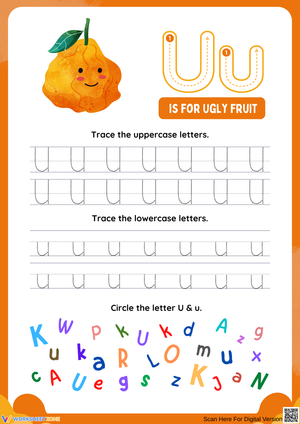
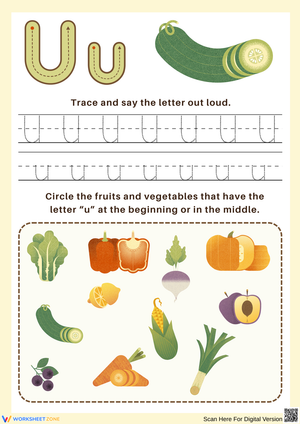
- Pencil control on guided lines: Large tracing lines let beginners work within a clearly defined space before moving to narrower ruled paper.
- Left-to-right directionality: Tracing left to right across each row reinforces print orientation, a concept kindergartners are still internalizing.
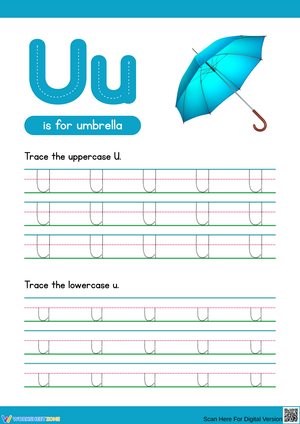
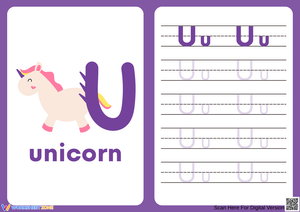
- Letter-picture connection: Images like umbrella and unicorn tie the letter's visual form to its sound, reinforcing the /u/ phoneme alongside handwriting practice.
- Visual discrimination between forms: Seeing uppercase U and lowercase u side by side helps children notice they are related but not identical.
Fine motor development is also in play here. A child who struggles to stay on the tracing line isn't necessarily confused about the letter — they may simply lack the hand strength or grip control to execute the shape. These worksheets give teachers a quick window into both issues at once, which is more useful diagnostic information than a letter-naming drill alone produces.
Student Mistakes Worth Knowing Before You Hand These Out
The most common error is starting the stroke at the bottom rather than the top. Students who watch a teacher model the letter once, then look away, often reverse the entry point — drawing a U from the bottom curve upward on one side, then up on the other. The shape may look approximately right, but the stroke habit is wrong and becomes harder to correct the longer it goes unchecked. Require students to touch the starting dot before they begin tracing, every single row.
A second pattern: lowercase u traced as a sharp angular shape rather than a smooth curve. When students press too hard or rush, the gentle bottom curve flattens into something that looks more like a box bottom. Slow the pace during teacher modeling and have those students trace one row with a finger first, feeling the curve before picking up a pencil.
Students also confuse lowercase u and lowercase n, particularly in early fall. Both letters use a similar curve — just oriented differently. A quick verbal anchor like "u goes down and comes back up, like a cup holding water" gives students a mental image that sticks better than correcting the reversal after repeated practice has already locked it in.
Where These Worksheets Fit in Your Week
The most efficient use is a short morning routine — worksheets on desks as students settle in, with three to five minutes of quiet tracing before the day formally begins. That window is long enough for meaningful repetition but short enough that it doesn't compete with primary instruction time. The predictability also helps: when students know exactly what to do the moment they sit down, the transition into the school day is noticeably smoother.
Literacy centers are a natural second home for these resources. Pair each worksheet with a small picture-word card set for U words and a few colored pencils. Students can trace, then sort or label pictures independently while the teacher pulls a small group. The tracing activity keeps the rest of the class productively occupied without requiring adult oversight at every step.
For small-group intervention, use one worksheet per student and model each row before students trace it. This slower pace allows real-time correction of stroke direction, grip, and line pressure — the kinds of adjustments whole-class tracing rarely catches. Keep an extra supply of kindergarten letter u tracing handwriting printable worksheets in intervention folders for students who need additional rounds with the letter before they are ready to write it without guided lines.
Standard Alignment
These worksheets address CCSS.ELA-LITERACY.L.K.1.A — "Print many upper- and lowercase letters." In kindergarten, this standard is introduced during the first weeks of alphabet instruction and revisited as students build fluency with each letter's form. Letter U, coming late in the alphabetical sequence, often receives less classroom time than A or B, which makes targeted tracing practice especially useful in the second half of the school year or during alphabet review rotations.
Adjusting the Work for Beginning and More Confident Writers
For students still developing grip strength and pencil control, reduce the expectation. Ask them to complete one or two rows rather than the full worksheet. Covering the remaining rows with a blank sheet of paper reduces visual clutter and helps students focus on a single line of tracing at a time — a small move that frequently produces cleaner, more deliberate letterwork. Some teachers also allow these students to use a fat primary pencil or a crayon, which requires less fine precision but still builds the core stroke motion.
Students who are ready to move beyond tracing can use each worksheet differently. Have them trace the first row, then write one uppercase U and one lowercase u independently in the remaining space or on the back. That shift from guided tracing to unassisted production is the actual instructional goal, and building it into the same session prevents the common pattern where students trace accurately but freeze the moment the dotted lines disappear.
Kindergarten letter u tracing handwriting printable worksheets also serve as a useful informal snapshot for the more advanced writers in the class. If a student finishes quickly and forms both letters cleanly without the tracing lines as a crutch, that is a meaningful data point — they may be ready for word-level writing practice rather than letter-by-letter tracing work.
Frequently Asked Questions
Do students need to finish the entire worksheet in one sitting?
Not necessarily. For students who tire quickly or whose fine motor control is still developing, stopping after one or two rows is entirely reasonable. Focused, accurate tracing of a few lines produces better results than rushing through every row with poor form. Quality of stroke matters more than completing the full set of lines.
How do these worksheets connect to phonics instruction?
They support phonics when the teacher explicitly names the letter, produces its sound, and connects it to a picture during modeling — "this is U, it makes the /u/ sound, like umbrella." Without that teacher-directed moment, tracing practice addresses handwriting only. The worksheet provides the visual and motor repetition; the oral connection is what links it to sound work.
When should a student stop tracing and write the letter independently?
The shift makes sense when a student can trace accurately, name the letter without hesitation, and identify where the stroke starts. A practical bridge is asking students to write one U and one u at the bottom of the worksheet after finishing the tracing rows. If the independent letters look recognizable and begin from the correct entry point, the student is ready to move on. If they look very different from the traced version, more guided practice is the right next step.
Are these resources useful for students in first grade who still struggle with letter formation?
Yes. Kindergarten letter u tracing handwriting printable worksheets are a practical support for first graders who entered the year without solid formation habits for U. The large lines and clear stroke paths work well for any beginning writer who needs a structured return to letter basics — regardless of grade placement.