


























Views
Downloads
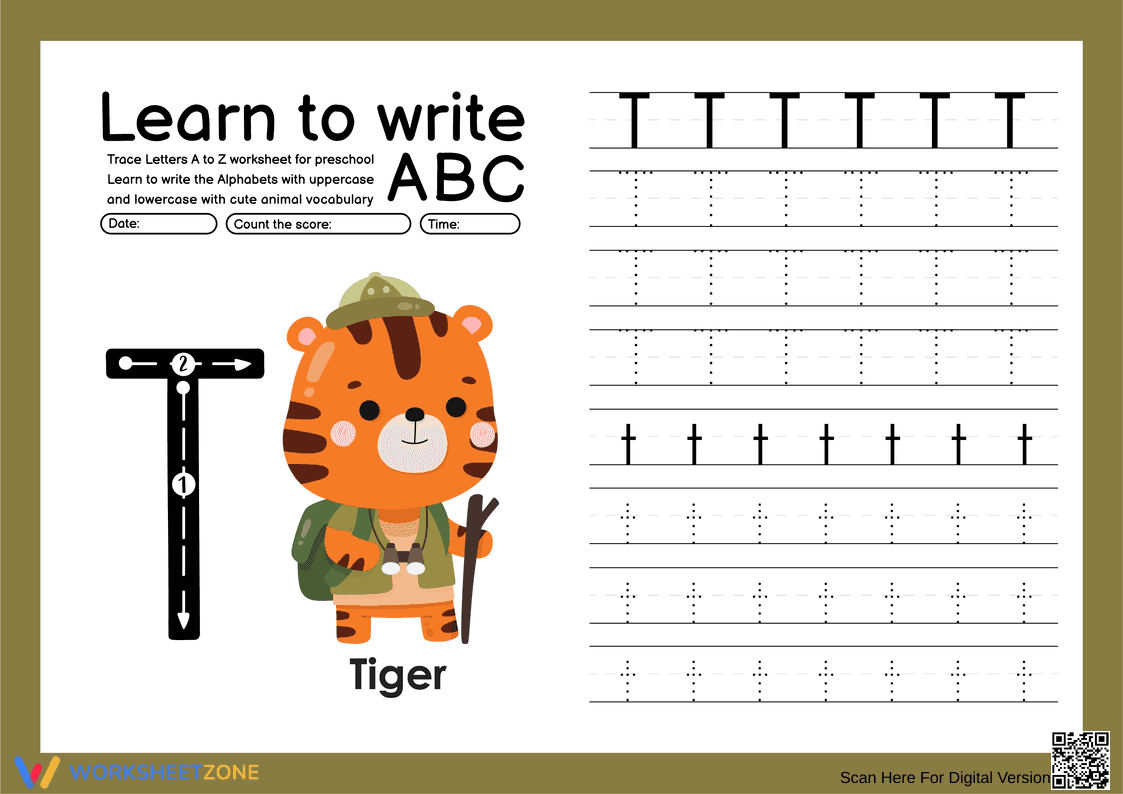

Letter T Writing Practice | Essential Kindergarten Worksheet
Paste this activity's link or code into your existing LMS (Google Classroom, Canvas, Teams, Schoology, Moodle, etc.).
Students can open and work on the activity right away, with no student login required.
You'll still be able to track student progress and results from your teacher account.
This Letter T writing worksheet helps early learners master the specific strokes required for uppercase and lowercase letter formation. By combining visual cues with repetitive tracing, students build the muscle memory necessary for legible handwriting. This resource ensures students can confidently identify and produce the letter T in various contexts.
At a Glance
- Grade: Kindergarten · Subject: ELA
- Standard:
CCSS.ELA-LITERACY.RF.K.1.D— Recognize and name all upper- and lowercase letters of the alphabet- Skill Focus: Letter T Formation
- Format: 1 page · 56 tasks · Answer key included · PDF
- Best For: Daily morning work or literacy centers
- Time: 10–15 minutes
The worksheet features a clear, large-scale example of the letter T with numbered directional arrows to guide the first stroke. It includes four rows dedicated to uppercase "T" and four rows for lowercase "t," providing ample repetition. A friendly tiger illustration reinforces the phonetic connection between the letter and its primary sound, making the learning process engaging for young children.
Skill Progression
- Guided Practice: Students engage by following numbered arrows on a large-scale model to understand the correct stroke order for both cases.
- Supported Practice: Learners move to tracing over 40 dotted-line characters that provide a consistent scaffold for hand movement and letter sizing.
- Independent Practice: The worksheet encourages mastery as students maintain consistent letter height and spacing across the final rows of the page.
This gradual-release model moves from high teacher support to autonomous student production, following the I Do, We Do, You Do instructional framework.
Standards Alignment
This resource is specifically aligned with `CCSS.ELA-LITERACY.RF.K.1.D`, which requires students to recognize and name all upper- and lowercase letters of the alphabet. It also supports foundational writing standards related to print concepts and fine motor development. Both standard codes can be copied directly into lesson plans, IEP goals, or district curriculum mapping tools.
How to Use It
Use this worksheet during the independent practice phase of a direct instruction lesson on the letter T. It is particularly effective as a quiet-time activity after reading a T-themed book. Teachers can use the "Count the score" box as a formative assessment tool to track how many letters a student formed correctly without straying from the lines. Expected completion time is 12 minutes.
Who It's For
This printable is designed for Preschool, Kindergarten, and Grade 1 students who are developing their graphomotor skills. It is an excellent fit for English Language Learners (ELLs) who benefit from the visual "Tiger" anchor word. Pair this worksheet with an alphabet anchor chart or a tactile sand-tray tracing activity to provide a multi-sensory learning experience.
According to the RAND AIRS 2024 report on early literacy, explicit instruction in letter formation is a critical precursor to reading fluency and orthographic mapping. Research by Fisher & Frey (2014) emphasizes that repetitive, scaffolded tracing activities allow young learners to internalize the geometric shapes of the alphabet, reducing the cognitive load during later composition tasks. This worksheet implements these findings by providing 56 distinct opportunities for letter production, ensuring that the physical act of writing becomes second nature. By focusing on the specific standard CCSS.ELA-LITERACY.RF.K.1.D, the resource bridges the gap between simple recognition and active production. Consistent use of such structured materials has been shown in NAEP data to correlate with higher literacy achievement in the primary grades, as it establishes a firm foundation for both phonics and written expression.


