




























Views
Downloads

Printable Letter T Tracing Worksheet | Kindergarten ELA

Paste this activity's link or code into your existing LMS (Google Classroom, Canvas, Teams, Schoology, Moodle, etc.).
Students can open and work on the activity right away, with no student login required.
You'll still be able to track student progress and results from your teacher account.
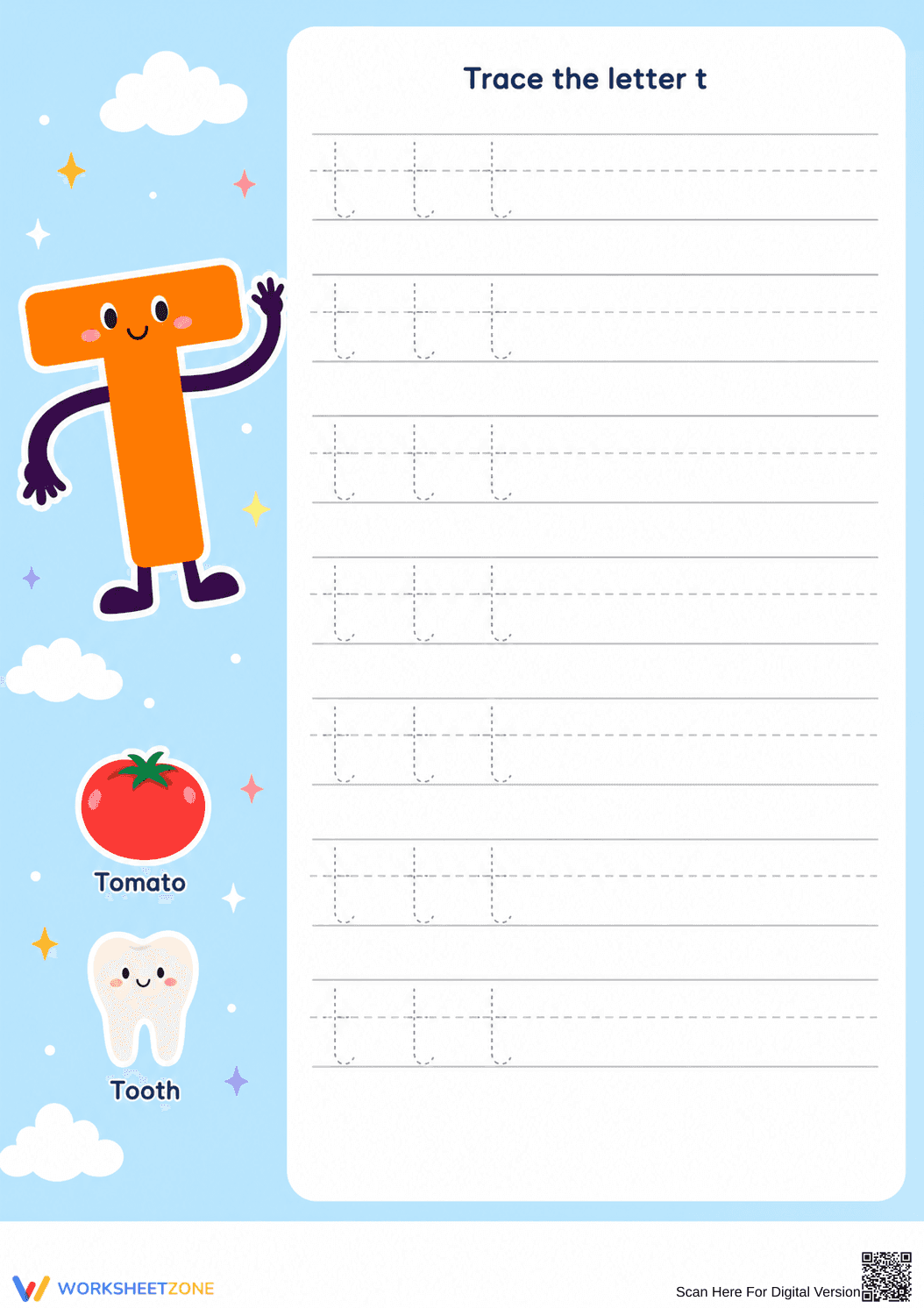
This foundational handwriting worksheet helps early learners master the formation of the lowercase letter T. By combining guided tracing lines with engaging visual cues, students build fine motor skills while reinforcing beginning sound recognition. This single-page resource provides immediate, focused practice for emerging writers.
At a Glance
- Grade: Kindergarten · Subject: English Language Arts
- Standard:
CCSS.ELA-LITERACY.L.K.1.A— Print many upper- and lowercase letters- Skill Focus: Letter T tracing and handwriting
- Format: 1 page · 21 problems · No answer key needed · PDF
- Best For: Independent morning work
- Time: 5–10 minutes
Inside this straightforward resource, educators will find a single practice page dedicated to the lowercase letter T. The layout features seven handwriting rows, each containing three dotted letters for guided tracing. To support phonetic connections, the left margin includes colorful illustrations of a tomato and a tooth, visually anchoring the letter's beginning sound. The clear design ensures students concentrate entirely on pencil grip and stroke sequence.
Zero-Prep Workflow
This resource is designed for immediate classroom implementation.
- Print (1 minute): Download the PDF and print. High-contrast lines ensure clear reproduction.
- Distribute (1 minute): Hand out with primary pencils. Visual instructions are intuitive.
- Review (1 minute): Scan completed pages to check stroke direction.
With prep time under two minutes, this worksheet serves as an excellent sub plan or quick transition activity.
Standards Alignment
This tracing activity aligns with CCSS.ELA-LITERACY.L.K.1.A, requiring students to print many upper- and lowercase letters. By providing structured practice on standard lines, the worksheet ensures students develop muscle memory for fluent letter formation. Both standard codes can be copied directly into lesson plans, IEP goals, or district curriculum mapping tools.
How to Use It
This tracing sheet functions perfectly as morning work. Teachers can introduce the letter T during whole-group instruction, demonstrating strokes on a whiteboard, before transitioning to independent practice. As a formative assessment tip, observe students to ensure they start pencil strokes at the top line. Expected completion time is five to ten minutes.
Who It's For
Designed for Kindergarten students learning alphabet formation, this also serves as an intervention tool for first-grade students needing handwriting support. Teachers can pair this worksheet with a tactile activity, like tracing in sand, before moving to paper. It pairs naturally with any letter-of-the-week sequence.
Developing automaticity in handwriting is a critical precursor to expressive writing and overall literacy success in early childhood classrooms. This targeted resource directly addresses CCSS.ELA-LITERACY.L.K.1.A, ensuring students can print many upper- and lowercase letters with accuracy and confidence. According to a comprehensive educational review by Fisher & Frey (2014), explicit handwriting instruction combined with brief, frequent, and highly focused practice sessions significantly improves both letter recognition and reading fluency. When young students no longer have to expend heavy cognitive energy on the physical act of forming letters, they can successfully allocate more working memory to phonemic awareness and early composition skills. By integrating visual vocabulary cues like a tomato and a tooth alongside the structured tracing tasks, this worksheet bridges the gap between mechanical handwriting practice and foundational phonics, providing a highly effective, holistic approach to early literacy development.


