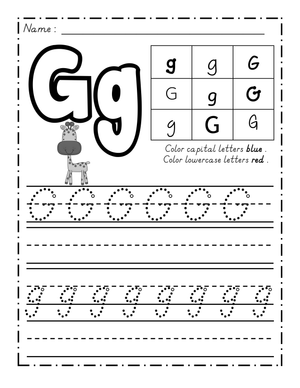
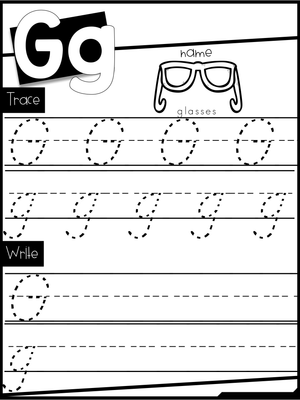
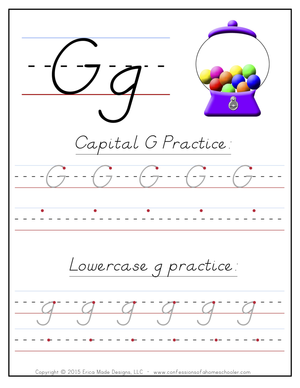
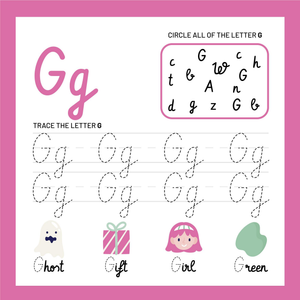
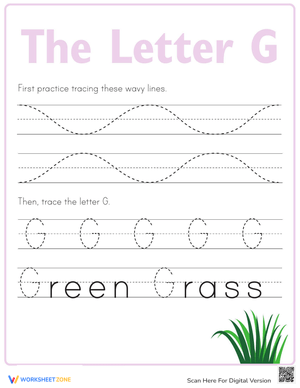
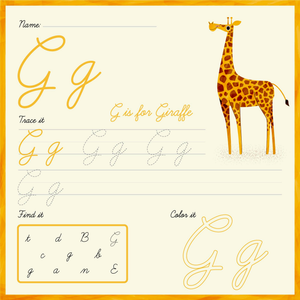
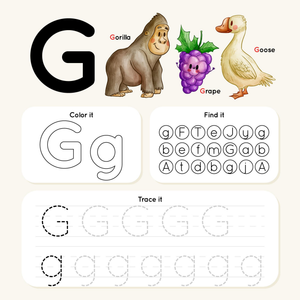
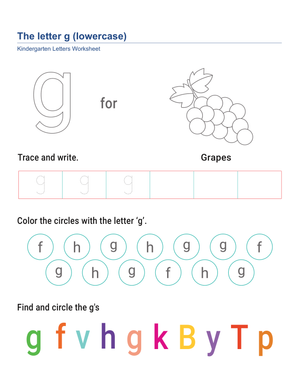
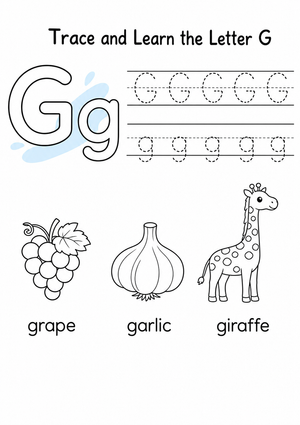
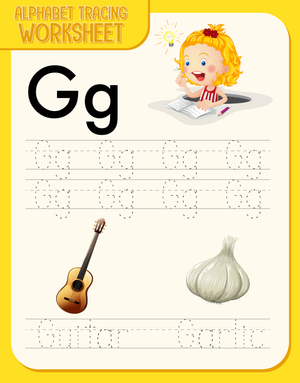
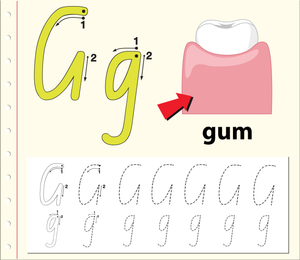
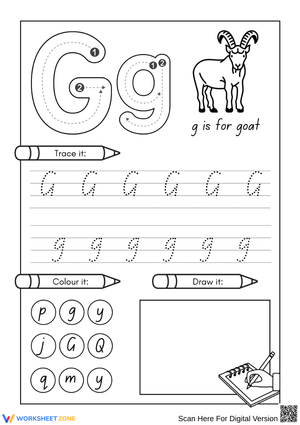
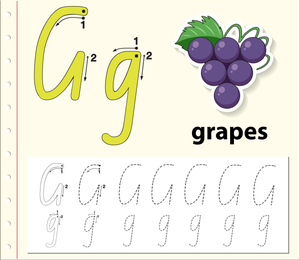
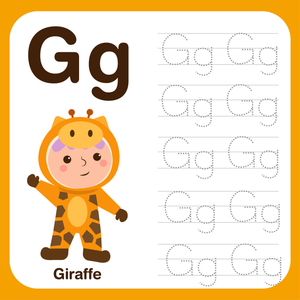
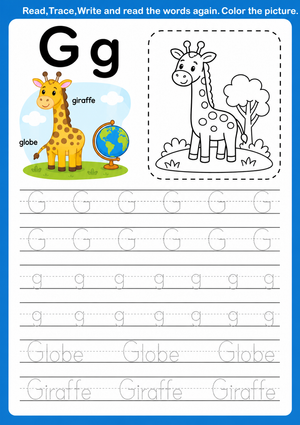
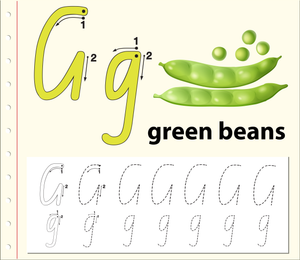
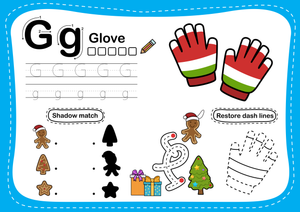
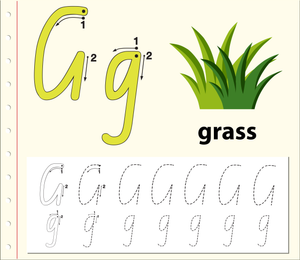
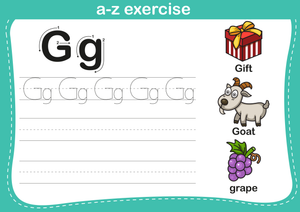
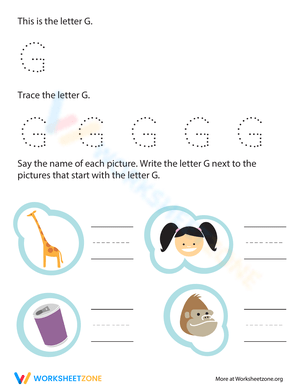
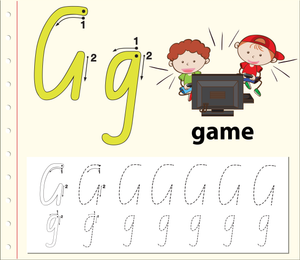
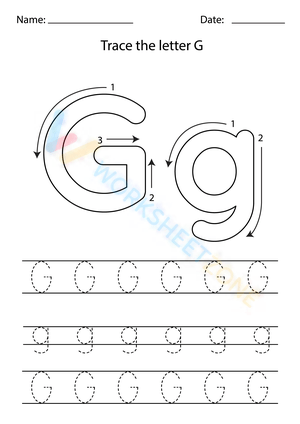
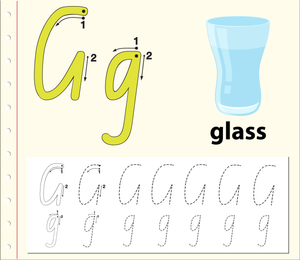
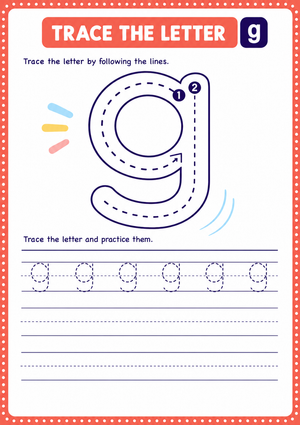
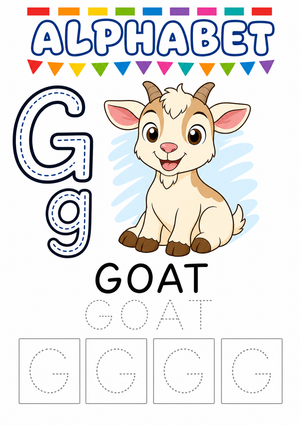
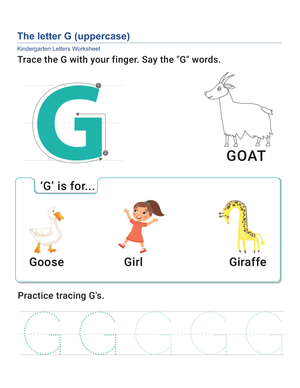
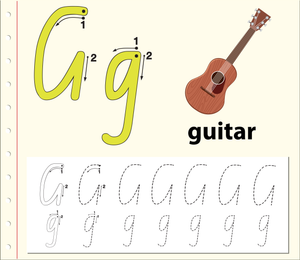
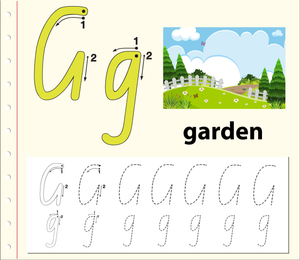
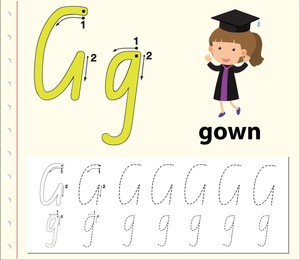
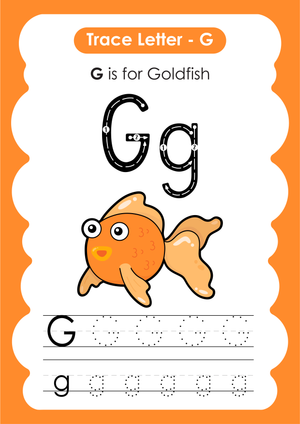
These letter g tracing handwriting printable worksheets for kindergarten address one of the most demanding letters in the early alphabet sequence — a letter whose uppercase and lowercase forms share almost nothing in common structurally, and whose lowercase carries a descending tail that takes students below the baseline for arguably the first deliberate time in their handwriting experience. The set works through both forms with dotted stroke paths, directional arrows, and starting-point markers so that correct movements get practiced before wrong ones take hold.
The Skills Each Worksheet Builds
Uppercase G belongs to what many primary curricula call the "magic C family" — it begins with the same counterclockwise arc as C, O, and Q. The complication is that uppercase G requires students to pause mid-curve at the midline and add a short horizontal bar inward. That two-part interruption is what makes it harder than the letters it resembles. Students who can draw a smooth C will often keep curving rather than stopping to reverse direction.
Lowercase g is a different matter entirely. The circle body sits between the midline and baseline, then a tail drops below the bottom line into the descender space — territory most kindergartners haven't written in before. On primary handwriting paper, that space exists but rarely gets explicit attention in early writing units. Tracing lowercase g correctly introduces students to the full vertical range of their writing lines. Each worksheet marks the descender space clearly so students understand where the tail should land, not just that it goes "down."
Beyond the letter itself, each worksheet reinforces:
- Left-to-right directionality through consistent arrow placement on every stroke segment
- Starting-point discipline through numbered or colored entry dots
- Letter-sound connection through simple G-word illustrations alongside the tracing rows
- Independent writing practice in open rows at the bottom, for students ready to form the letter without a dotted guide
Stroke Errors Worth Watching For and Addressing
The g/q reversal is the most persistent error with this letter. Both forms begin with the same circle, and the only structural difference is which direction the tail curves at the bottom — left for g, right for q. That distinction is small, easy to trace over without internalizing, and easy to automate incorrectly. Worksheets that include directional arrows on the descending tail help, but arrows alone are often not enough. The more reliable correction is pairing the tracing motion with a spoken cue: as students drag the tail downward, they say "down and hook left." Physical movement combined with language creates a dual-channel memory trace that visual practice alone doesn't build.
A second error appears less often in teaching conversations but shows up consistently in actual student work: students who begin uppercase G at the bottom of the curve and draw upward rather than starting near the two o'clock position and curving down and left. In the early stages, both strokes produce letters that look similar on paper — exactly why teachers miss the problem until it's entrenched. Worksheets with a clearly numbered starting dot, rather than just an entry arrow, catch this before the wrong sequence becomes automatic.
Bottom-up formation of lowercase g is also common among students who learned to draw circles in art or play contexts, where starting position doesn't matter. Handwriting is different. Consistent starting position affects letter fluency and, later, letter connections in cursive. Early instruction needs to enforce it explicitly, not just suggest it.
Fitting These Worksheets Into Your Lesson Planning
Morning arrival is one of the most practical windows for independent tracing practice. A letter G worksheet on the desk as students settle in gives them something focused and quiet before the literacy block begins, activating pencil grip and fine motor engagement without requiring teacher direction. That's a small benefit in isolation, but it compounds over weeks of consistent use.
Writing centers with laminated worksheets and dry-erase markers let students practice formation repeatedly without consuming extra paper. That setup also makes error patterns visible in a useful way: a student who keeps starting in the wrong place leaves marks that show the habit across multiple attempts, and a teacher checking in during center rotation can address it directly rather than guessing from a finished product.
Small-group guided sessions are where letter g tracing handwriting printable worksheets for kindergarten offer the most diagnostic value. With five or six students at the table, a teacher watches pencil grip, starting position, and stroke sequence simultaneously — catching habits that are invisible during whole-group instruction. Five minutes of close observation here tells more about where each student stands than a full stack of independently completed tracing rows reviewed after the fact.
Standard Alignment
These worksheets address CCSS.ELA-LITERACY.L.K.1.A, which requires kindergartners to print many uppercase and lowercase letters by year's end. That standard frames handwriting as a literacy skill, not a separate subject. In most kindergarten pacing guides, explicit letter formation instruction runs through the first half of the year, with consolidation and application expected in the second half. Targeted G practice belongs in the explicit instruction phase — ideally introduced during the same week G appears in a phonics sequence, so handwriting and sound work reinforce each other rather than competing for attention on different days.
Adjusting the Set for Different Levels of Readiness
Letter g tracing handwriting printable worksheets for kindergarten span a wider readiness range than most single-letter resources because G carries two genuinely distinct forms and an above-average fine motor demand. For students still developing pencil control, start with uppercase G only — the stroke is larger, stays within the standard line space, and produces faster early success before tackling the descender challenge. Students who fatigue quickly or struggle with grip often do better working on a slightly slanted surface, which reduces wrist strain during the curved stroke. That's a setup adjustment, not a worksheet change, but it matters for sustained practice.
Students who move through tracing quickly can advance to the open writing rows and then to short G-words — go, get, gap — where the letter appears in context. Asking a student to locate and underline every g in a short sentence before writing it independently adds a retrieval step that tracing alone doesn't require, and retrieval produces stronger retention. For students who continue to confuse g and q after guided instruction, isolate one letter at a time for several sessions before reintroducing comparison work. Side-by-side comparison helps students who already have both motor patterns sorted out; for students who haven't yet formed either letter reliably, it deepens the confusion rather than resolving it.
Frequently Asked Questions
What's the right way to introduce lowercase g before students touch the worksheet?
Model the stroke on a whiteboard at a size the whole group can see clearly, narrating each movement: "Start at the midline, circle around to the right, all the way down to the baseline, then drop straight down past the line and hook left." Have students air-trace the motion two or three times before picking up a pencil. That physical rehearsal reduces direction errors on the first tracing row and gives you a quick read on which students are already unclear about which way the hook goes.
How many tracing repetitions does a student need before moving to open writing rows?
There's no fixed number, and chasing one leads to fatigue without gain. A better signal is consistency: when a student forms three consecutive letters with correct starting position, direction, and tail placement, they're ready to write without a dotted guide. Five well-formed letters build stronger motor memory than twenty traced with deteriorating form, and poor form practiced repeatedly is harder to correct than poor form caught early.
Can these worksheets travel home for additional practice?
Letter g tracing handwriting printable worksheets for kindergarten work well as home practice when families receive a brief orientation to the stroke language. When a parent knows to say "start at two o'clock, curve down and left, stop at the midline, then add the bar inward" for the uppercase, they reinforce what's being taught rather than introducing competing instructions. A one-sentence explanation at pickup or a short note attached to the worksheet is enough. Without that context, home practice can undo classroom progress if a parent inadvertently models the stroke from the wrong starting point.
Do students need to master uppercase G before working on lowercase?
Not necessarily, though many teachers find that introducing uppercase first reduces the number of things competing for a student's attention — the stroke is larger, the spatial range is simpler, and success comes faster. For students who enter with stronger fine motor skills, both forms can be introduced in the same week. The more important rule is to avoid practicing both forms on the same day until students can reproduce each one reliably in isolation. Mixing them too early is the fastest path to a g/q confusion that can take weeks to untangle.