




























Views
Downloads
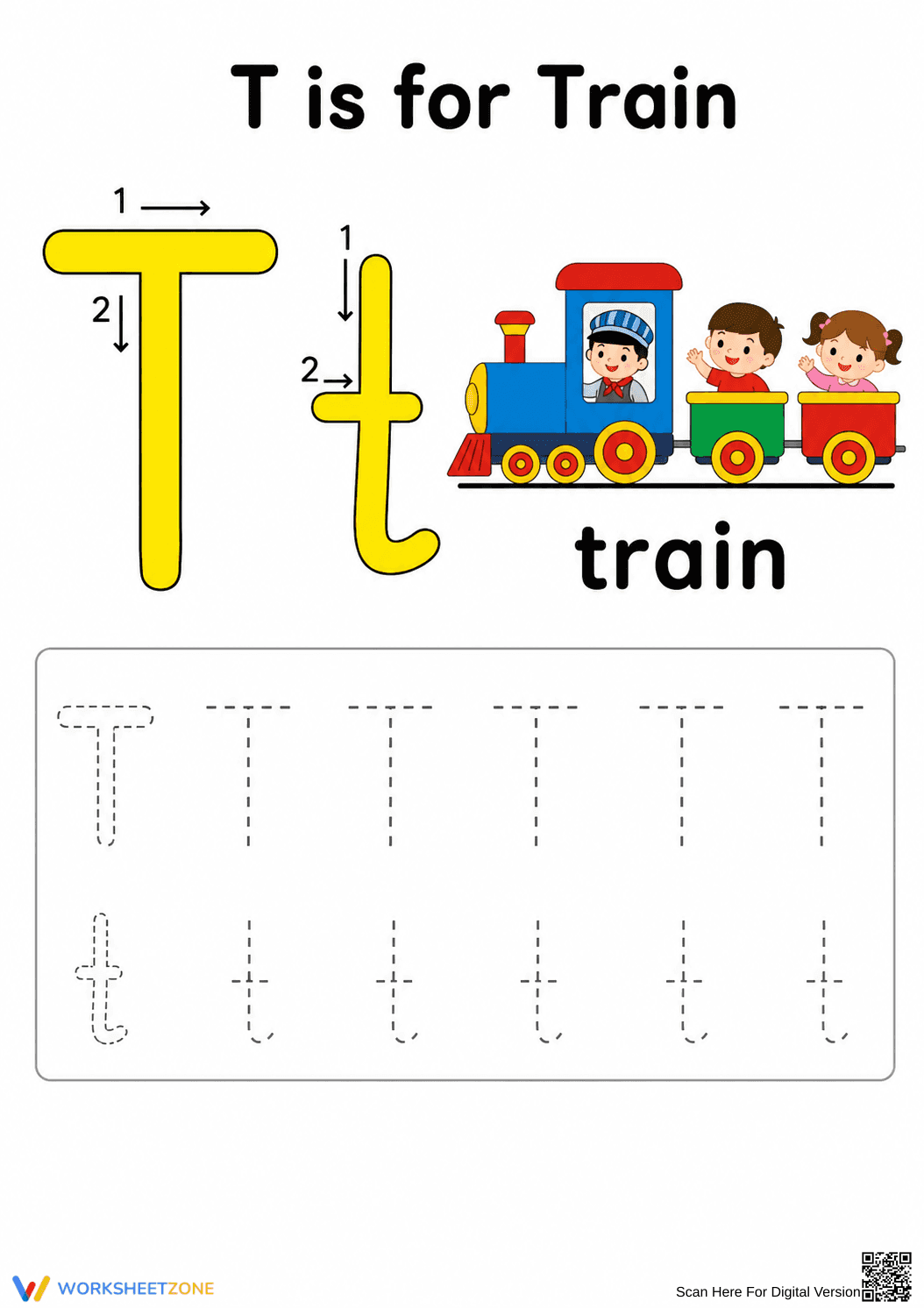

Letter T Tracing Worksheet | Essential Grade K-1

Paste this activity's link or code into your existing LMS (Google Classroom, Canvas, Teams, Schoology, Moodle, etc.).
Students can open and work on the activity right away, with no student login required.
You'll still be able to track student progress and results from your teacher account.
This Grade K-1 letter T worksheet provides immediate practice for early learners to master uppercase and lowercase letter formation. By connecting the visual of a train to the "t" sound, students build essential phonemic awareness while developing the fine motor control necessary for legible handwriting and future literacy success.
At a Glance
- Grade: K-1 · Subject: ELA Phonics
- Standard:
CCSS.ELA-LITERACY.L.K.1.A— Print upper- and lowercase letters with correct stroke order and form- Skill Focus: Letter T formation and beginning sounds
- Format: 1 page · 12 problems · Answer key included · PDF
- Best For: Independent morning work or literacy centers
- Time: 5–10 minutes
The worksheet features a clear, high-contrast layout designed for young eyes. At the top, large reference letters include numbered arrows to demonstrate the proper stroke sequence for both uppercase and lowercase forms. Below, a dedicated tracing box contains 6 uppercase "T" and 6 lowercase "t" characters. The inclusion of the "train" keyword and a colorful illustration reinforces the phonetic connection between the grapheme and its primary phoneme.
This resource follows a zero-prep workflow designed for busy educators. First, print the single-page PDF (30 seconds). Second, distribute to students during your phonics block or as a quiet transition activity (1 minute). Finally, review the letter formation by checking for proper top-to-bottom and left-to-right strokes (2 minutes). This efficient design makes it an ideal choice for emergency sub plans or daily handwriting drills.
Primary alignment is to `CCSS.ELA-LITERACY.L.K.1.A`, which requires students to print many upper- and lowercase letters. It also supports `CCSS.ELA-LITERACY.RF.K.1.D` by helping students recognize and name the letter T in multiple forms. Both standard codes can be copied directly into lesson plans, IEP goals, or district curriculum mapping tools to ensure compliance with state and national frameworks.
Use this worksheet as a formative assessment during the independent practice phase of a lesson. Observe students as they trace to ensure they are following the numbered stroke guides rather than drawing the letters haphazardly. It also serves as an excellent quiet-time activity for students who finish their primary literacy tasks early, providing 5 to 10 minutes of focused, meaningful practice.
This resource is tailored for Kindergarten and Grade 1 students who are beginning their journey into literacy. It is particularly helpful for English Language Learners (ELLs) who benefit from the visual anchor of the train illustration. Pair this worksheet with a tactile sand tray or a letter T anchor chart to create a multi-sensory learning experience that caters to diverse needs.
According to Fisher & Frey (2014), the use of guided tracing serves as a critical scaffold in the gradual release of responsibility model for early literacy. Research indicates that explicit instruction in letter formation, combined with visual cues like stroke arrows, significantly improves handwriting fluency and subsequent reading speed. This worksheet applies these principles by providing 12 specific opportunities for repetition, which is the threshold often cited by NAEP for establishing muscle memory in early childhood education. By focusing on the specific phoneme-grapheme correspondence of the letter T, the resource ensures that students are not just drawing shapes but are internalizing the building blocks of the English language. This structured approach to phonics instruction is a hallmark of high-quality, evidence-based primary curriculum design that supports long-term academic growth.


