




























Views
Downloads

Letter T Tracing Worksheet | Printable Grade K ELA

Paste this activity's link or code into your existing LMS (Google Classroom, Canvas, Teams, Schoology, Moodle, etc.).
Students can open and work on the activity right away, with no student login required.
You'll still be able to track student progress and results from your teacher account.
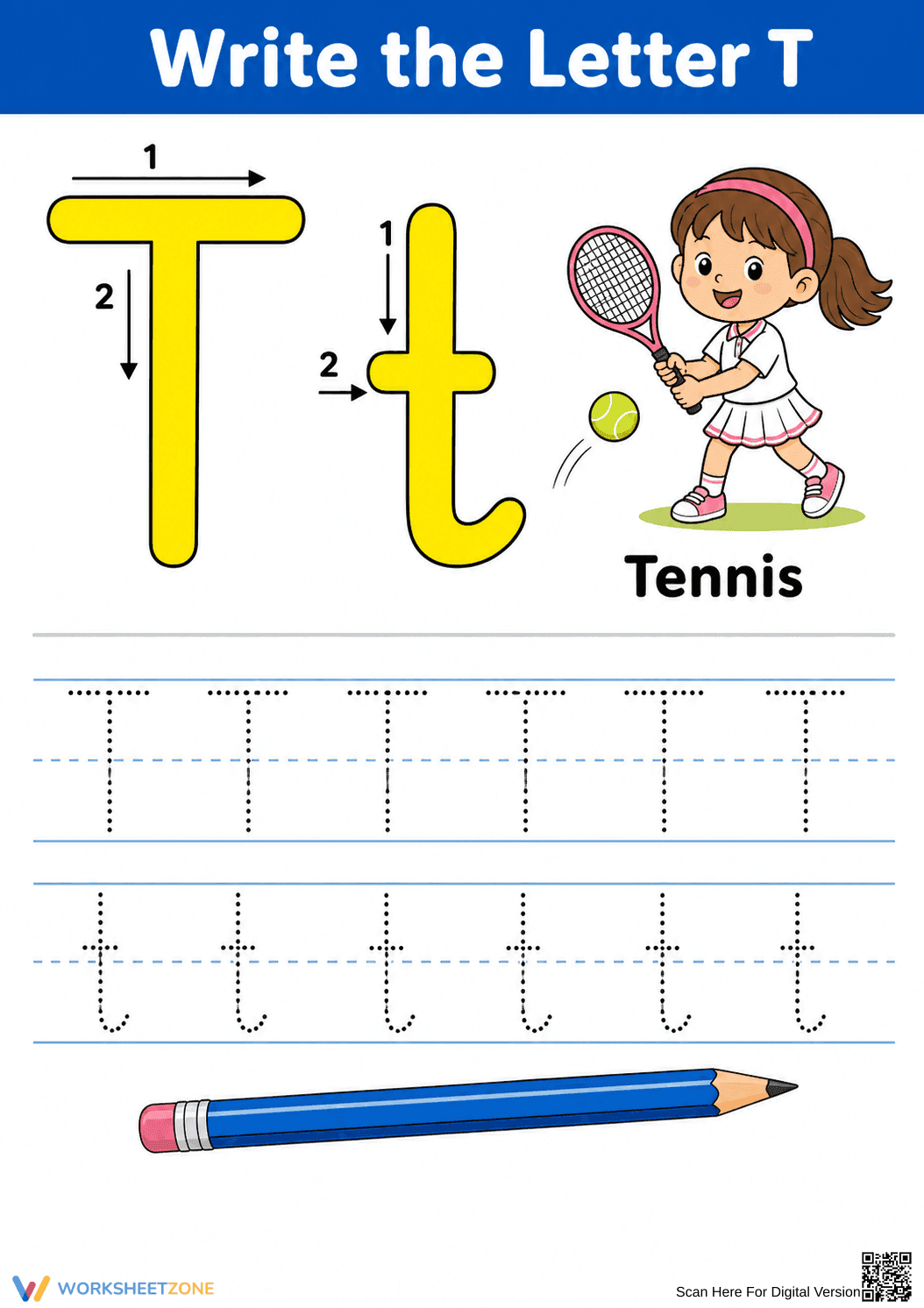
This foundational Kindergarten ELA worksheet helps early learners master the formation of the letter T while reinforcing beginning sound recognition. By combining guided stroke directions with independent tracing practice, students develop essential fine motor skills and phonics awareness required for early reading and writing success.
At a Glance
- Grade: Kindergarten · Subject: ELA
- Standard:
CCSS.ELA-LITERACY.L.K.1.A— Print many upper- and lowercase letters.- Skill Focus: Letter T formation and beginning sounds
- Format: 1 page · 12 problems · No answer key needed · PDF
- Best For: Morning work or literacy centers
- Time: 10–15 minutes
This single-page resource features a clear, visual introduction to both the uppercase and lowercase letter T, complete with numbered directional arrows to guide proper pencil strokes. A vibrant illustration of a girl playing tennis provides a memorable anchor word to reinforce the beginning consonant sound. The lower half of the page provides 12 dashed tracing tasks—six for the uppercase letter and six for the lowercase letter—set on standard primary writing lines to ensure correct sizing and placement.
Designed for immediate classroom implementation, this resource requires absolutely no teacher setup.
- Print (1 minute): Simply download the PDF and print a class set. The high-contrast design ensures crisp copies.
- Distribute (1 minute): Hand out the sheets during morning arrival or transition times. The visual instructions make the task immediately clear to young learners.
- Review (Ongoing): Monitor students as they trace, providing quick corrective feedback on pencil grip and stroke order.
With a total prep time of under two minutes, this activity is an excellent addition to any emergency sub plan or daily routine.
This activity is directly aligned to CCSS.ELA-LITERACY.L.K.1.A, which requires students to print many upper- and lowercase letters. It also supports foundational phonics skills by connecting the visual letter form to its spoken sound. Both standard codes can be copied directly into lesson plans, IEP goals, or district curriculum mapping tools.
Deploy this worksheet during morning work to establish a calm, focused start to the school day while reinforcing recent phonics lessons. Alternatively, place it in an independent literacy center alongside tactile letter-building materials like playdough or sand trays. As a formative assessment tip, observe students while they work to ensure they are following the numbered stroke arrows rather than drawing the letters from the bottom up. Expected completion time ranges from 10 to 15 minutes.
This resource is ideal for Kindergarten students who are actively learning the alphabet and developing fine motor control. It also serves as a helpful intervention tool for first-grade students who need targeted remediation in letter formation or handwriting legibility. Pair this tracing practice with a whole-group read-aloud focusing on words that start with the /t/ sound to maximize engagement and retention.
Mastering letter formation is a critical stepping stone in early literacy development. When students practice printing upper- and lowercase letters, as outlined in CCSS.ELA-LITERACY.L.K.1.A, they build the automaticity required for fluent writing and reading. According to Fisher & Frey (2014), explicit instruction in handwriting and letter-sound correspondence significantly reduces cognitive load, allowing young learners to focus their mental energy on higher-order tasks like vocabulary acquisition and reading comprehension. This targeted practice ensures that students not only recognize the letter T but can also produce it efficiently. By integrating visual cues, such as the tennis illustration, with physical tracing exercises, educators can create a multisensory learning experience that solidifies both the mechanical skill of writing and the phonological awareness of beginning sounds.


