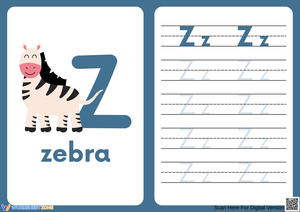
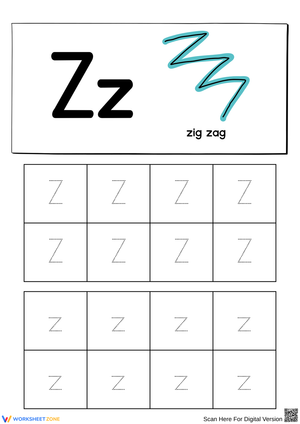
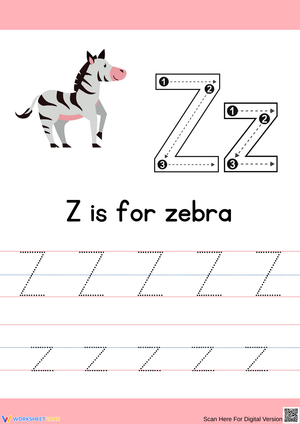
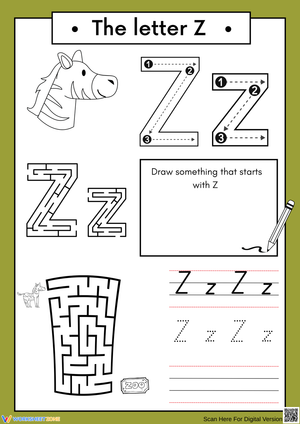
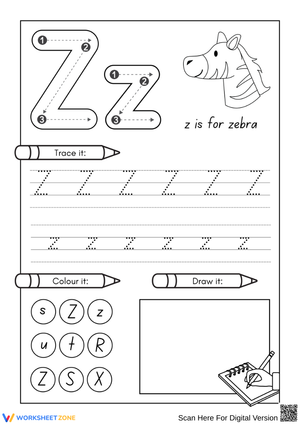
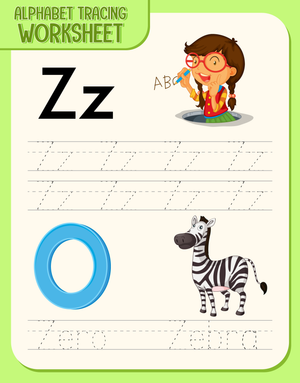
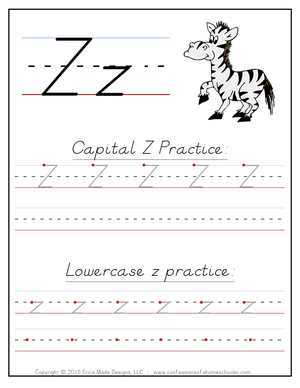
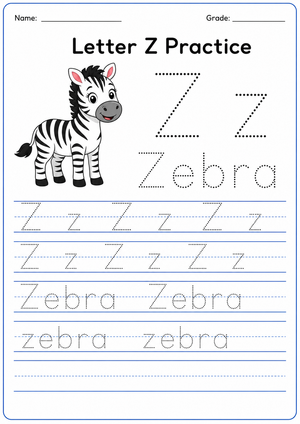
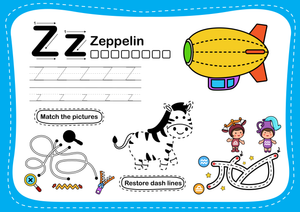
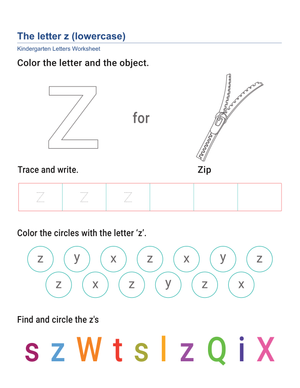
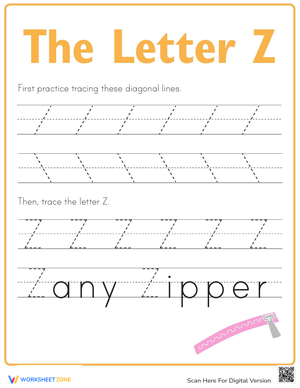
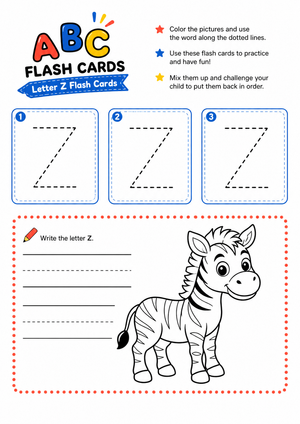
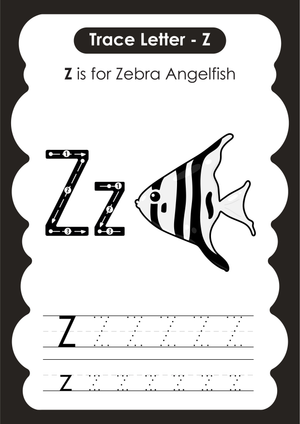
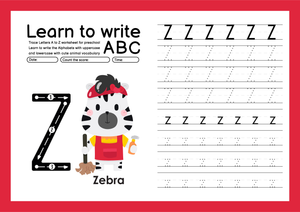
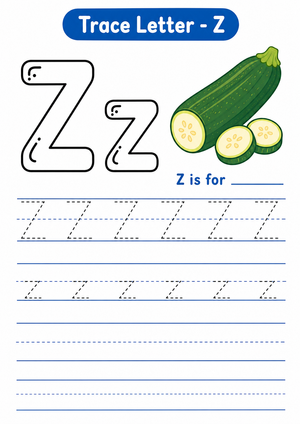
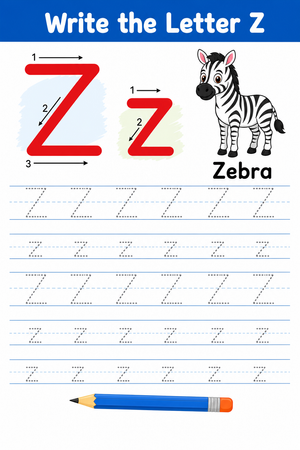
Kindergarten letter z tracing handwriting worksheets give students the chance to slow down on a letter that gets far less page time than A, B, or S — which means most children arrive at Z having seen the shape only a handful of times. Each worksheet pairs uppercase Z and lowercase z models with dotted tracing lines and open writing space, keeping the task narrow enough for a five-year-old to complete with genuine care.
Where Letter Z Falls in Early Alphabet Instruction
Most kindergarteners have written their own name, recognized M and T in books, and traced at least a dozen letters before Z comes up in direct instruction. Because Z appears so rarely in the words children read and hear at this age — common sight words almost never begin with Z, and few children's names do either — students reach it without the casual repeated exposure that makes A or S feel automatic. That gap in exposure is exactly why a focused practice moment matters. When a child hasn't encountered Z in several weeks, formation habits haven't had time to settle, and the diagonal stroke is easy to misremember.
The diagonal in both uppercase Z and lowercase z also makes this letter developmentally interesting. Horizontal and vertical strokes come earlier in fine-motor development; diagonals require more precise directional control. A well-timed tracing worksheet gives students a structured moment to practice that stroke under guidance before they're expected to produce it independently.
What Each Worksheet Includes
Each worksheet focuses on one clear task: tracing and writing the letter Z with correct formation. The layout keeps things straightforward for beginning writers.
- Side-by-side uppercase and lowercase models so students can compare Z and z before beginning any tracing
- Dotted tracing lines that guide stroke order and direction, followed by blank handwriting lines for independent writing
- Line spacing sized for kindergarten pencil control — not the cramped spacing that shows up in first-grade materials
- A picture cue, such as a zebra or zipper, that links the letter to its sound without adding a reading demand
- Short task length so a child can finish carefully rather than rush through the final rows
The trace-then-write sequence is not arbitrary. Students who move directly to independent writing before their motor memory is set tend to revert to approximate shapes — something that looks roughly like Z but begins at the wrong point or collapses the diagonal into a straight line. Tracing first establishes the movement pattern before the support disappears.
Formation Errors Worth Watching For and Correcting
The most common uppercase Z error is starting the diagonal from the bottom rather than the top. Students draw a forward slash first and then attempt to attach horizontal strokes around it, ending up with something closer to a backwards N. The correction is direct: start at the top left, go across, slant down to the right, then go across again. That verbal cue, repeated during whole-group modeling, gives students something to say quietly to themselves as they trace.
Lowercase z gets confused with the number 2 more often than teachers expect. The bottom curve of a 2 and the bottom stroke of a lowercase z occupy similar visual territory for a five-year-old who is still sorting letter shapes from number shapes. When you see a lowercase z with a small tail curling off the bottom, that's the source. Drawing z and 2 side by side on the board and narrating the difference does more good than simply marking the worksheet incorrect.
A third pattern appears in rushed work: students omit the diagonal entirely and write two horizontal lines stacked on each other. That shape isn't Z, but it's what happens when a child moves too fast to register the slant. A brief whole-group model before independent time — with a deliberate, slow diagonal drawn in front of the class — catches this before it shows up across an entire class set of worksheets.
Building These Worksheets Into Your Lesson Planning
Kindergarten letter z tracing handwriting worksheets fit naturally into morning work or the transition just before a literacy block. Five to eight minutes is about right — long enough for students to complete the task with care, short enough to avoid the pencil fatigue that turns the final rows into rushed squiggles.
A reliable routine: model the letter on the board with a short verbal cue while students watch, air-write it together once, complete the first tracing row as a class, then release students to finish on their own. That whole sequence runs less than ten minutes and reduces the number of students who start from the wrong point or lose the diagonal entirely.
In literacy centers, pair the worksheet with a small set of Z-word picture cards or a simple picture sort. Students who finish the tracing task early can hunt for other Z words around the room, sort pictures by beginning sound, or draw and label their own Z-word picture. These additions keep the center active without pulling students ahead to other letters before the week's focus is complete.
For homework, send the worksheet with a specific instruction asking families to watch their child trace one row and then write the next row without looking at the dotted lines. That one sentence prevents the common situation where a child traces every row from top to bottom and never practices producing the letter from memory.
Adjusting These Worksheets Across a Range of Learners
Students who are still developing pencil grip and hand strength often do better with a reduced version of the task. Fold up the bottom half of the worksheet and ask them to complete only the top two or three rows — done carefully and correctly — rather than working through a full sheet with an uncomfortable grip. As fine-motor endurance builds, extend the task a little at a time.
For students ready to move past dotted tracing, cover the guided rows with a strip of paper and ask them to write from the model alone. You can take this further by asking them to write Z and z from memory, then compare their letters against the model and mark any difference they notice. That self-correction step — writing before checking — builds stronger letter memory than tracing-only work.
Multilingual learners benefit from having the picture cue named aloud before the worksheet begins. A student who doesn't yet know the English word zebra can still trace Z successfully, but connecting the sound to an image in their home language, when possible, strengthens the letter-sound link. The tracing task stays the same; the oral preview carries the language support.
Standard Alignment
These kindergarten letter z tracing handwriting worksheets address CCSS.ELA-LITERACY.L.K.1a, which calls for students to print many upper- and lowercase letters. In classroom practice, this standard comes into focus during explicit handwriting instruction in the first and second quarters of the school year, when teachers move through the alphabet in a deliberate sequence. Letter Z typically arrives near the end of that sequence, making targeted review especially useful in late fall or early winter — the window when students are consolidating their full letter repertoire before the instructional emphasis shifts toward sight words, early spelling patterns, and sentence-level writing.
Frequently Asked Questions
How many tracing rows should kindergarteners complete before writing independently?
Two or three carefully traced rows is usually enough before removing the dotted support. Row count matters less than quality — a child who traces two rows deliberately and correctly builds more motor memory than one who rushes through five rows without noticing the diagonal. Watch grip and starting point during those first rows and step in before releasing students to write on their own.
What is the right way to explain the difference between uppercase Z and lowercase z to a five-year-old?
Both letters follow the same three-stroke movement: across the top, diagonal down to the right, across the bottom. The difference is size and placement on the writing line. Uppercase Z fills the full height from the top line to the baseline. Lowercase z sits in the middle zone — between the dotted midline and the baseline — without ascending or descending. Holding two fingers horizontally on the board to show "tall space" and "small space" helps students see the difference before they try to write it.
Can these worksheets double as an informal assessment?
Kindergarten letter z tracing handwriting worksheets work well as informal formative records. A completed worksheet shows whether a student knows the correct starting point, uses the right stroke direction, and keeps the letter on the baseline. It won't replace a one-on-one formation check, but it gives you a paper record to reference. Keeping a few dated samples from early fall, mid-fall, and midwinter makes growth visible in a way that's easy to share with families or a support team.
What should I do if a student finishes quickly but the letter formation is still incorrect?
Speed and accuracy rarely match in kindergarten handwriting. A child who moves through the worksheet in two minutes likely went faster than their motor control could follow. Return to the worksheet together, find one row they completed correctly, and ask them to slow down and match that quality on a fresh piece of paper. Limiting the task to two careful rows with a clear quality standard — rather than repeating the full worksheet — usually produces better results than sending the same assignment home again.