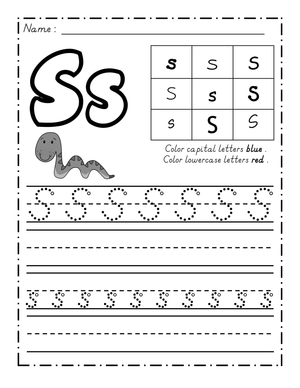
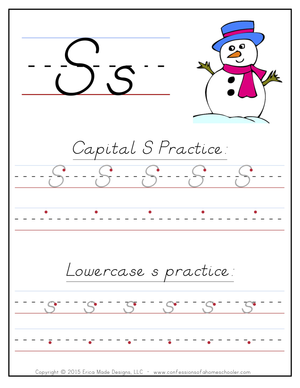
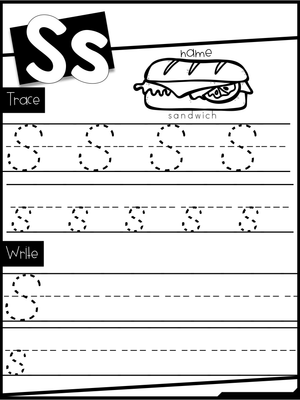
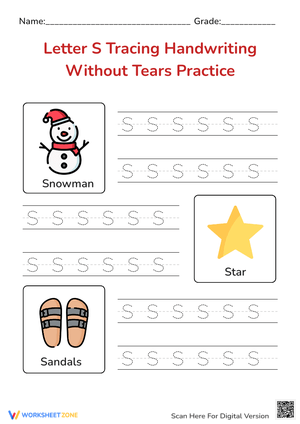
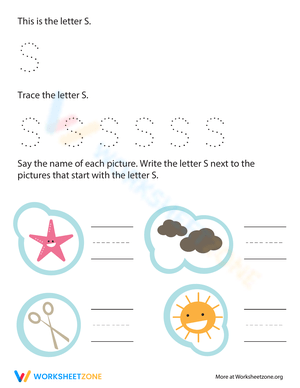
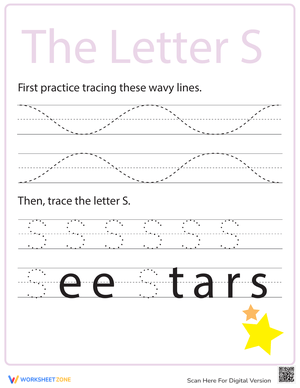
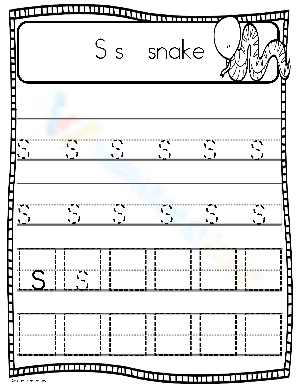
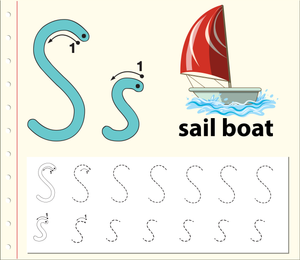
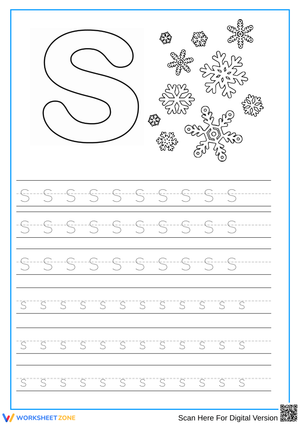
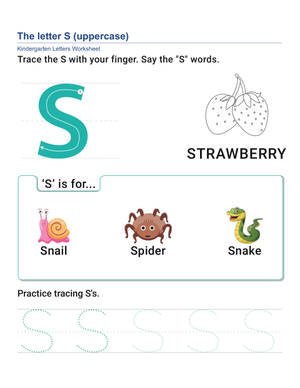
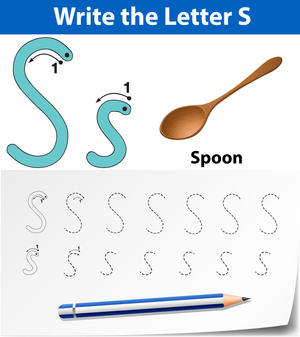
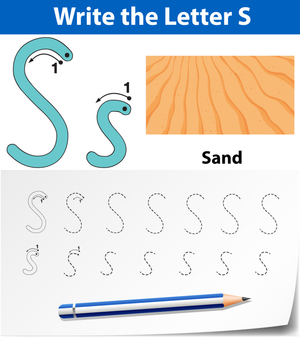
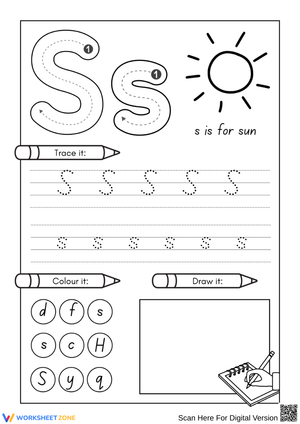
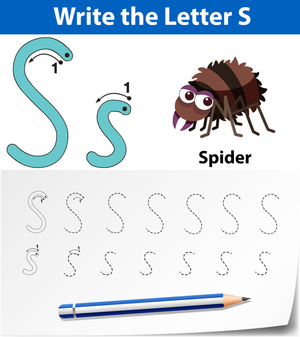
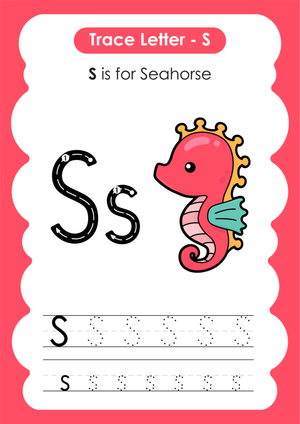
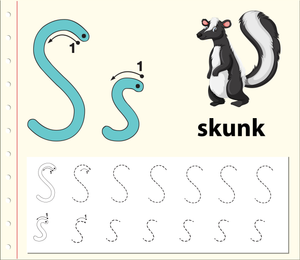
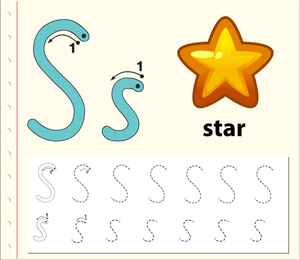
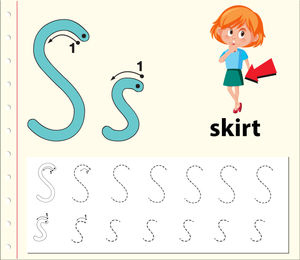
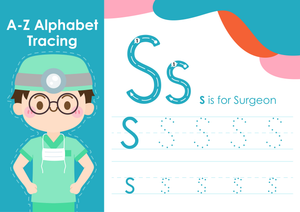
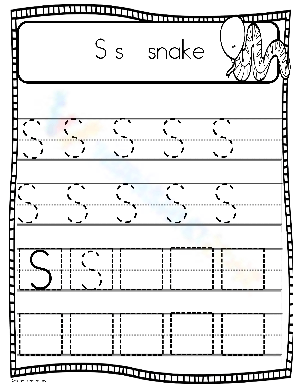
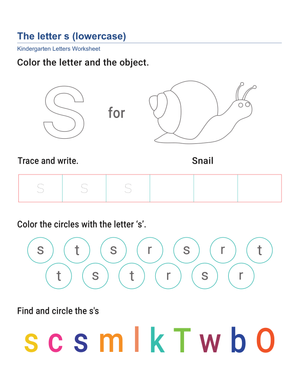
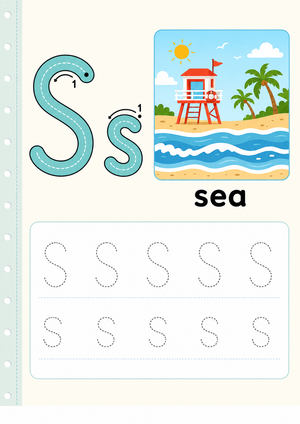
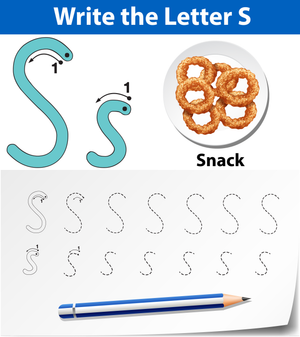
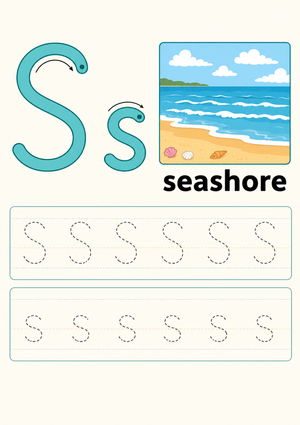
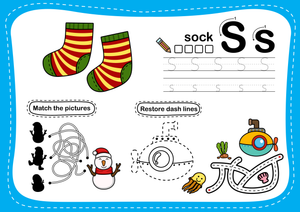
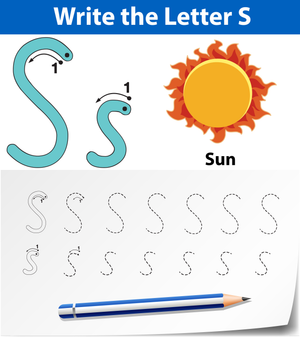
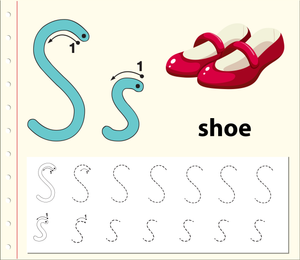
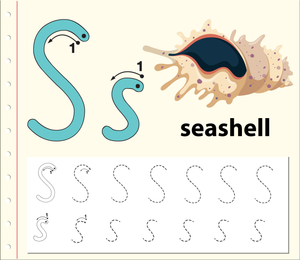
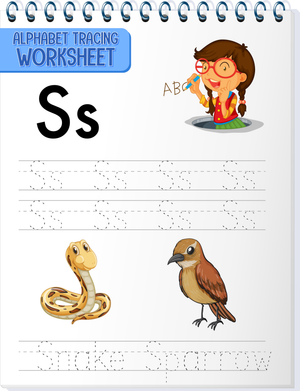
These kindergarten letter s tracing handwriting printable worksheets give teachers a focused set of practice resources built around the one letter that generates more reversal errors than nearly any other character in the early alphabet. Each worksheet targets the S's continuous double-curve stroke, guides students through it with starting dots and directional arrows, and includes a free-write row so the lesson moves from guided tracing to independent production without changing materials.
What Each Worksheet Builds
The set covers uppercase S and lowercase s in separate practice sequences, which matters because the two versions sit differently on the line — uppercase spans full height, while lowercase occupies only the midpoint-to-baseline zone. Students who learn only one version often misplace the other when they begin writing words. Each worksheet has students:
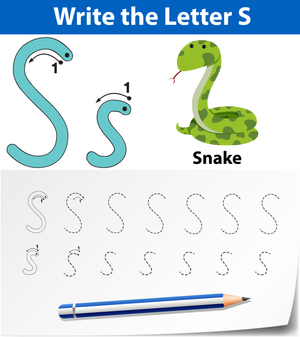
- Find the starting dot at the top right before beginning any stroke
- Trace the initial pull-back arc to the left, then swing right through the midsection
- Complete the letter as a single unlifted stroke rather than two separate arcs
- Follow directional arrows at a glance without stopping to reason through the sequence
- Write the letter independently in the rows below the traced models
The independent row at the bottom is not decorative. Moving directly from tracing to independent writing uses the brief window when the motor pathway is freshest — before the student sets the pencil down and the lesson shifts to something else.
The Reversals Teachers Can Expect to See
A reversed S usually means the student has established a motor pathway that starts from the bottom left and builds upward, rather than beginning at the top right and pulling back. In actual student work it looks like a backwards S or a sideways 2, and students often have no sense anything is wrong because the proportions feel approximately correct. This is a motor memory issue, not a visual perception issue, which is why pointing out the error rarely fixes it — the student needs correctly traced repetitions under close monitoring to overwrite the existing movement. A second pattern worth watching: students who lift the pencil between the two arcs and treat the S as separate strokes. The resulting letter is recognizable but poorly proportioned, and it tends to persist unless the teacher addresses the continuous-stroke requirement directly during the tracing phase, not after.
Fitting These Worksheets Into the Weekly Flow
These worksheets function well as morning work during the week a class focuses on the letter S in phonics. The format requires no verbal setup at the moment of distribution — students see the starting dot, arrows, and dotted path and begin — making each worksheet a dependable 8-to-10-minute task in the gap between morning meeting and the first whole-group lesson. Before pencils go down, spend 60 seconds on shared air-tracing while narrating the stroke aloud: "Start at the top, pull left, swing right through the middle, pull left again to land at the bottom." Saying it before touching paper primes the motor pathway in a way that silent distribution does not.
For small-group intervention, pull kindergarten letter s tracing handwriting printable worksheets for students still showing reversals after initial instruction and pair the worksheet with a tactile surface — a sand tray, dry-erase board, or piece of textured foam. Alternating between pencil tracing on paper and forming the letter through touch corrects the starting-direction error more efficiently than more paper practice alone. Rainbow tracing also fits this context: have students trace the same large dotted S three times using three different crayons. Crayon wax creates more friction than a pencil, which sends stronger sensory feedback about stroke direction and helps reset the muscle starting point before the student returns to finer pencil work.
Standard Alignment
These worksheets address CCSS.ELA-LITERACY.L.K.1.A, which requires kindergarteners to print many upper- and lowercase letters. The S deserves earlier and more sustained attention than most teachers budget for it, because its complexity means some students need significantly more practice to meet this standard than they would for a letter built from straight lines. Using kindergarten letter s tracing handwriting printable worksheets during the S focus week and again as a small-group pull-out in October or November gives teachers a clear, standards-aligned record of targeted handwriting support — useful documentation when a student's formation is flagged at a conference or a team meeting.
Adjusting These Worksheets for a Range of Writers
Students with limited pencil control need large letter models, thick dotted lines, and an unmissable starting dot. The larger the model, the less hand precision required, which reduces fatigue before the fine muscles have built endurance. Have this group use a thick crayon before transitioning to a standard pencil; the added grip thickness keeps their hand position more stable during the wrist rotation the S demands.
Students who hold a pencil comfortably but still reverse the stroke direction benefit from a numbered arrow sequence — one arrow for the pull-back, a second for the swing, a third for the close. This gives the movement a three-part mental structure they can hold in working memory while the habit is forming, without actually segmenting the physical stroke into separate pieces.
Students who have the stroke correct need to exit the full dotted model quickly. Extended tracing on dotted lines can produce its own problem: the student traces accurately but cannot write the letter without the visual guide. A faded gray outline, or a worksheet with only a starting dot and blank writing lines below, removes that dependency while keeping a minimal reference point in place. The shift should feel like a natural next step, not a test.
Frequently Asked Questions
Why does my student keep reversing the S even after multiple tracing sessions?
Persistence in reversals usually means the student is following the dotted path without attending to the directional cues — completing the physical motion by rote rather than internalizing the starting direction. Have the student narrate each phase of the stroke while tracing: "back, swing, back." Saying it aloud forces active attention to the movement instead of passive pencil-following. Also check whether the starting dot on the worksheet is prominent enough; if it blends into the paper, students default to whatever direction feels natural, which is typically wrong.
How many repetitions before a student should attempt independent writing?
A useful working target for most kindergarteners is five to eight repetitions per session, with the teacher checking after the first two to confirm the stroke direction is correct before the student continues. A student who traces ten times with a reversed starting arc has practiced the wrong formation ten times. When the stroke looks fluid and the student is not pausing to figure out what comes next, that is the signal to move to independent writing — not a specific count on the page.
Should uppercase S and lowercase s be introduced in the same week?
For most kindergarteners, yes — the stroke logic is identical for both, and teaching them together reinforces that connection. The differences are size and line placement, which are worth a quick explicit comparison at the board before students begin tracing. For students who are already uncertain about stroke direction, wait until the uppercase formation is consistent before introducing lowercase. Adding both simultaneously when the starting direction is still shaky makes an already difficult task harder without any instructional benefit.
Can these worksheets be sent home for additional practice?
These kindergarten letter s tracing handwriting printable worksheets travel home well because the instructions are self-contained — a caregiver does not need any background in handwriting instruction to sit with a child and say "trace the lines and follow the arrows." Send a brief note asking the child to start at the dot and keep the pencil moving without lifting it. Pencil grip correction, however, stays in the classroom; that is the one thing a teacher needs to see in real time to address before a wrong grip becomes a fixed habit.