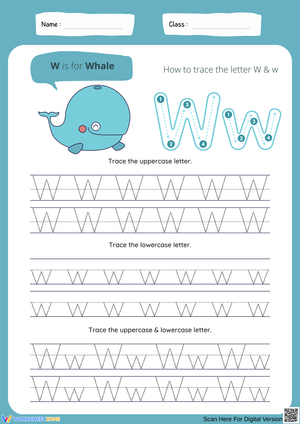
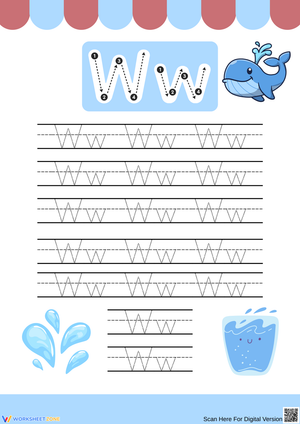
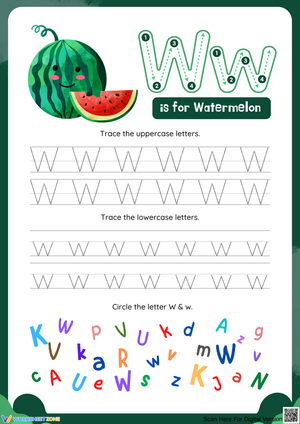
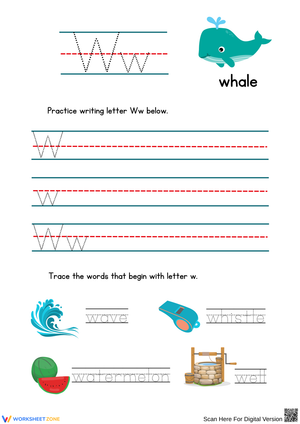
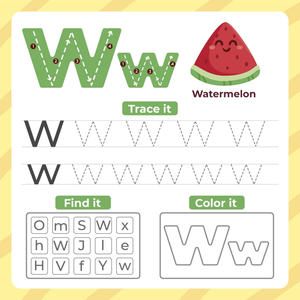
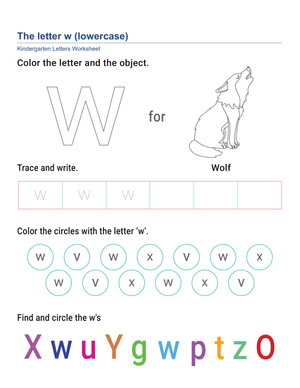
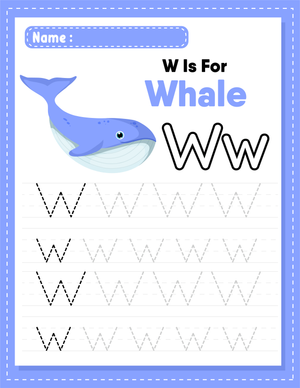
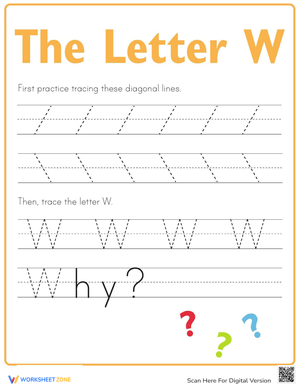
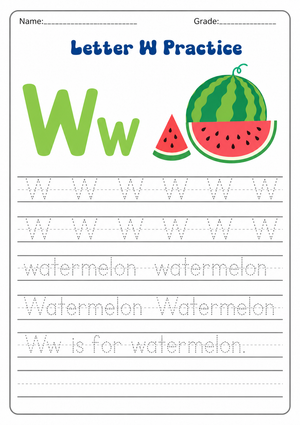
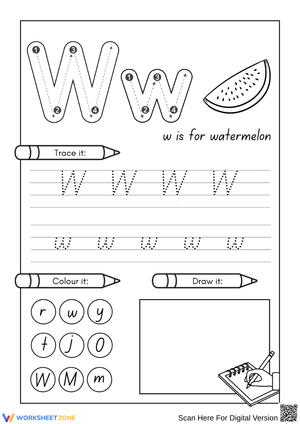
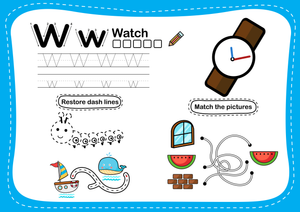
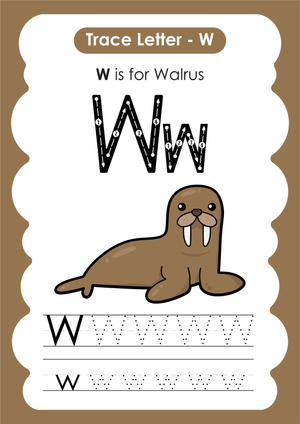
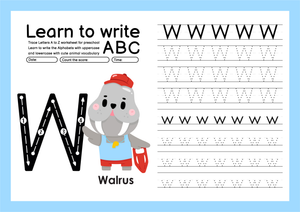
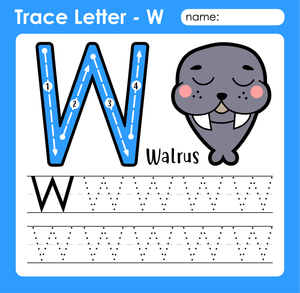
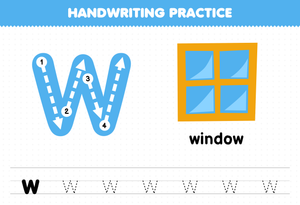
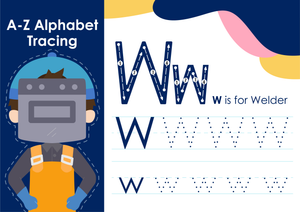
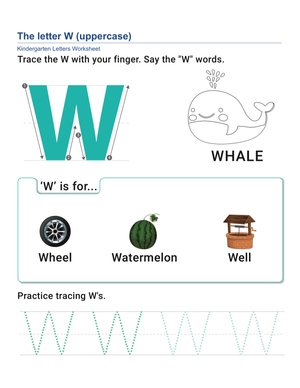
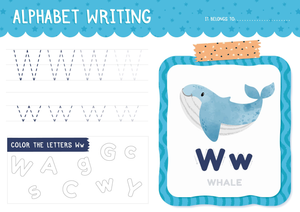
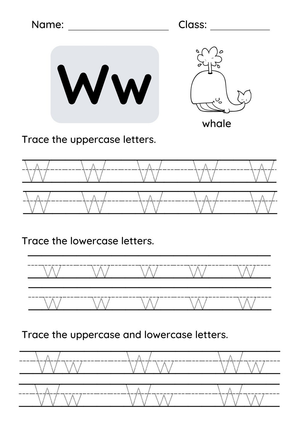
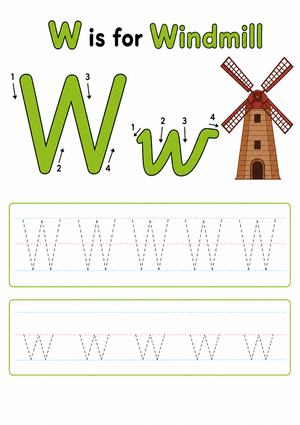
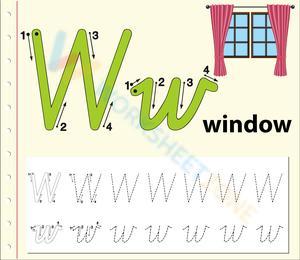
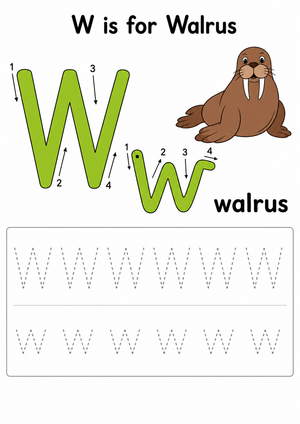
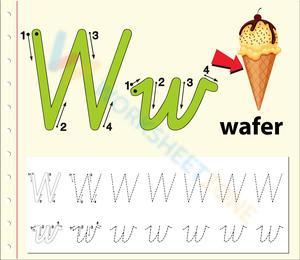
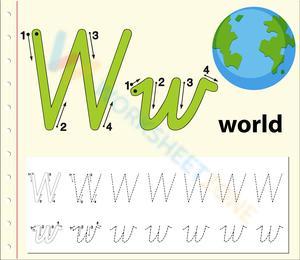
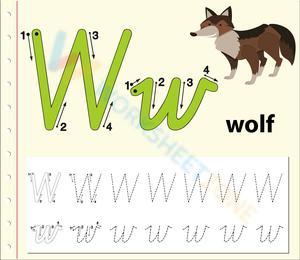
Letter w tracing handwriting printable worksheets for kindergarten give teachers a focused tool for building correct stroke formation before students begin writing the letter independently. These worksheets pair uppercase W and lowercase w on the same practice surface, with enough tracing rows to establish muscle memory and enough white space that young writers aren't crowding their pencil strokes. The strongest versions include directional stroke cues and a small set of familiar W pictures — whale, wagon, watermelon — that tie handwriting practice directly to beginning sound review.
What These Worksheets Target
Each worksheet addresses two parallel skills at once: letter formation and letter recognition. Students don't practice those abstractly — they trace the specific diagonal down-and-up strokes that produce W, compare the proportions of uppercase W against lowercase w, and then write several letters without any tracing support. That shift from guided tracing to independent production is where formation actually sticks.
- Uppercase W formation with numbered stroke cues teachers can reference during live modeling
- Lowercase w formation presented alongside the capital so students compare size and proportion directly
- Starting point placement — students learn where on the line the letter begins, not just what shape it makes
- Consistent letter size across a row, which distinguishes controlled practice from rushed output
- Sound-letter connection through picture prompts students name before or after tracing
Student Errors Worth Watching For and Correcting
The W is deceptively tricky. Students who draw an M accurately will sometimes write W as an exact mirror without adjusting proportions, so the result sits too tall or too wide on the line. More specifically, kindergartners tend to produce the lowercase w with only two humps instead of three distinct points and two inner valleys, which makes the letter read closer to a rounded u. Catching that error during the independent writing lines — not just during tracing — is where correction lands early enough to matter.
A second consistent problem: students start the uppercase W from the bottom and push strokes upward rather than beginning at the top and pulling down. The direction matters because upward-push habits affect fluency when students transition to faster writing later in primary grades. Worth flagging explicitly during your first modeling session rather than waiting to address it in reteach.
Where These Worksheets Fit Into the Week
Morning work is the most natural landing spot. Students arrive, find the worksheet on their desk, and start without waiting for instruction. That 5-to-8-minute window before the day formally opens is the right length for focused letter practice — short enough to keep quality up, long enough for two or three passes at each letter form. Literacy centers are another strong fit: drop the worksheet into a handwriting station alongside magnetic letters or alphabet picture cards, and students can trace, name the picture prompts, and circle all the W letters in a word row within a single rotation.
Small-group instruction is where letter w tracing handwriting printable worksheets for kindergarten earn real diagnostic value. Watching four or five students trace at the same time tells you immediately who is starting from the correct entry point, who is gripping with a fist, and who loses the letter shape after the first two strokes. That observation is harder to gather during whole-group work, where a student hunched at the back corner is easy to miss until the page comes in.
Reaching Different Learners With the Same Worksheet
For students still building fine motor control, tracing W with a yellow highlighter before picking up a pencil reduces physical pressure and keeps the letterform visible as a guide. That step also helps students who lose track of where the letter begins — seeing the full stroke highlighted first gives them a visual anchor before they attempt it independently. A related move: laminate the worksheet and let students trace with a dry-erase marker several times before producing a final copy in pencil. More repetitions, no extra copies.
Students who have already mastered the formation can skip the tracing rows and move directly to the independent writing lines, then use remaining time to write W words from memory or sort uppercase W and lowercase w picture cards. On the other end, students who struggle specifically with letter-sound connection — but can form the letters accurately — benefit from pointing to each picture prompt and saying the W sound aloud before tracing. That pairing builds phonics and handwriting in the same session without turning it into two separate lessons.
Standard Alignment
These worksheets connect to CCSS foundational skills standard RF.K.1d, which asks kindergartners to recognize and name all upper- and lowercase letters of the alphabet, and to L.K.1a, which addresses print conventions including the ability to print upper- and lowercase letters. Within a typical classroom alphabet sequence, W appears in the second half of the rotation — usually around weeks 18 to 22 — by which point most students have the hand strength to manage the diagonal strokes the letter requires. That timing also means students have already traced simpler letters like L, I, and T, so the multi-stroke complexity of W arrives after some baseline fluency is in place.
Frequently Asked Questions
Do these worksheets include both uppercase and lowercase W?
Yes. Each worksheet presents uppercase W and lowercase w together so students can compare the two forms directly. Kindergartners benefit from seeing both on the same practice surface because they can observe differences in height and proportion without moving between separate worksheets.
Can these be used inside dry-erase sleeves?
They work well that way. Slide the printed worksheet into a sleeve and students can trace with a dry-erase marker repeatedly — useful for centers where a teacher wants multiple students to use the same resource across a day. Students who need extra repetition get more passes at the letter without consuming additional copies.
At what point should students move from tracing to independent writing?
The shift works best when students can reproduce the letter from a verbal cue alone — "show me big W" — without looking at a model. For most kindergartners that readiness comes after several short practice sessions, not after completing letter w tracing handwriting printable worksheets for kindergarten once through. Watch specifically for consistent starting point, correct stroke direction, and appropriate size relative to the line. Those three markers together signal readiness more reliably than a full row of completed tracing does.
How do these fit alongside a phonics program?
Handwriting practice and phonics instruction reinforce each other when the letters students are tracing match what they're learning to decode. If a program introduces W sounds in a particular unit, letter w tracing handwriting printable worksheets for kindergarten can run alongside that instruction — students trace during handwriting blocks while simultaneously encountering W words in their reading group. That alignment isn't required, but it accelerates both recognition and formation retention.