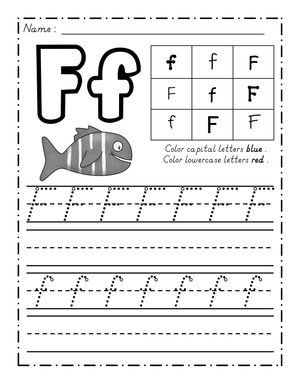
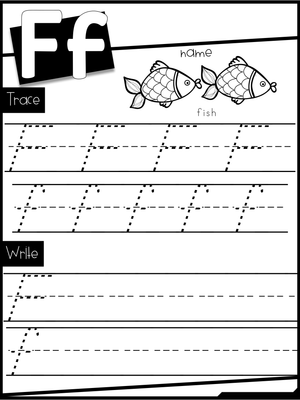
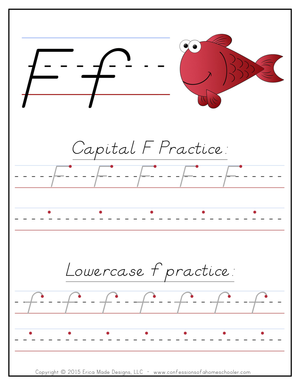
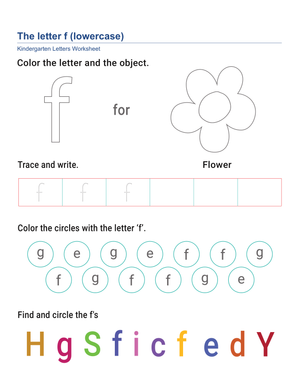
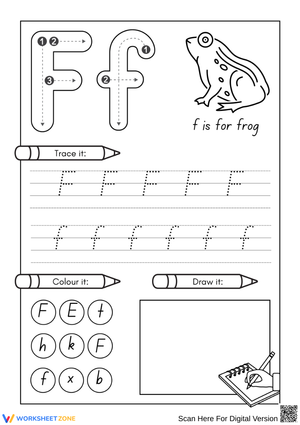
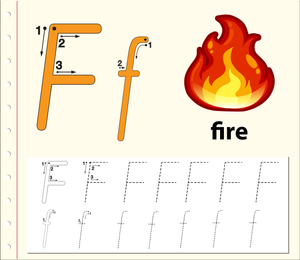
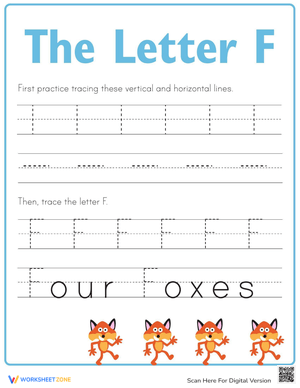
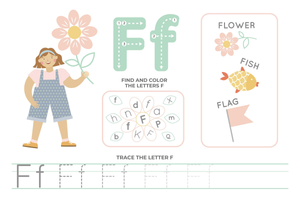
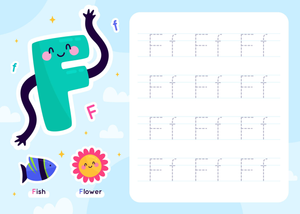
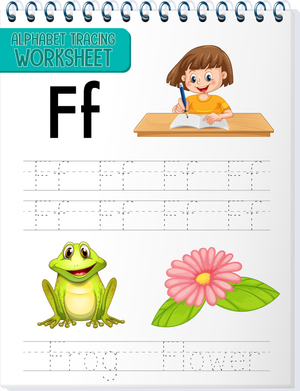
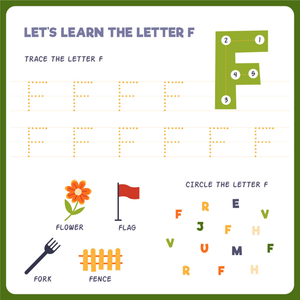
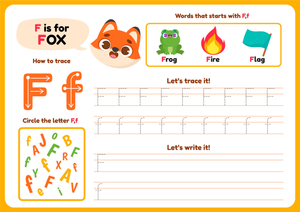
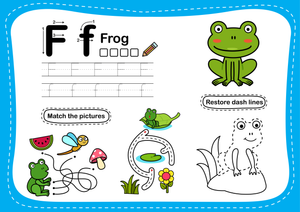
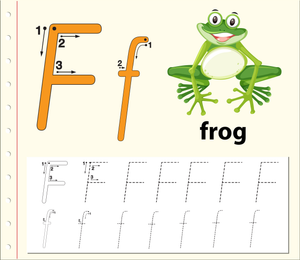
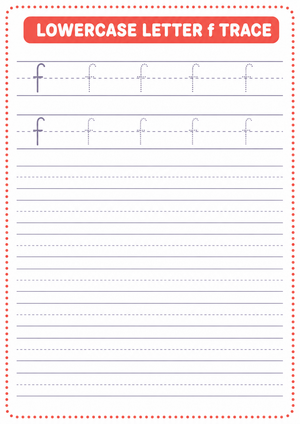
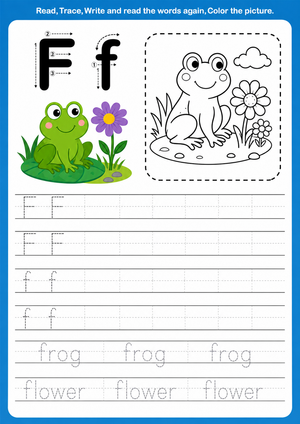
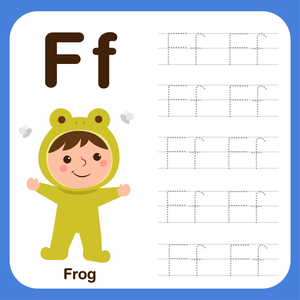
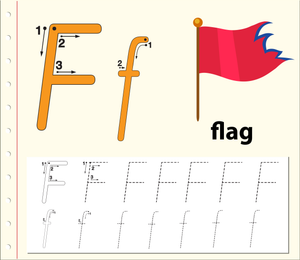
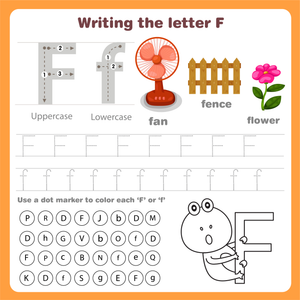
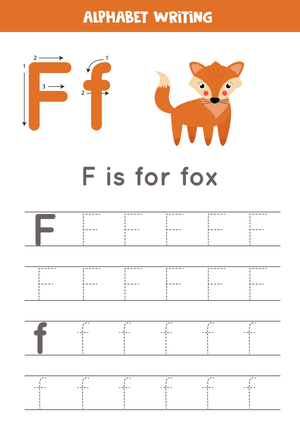
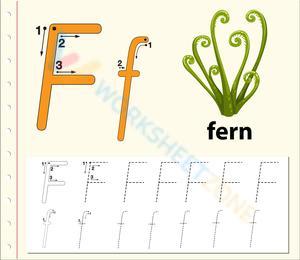
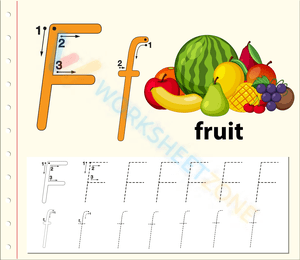
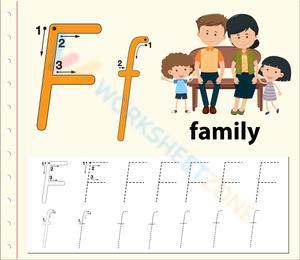
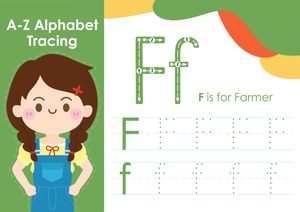
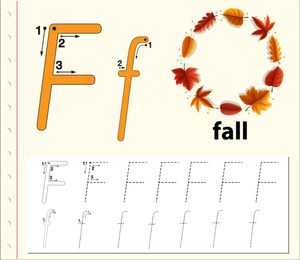
These letter f tracing handwriting pdf worksheets for kindergarten give students structured practice on both uppercase and lowercase forms — including the specific stroke sequences that, if learned correctly early, prevent the hand habits hardest to undo by second grade. Each worksheet pairs tracing rows with a phonics cue, so students connect the letter's shape to its sound in the same sitting.
What Each Worksheet Covers
The set addresses two distinct motor challenges that F presents. Uppercase F looks deceptively simple — three lines — but crossbar placement trips students up in ways that create real confusion at reading speed. Lowercase f introduces an entry curve, a downstroke, and a crossing stroke, requiring students to sequence three physically different movements before the letter is complete. Each worksheet targets one form before asking students to produce both.
Skills practiced across the set include:
- Top-to-bottom stroke direction for the vertical line in both uppercase and lowercase forms
- Correct crossbar placement — full-width at the top of uppercase F and a shorter bar at midline, with one crossing stroke at mid-height on lowercase f
- The entry curve on lowercase f, arcing up from just below the top line before pulling straight down
- Left-to-right directionality on all horizontal strokes
- Consistent letter sizing within primary-ruled lines
How Uppercase F and Lowercase f Are Actually Built
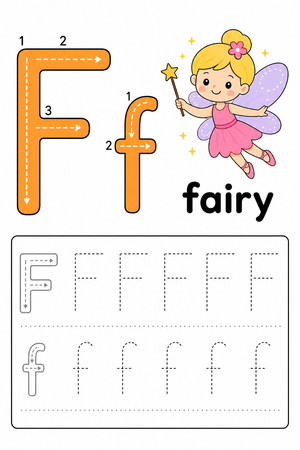
Uppercase F uses three strokes, and sequence shapes the outcome. Students start at the top-left with a vertical line pulling down to the baseline. The second stroke runs horizontally across the top, left to right. The third stroke is a shorter horizontal line at midline — and shorter matters, because students who make both crossbars the same width produce something that looks like an E at reading speed. Cuing students to stop the middle bar at roughly the center of the paper width, rather than extending it to the right edge, heads off this confusion before it becomes automatic.
Lowercase f starts just below the top line with a small curve that arcs up to touch the ceiling, then continues in one unbroken motion straight down to the baseline. The crossing stroke sits at mid-height. The most common breakdown is skipping the curve and launching straight into a vertical — which produces something closer to a lowercase t than an f. The curve and the downstroke are one continuous motion, not a lift-and-restart, and worksheets that show a dotted directional path make that continuity visible in a way a finished model letter cannot.
Student Errors Worth Catching Before They Calcify Into Habits
The error that shows up most reliably on uppercase F is a middle crossbar placed too high. Students see two horizontal lines and space them evenly from the top, which sets the second bar at roughly one-third of the way down rather than halfway. The fix is a cue delivered before the student draws it: "Show me where the middle is." Having students point to or tap the midline on the paper before reaching for the pencil builds the visual anchor faster than any correction made after the stroke is already down.
On the lowercase form, watch for the crossing stroke landing above the midline. This shifts it toward the entry curve and produces something that reads more like a musical note than an f. Placing a small dot on the midline of the first practice letter gives students a physical target before they begin. A second pattern worth catching: students who treat the entry curve and the downstroke as two separate strokes and lift their pencil between them. The letter then shows a visible gap or angle where the curve meets the vertical. Slowing down the demonstration and narrating out loud — "Curve up, touch the sky, and pull straight down without stopping" — resets this more reliably than silent modeling.
Standard Alignment
Consistent use of letter f tracing handwriting pdf worksheets for kindergarten directly supports CCSS.ELA-Literacy.L.K.1a, which requires kindergarteners to print many upper- and lowercase letters. In classroom terms, that standard means students need enough varied repetition with each letter that production becomes reliable across writing contexts — not just a one-time demonstration with a teacher standing over them. F typically follows simpler straight-line letters like L, T, and H in most kindergarten sequences, placing it in the second or third month of the school year. Targeting it with a dedicated worksheet rather than a general alphabet activity lets teachers give deliberate attention to the specific stroke challenges this letter presents at that developmental moment.
Where These Worksheets Fit in the Weekly Flow
The most efficient structure is a three-day micro-unit inside a letter-of-the-week block. Day one: uppercase F only — tracing rows, then a copying row, then a final row from memory. Day two: lowercase f using the same progression. Day three: both forms side by side, plus a labeled picture prompt. Teachers who try to introduce uppercase and lowercase on the same day consistently report that students confuse the two crossbar sequences — particularly the distinction between the full-width top bar on the uppercase and the single mid-height crossing on the lowercase. The extra day is not overhead; it protects the accuracy of what students are encoding.
Letter f tracing handwriting pdf worksheets for kindergarten also work well laminated for dry-erase center use. One laminated worksheet per student, a thin dry-erase marker, and an old sock as an eraser gives unlimited repetition without paper waste. This setup suits the eight minutes between morning meeting and the first whole-group lesson particularly well — students arrive at their seats, find a familiar routine, and have something physical to do while attention is still settling. The motor activity also primes fine motor readiness for whatever writing task follows.
Adapting the Set for the Range of Writers in the Room
Letter f tracing handwriting pdf worksheets for kindergarten work across a wide ability range with a few deliberate adjustments. For students still developing grip strength, reduce the required rows and add a brief pre-writing warm-up: ten seconds of finger taps — each fingertip touching the thumb in sequence — before picking up a pencil activates the small muscles that make controlled tracing possible. Some students genuinely cannot produce legible tracing until those muscles are ready, and pushing through without the warm-up produces sloppy work that reinforces nothing useful.
Students who trace with consistent control can move past guided rows quickly. Ask them to write a row of F and f letters independently, then produce a labeled drawing — a fish next to the lowercase, a flag next to the uppercase — so handwriting stays connected to meaning rather than becoming a rote exercise they complete on autopilot. At the other end, students still working on grip itself benefit from a shorter pencil. A golf-length pencil makes it physically harder to fist-grip, which is the most common grip error at this age and the one that causes the most fatigue during longer writing tasks.
Frequently Asked Questions
Should students learn uppercase F before lowercase f?
Most kindergarten sequences introduce uppercase before lowercase, and uppercase F supports that approach — it is built entirely from straight lines, which makes it more accessible early in the year. Lowercase f introduces an entry curve that requires a different kind of control. Teaching them in sequence, with at least one practice session between the two, lets students solidify each form before comparison introduces confusion.
How many repetitions does a kindergartener need before F production becomes reliable?
Classroom observation suggests most students need somewhere between 30 and 50 correct productions before a letter appears consistently across different writing tasks. A single worksheet session starts that process but does not complete it. The reliability comes from distributed practice over several days — which is why these resources fit a recurring warm-up slot better than a single stand-alone lesson.
What should I do if a student reverses the letter, writing it facing right instead of left?
Reversals at this age are developmentally typical and are not a reliable indicator of a reading disorder. The most effective response is a positional cue given before the stroke rather than a correction made after. Place a small green dot at the starting position on the first letter in each tracing row. Students have a concrete anchor for top-left placement, and reversals drop off faster than they do with verbal reminders delivered mid-stroke — which most kindergarteners cannot process quickly enough to act on.