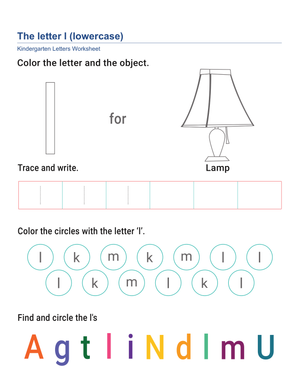
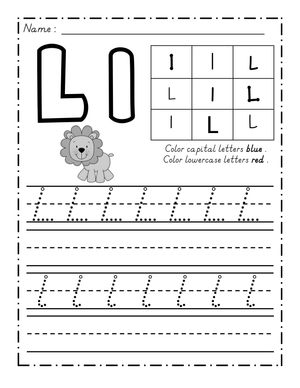
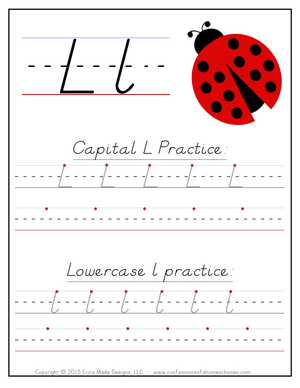
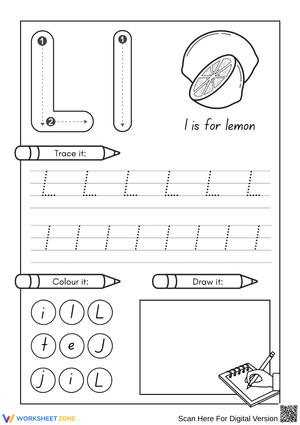
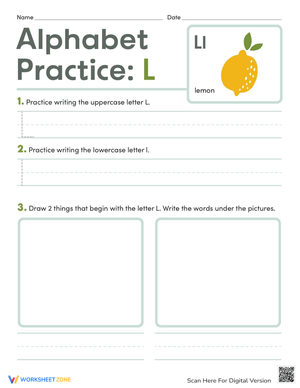
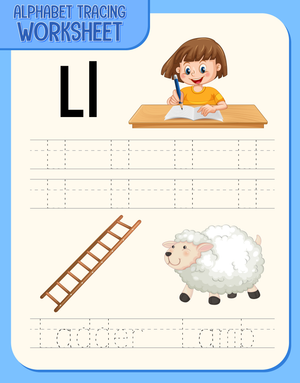
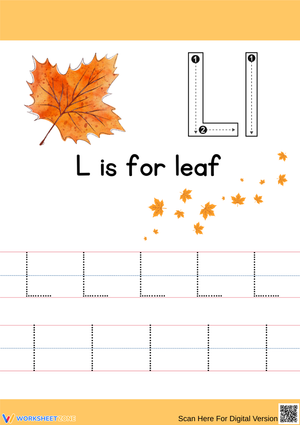
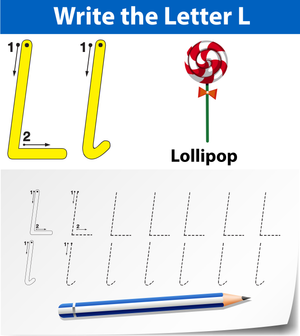
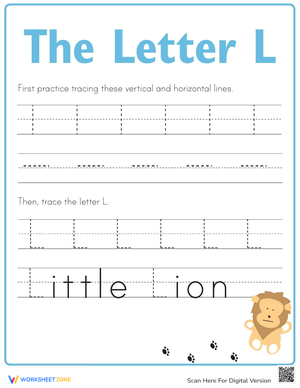
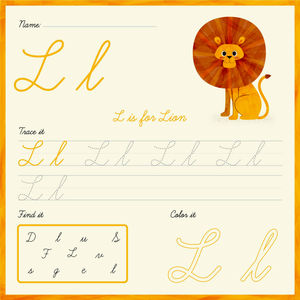
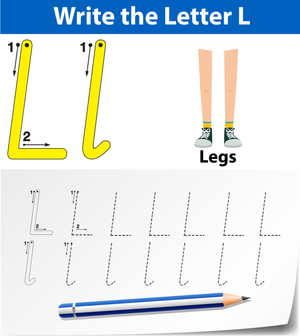
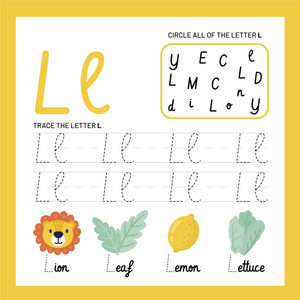
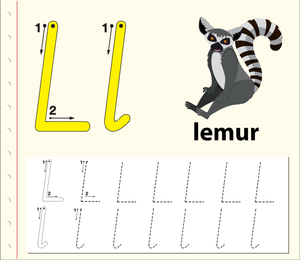
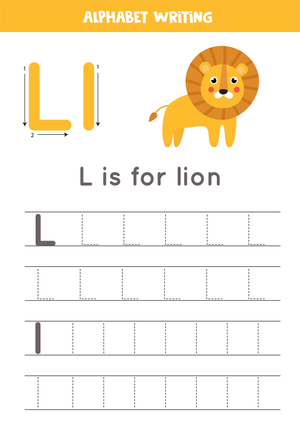
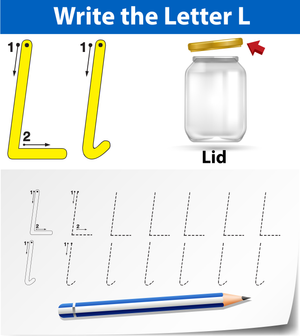
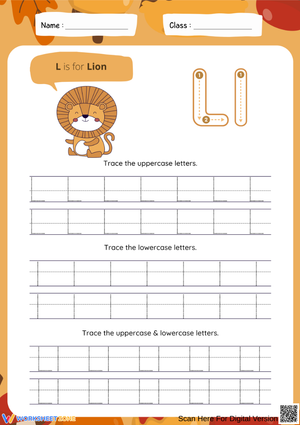
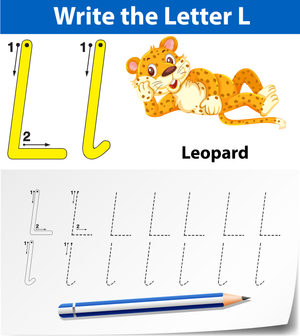
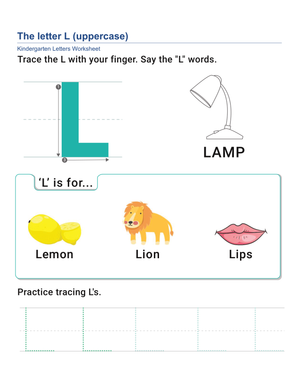
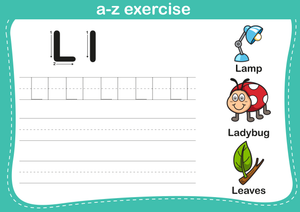
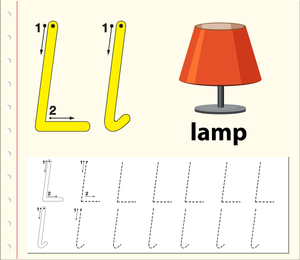
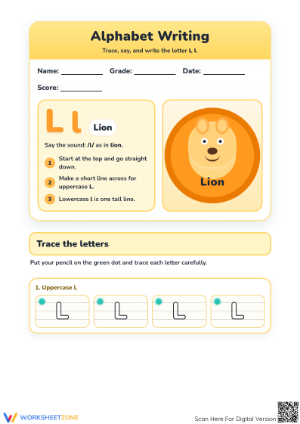
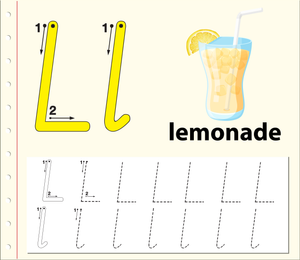
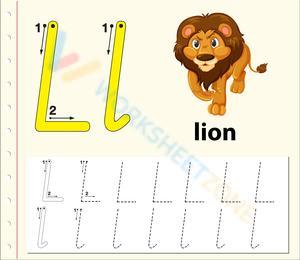
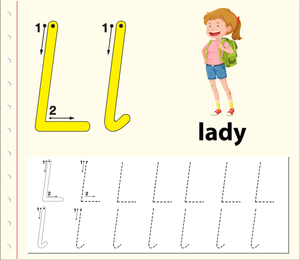
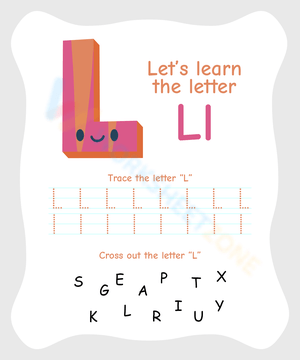
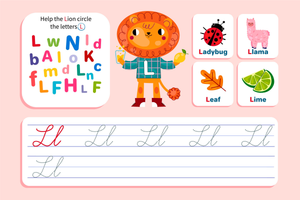
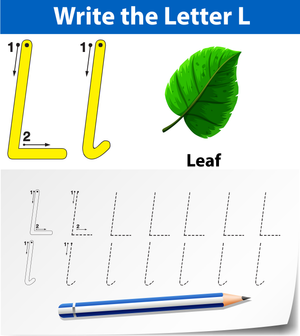
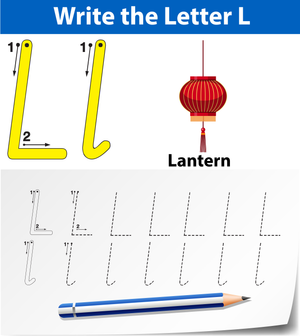
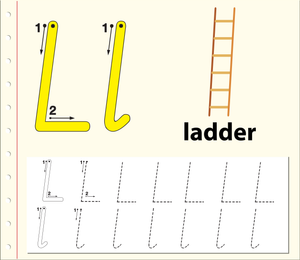
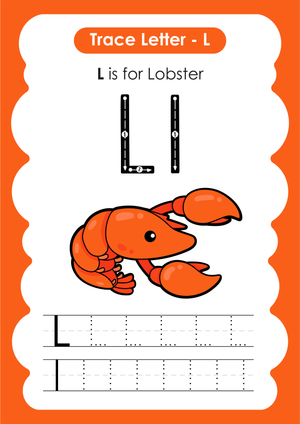
These letter l tracing handwriting worksheets for kindergarten give you both uppercase L and lowercase l in a repeatable, low-prep format that holds up whether you're running a whole-group phonics lesson or filling a literacy center bin on Monday morning. Each worksheet pairs tracing rows with picture-word anchors — lion, leaf, lamp — so the letter doesn't get practiced as an abstract shape divorced from phonics. The PDF format means class sets print consistently and slip into substitute folders or intervention binders without any reformatting on your end.
What Students Practice Across the Set
Uppercase L is two strokes: a vertical line pulled straight down, then a short horizontal line across the baseline. Lowercase l is a single tall stroke from the ascender line to the baseline — nothing more. Both letters have no curves, no directional reversals, no tricky transitions, which is exactly why L appears early in most Kindergarten handwriting sequences. The worksheets use that structural simplicity as a foundation for building reliable pencil habits, not an excuse for low expectations.
Each worksheet asks students to do four distinct things:
- Trace uppercase L from a model with a clearly marked starting point, repeated across several rows to build a consistent motor pattern.
- Trace lowercase l with specific attention to letter height — the stroke should reach the ascender line, not stop at the midline where short letters sit.
- Connect the letter to vocabulary by coloring or identifying picture cues, reinforcing the /l/ phoneme alongside the written form.
- Attempt independent writing at the end of each worksheet, giving teachers a direct look at whether tracing has transferred to self-directed formation.
Formation Errors That Surface Most During Letter L Practice
Lowercase l fools students in a specific way: because it's just one vertical stroke, they assume it behaves like a short letter. By October, when words like look and like start appearing on word walls, students write them with a lowercase l that reaches only to the midline — sitting at the same height as a or o. At a glance, it reads as a lowercase i, and in running writing it practically disappears. The problem isn't pencil control; it's that "tall" was never attached to this letter in students' understanding of it.
For uppercase L, the most common error is a rightward curve at the end of the horizontal stroke. Students have been trained on letters that lift and curve at the end, and that habit bleeds into L, turning it toward something closer to a J. Naming the distinction explicitly before tracing begins — "the line goes straight across and stops flat, it doesn't curl up" — reduces this error in most students. The worksheet model shows the correct form, but the verbal call-out before pencil touches paper is what actually prevents the error from compounding across the row.
Fitting These Worksheets Into the Week Without Extra Prep
The most direct sequence for introducing a new letter formation: model uppercase L and lowercase l on chart paper while students air-write alongside you, then distribute the worksheet for guided tracing, then circulate for 60 to 90 seconds before students attempt the independent writing section. Kindergartners can hold a new motor pattern actively for roughly that window, so moving quickly from tracing to observation catches grip errors and starting-point problems before they're reinforced across every row.
These letter l tracing handwriting worksheets for kindergarten also work well as independent literacy center tasks once the letter has been introduced in whole group. Set a worksheet beside a pencil and a small alphabet reference card, and most students can complete it without additional direction. For morning work, one worksheet on each desk during arrival gives students a purposeful task during that first 8 to 10 minutes when the room is still filling and whole-group instruction hasn't started — which is otherwise one of the harder transitions to manage in early fall.
One approach worth trying: print the same worksheet twice and use the first copy during explicit instruction, then place extras in a fast-finishers bin. Students who encounter the same layout later in the day complete it more fluently because the motor pattern was already introduced that morning. That second exposure functions as spaced retrieval rather than copying — the slight time gap makes it practice rather than mere repetition.
Differentiating Across Ability Levels in the Same Room
Handwriting readiness in Kindergarten spans a wider range than most academic subjects. Some students arrive having traced letters for months; others are still building the hand strength to hold a pencil past the first few minutes. These worksheets handle that range without requiring a different resource for every ability level.
- For students who need strong motor support: Pre-trace the letters in yellow highlighter before distributing the worksheet. Students follow the highlighted path, which gives them a thicker, higher-contrast guide than the printed lines alone.
- For students who fatigue quickly: Set an expectation of two or three rows rather than the full set. A few neat rows are more useful than a completed worksheet with declining quality across the bottom half.
- For students with limited exposure to English print: Name each picture cue aloud — lion, leaf, lamp — and have the student repeat the word before tracing begins. The goal is for the /l/ sound and the written letter to connect in working memory, not just for the hand to follow a line.
- For students ready to move beyond tracing: Use the independent writing section as the primary task and move past most of the tracing rows. A student who can write a clean uppercase L and lowercase l from memory needs open writing practice more than guided repetition.
Frequently Asked Questions
How many rows of tracing should a Kindergartner complete at one time?
Three to five rows tends to be the productive range. Students who push past that often show noticeably messier formation in the final rows, which means the last several repetitions are reinforcing a less accurate version of the letter. Revisiting the same letter across multiple days — rather than completing an exhausting run in one sitting — builds stronger retention with less fatigue.
What verbal cues work best for uppercase L and lowercase l?
For uppercase L, a short phrase like "down, across, stop" matches the two strokes and gives students something to say while they write. For lowercase l, "start at the top, pull straight down" keeps attention on the ascender-line height that students most often miss. Using the same language consistently — during air-writing, tracing, and independent practice — builds a motor-verbal connection that helps students self-correct without waiting for teacher feedback.
Are these worksheets useful for pull-out support, or only whole-class instruction?
Using letter l tracing handwriting worksheets for kindergarten in small-group or pull-out settings is often where they show the most value, because you can focus observation on one or two specific formation habits — starting point, letter height, pencil grip — without the noise of a full-class session. The clean, uncluttered layout means students with attention difficulties aren't distracted by competing visuals while you watch their pencil movement closely.
When should tracing give way to independent letter writing?
A practical readiness signal: a student who can trace an entire row cleanly and then write one independent letter that matches the model without repeatedly looking back at it is ready to spend more time on open writing than guided tracing. These letter l tracing handwriting worksheets for kindergarten include an independent writing section at the end of each worksheet specifically so teachers can use that space as a formative check — how a student approaches the empty line tells you more about readiness than the tracing rows alone.