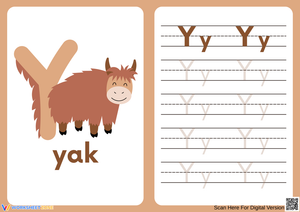
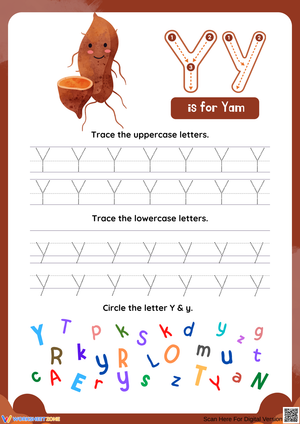
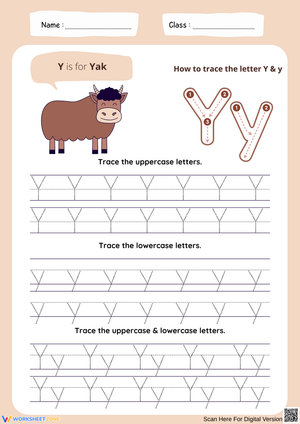
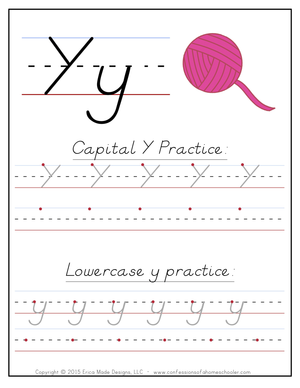
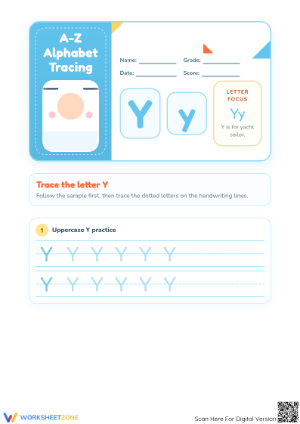
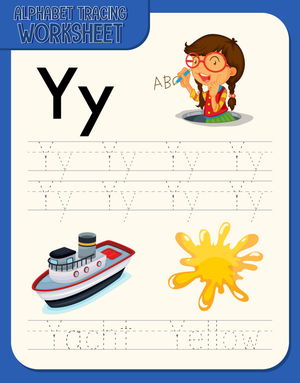
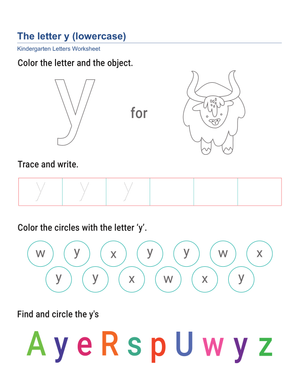
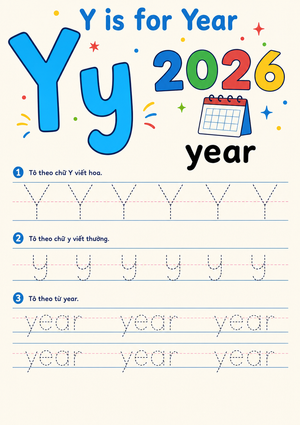
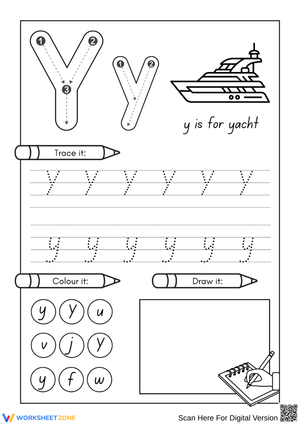
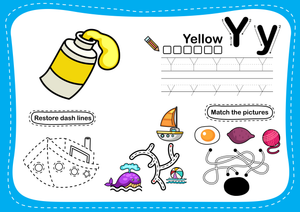
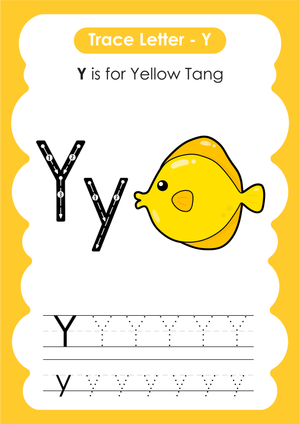
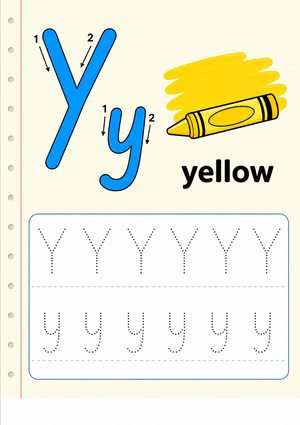
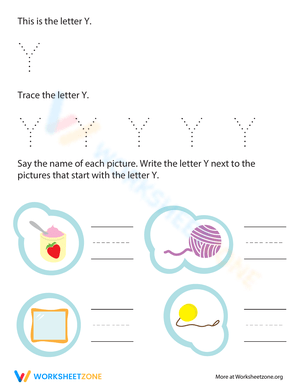
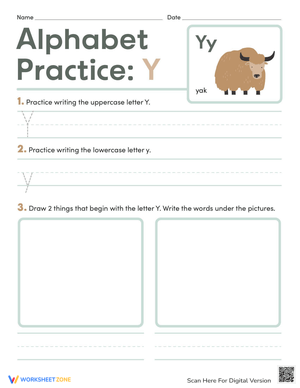
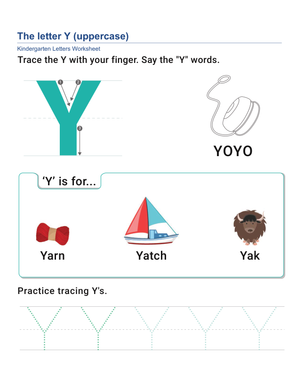
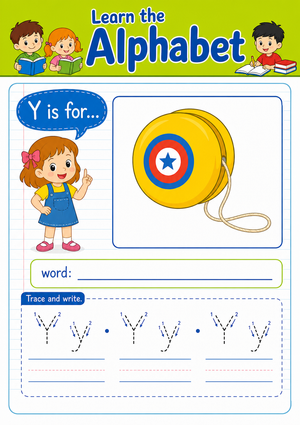
These kindergarten letter y tracing handwriting worksheets resources give teachers a focused, print-ready tool for one of the alphabet's more awkward letters to teach. Lowercase y's descender — the tail that drops below the baseline — catches kindergarteners off guard, and uppercase Y's three-stroke structure requires explicit modeling before students can reproduce it independently. Each worksheet targets both letter forms with guided tracing rows, independent writing space, and a picture cue tied to the /y/ sound.
Skills These Worksheets Build
Letter Y sits late in the alphabet sequence, and most kindergarten classrooms reach it after students have already developed some baseline pencil control. That timing matters. The skills practiced here sit at the intersection of motor development and letter knowledge — and Y pushes both.
- Uppercase Y formation: Students trace the two diagonal strokes that converge at a center point, then pull a vertical stroke straight down. The three-part sequence is harder than it looks for children still building directional control.
- Lowercase y formation: Students practice both downward strokes, with deliberate attention to the second stroke extending below the baseline — where most errors appear.
- Faded-model tracing: Dotted or faded letter guides give students a visible path before they attempt independent writing.
- Independent writing rows: After tracing with support, students copy the letter without a model — a step toward automatic, consistent letter production.
- Beginning sound connection: A picture cue such as yarn, yak, or yo-yo anchors the handwriting practice to concurrent phonics instruction.
Common Mistakes Students Make That These Worksheets Help You Catch
The most consistent error with lowercase y is treating it like a u. Students draw a rounded bottom and bring the pencil back up, ending at the baseline — no descender at all. At a glance, the result reads as a u or a v. This happens because nearly every letter kindergarteners practice before Y lives on or above the baseline. Lowercase y, along with g and p, is among the first to break that pattern, and students need that made explicit rather than discovered through repeated incorrect attempts.
Uppercase Y produces a different problem. Students frequently draw a V shape, then add a vertical line dropping from the bottom point of the V — rather than starting that vertical stroke at the center where the two diagonals meet. The resulting letter looks close to correct but starts from the wrong anchor point. Teachers who circulate during center work catch this in the tracing stage, before the incorrect habit moves into independent writing. That is the clearest argument for using these worksheets in small-group settings rather than as purely independent work.
Where These Worksheets Fit Into a Kindergarten Week
The most efficient routine is a brief warm-up at the start of literacy block — not a separate handwriting period. Five minutes of focused letter tracing before shared reading or word work keeps motor practice short and frequent. Frequency beats duration in kindergarten handwriting development; three brief sessions across a week produce better results than one extended one.
The PDF format of these kindergarten letter y tracing handwriting worksheets resources makes classroom logistics simple. Print a class set, keep a small stack for absent students, and send identical copies home without reformatting anything. That consistency across settings — classroom, center, take-home folder — reinforces the same stroke sequence every time a student picks up a pencil.
- Morning arrival: Place a worksheet on each desk before the bell. Students arriving early get a quiet, purposeful task without waiting for whole-group instruction to begin.
- Literacy centers: Set out pencils and dot markers together. Students trace in pencil and then outline in dots, adding a tactile layer to the same letter practice without changing the academic target.
- Small-group reteaching: Four to six students at a table with the teacher present is where these worksheets do their most targeted work — grip, starting point, and stroke direction can all be corrected in real time before incorrect habits take hold.
- Take-home folders: The picture cue gives families a natural prompt to practice the /y/ sound alongside the handwriting, which connects home practice to what students are doing in phonics instruction.
A practical three-day approach: pencil tracing with teacher modeling on day one, rainbow tracing with crayons on day two, and independent writing rows on day three. One print run covers three sessions, and the variation in tool holds attention without changing the academic focus.
Adjusting These Worksheets for a Range of Learners
For students still developing fine motor control, the tracing rows are the whole task. Have them finger-trace the letter directly on the worksheet before picking up a pencil. Pairing finger tracing with a verbal cue — "down and in, down below the line" — gives them a motor sequence to internalize before grip and pencil pressure enter the picture. Air tracing works too and removes both grip demand and the visual distraction of holding a tool.
Students who trace accurately and write independently are ready to extend beyond the tracing rows. Ask them to write a word beginning with Y next to the picture cue, or sketch a second Y-word object in any open space on the worksheet. Neither extension requires additional materials, and both keep the letter knowledge active rather than mechanical. For the highest-readiness students, each worksheet functions as a brief accuracy check before moving to sentence-level or word-level writing tasks.
These kindergarten letter y tracing handwriting worksheets resources also serve well in intervention settings. A student who has mastered most of the alphabet but still misforms Y can use the guided tracing rows as corrective practice rather than new instruction. The uncluttered layout makes reteaching easier because there is nothing pulling attention away from the letter itself — no decorative borders, no multi-step directions competing with the writing task.
Standard Alignment
These worksheets connect directly to CCSS.ELA-LITERACY.L.K.1.A: "Print many upper- and lowercase letters." The standard positions handwriting as a language foundational skill, not a separate subject — which is why pairing letter tracing with phonics instruction (the /y/ sound, the letter name) reflects the standard's intent rather than treating printing as rote repetition. The picture cues also support CCSS.ELA-LITERACY.RF.K.1.D: "Recognize and name all upper- and lowercase letters of the alphabet," since accurate formation and visual recognition reinforce each other at this stage. Accurate letter formation, once automatic, frees up cognitive attention for the composing demands that arrive in first grade.
Frequently Asked Questions
Why does lowercase y trip up kindergarteners more than most other letters?
The descender is the primary issue. Most letters students practice through the first half of the year sit on or above the baseline. Lowercase y, along with g and p, breaks that pattern by dipping below it — and that spatial shift is genuinely unfamiliar. Students need clear, repeated instruction on where the baseline sits and exactly how far below it the y tail extends. Showing two completed letters side by side — one that stops at the baseline, one that drops below — makes the distinction concrete in a way that verbal explanation alone does not.
Should teachers introduce stroke direction before handing out the worksheet?
Yes. Even a one-minute demonstration at the board — naming the starting point, narrating the stroke sequence aloud — improves what students do during tracing. Students who pick up the pencil without any modeling tend to start from the bottom and work upward, or combine strokes in ways that look roughly correct briefly but become harder to undo later. The tracing rows work best as guided practice following teacher demonstration, not as cold independent work with no prior instruction.
How do these worksheets hold up for students who are already writing most letters fluently?
For fluent writers, each worksheet functions as a quick accuracy check rather than initial instruction. A student who writes quickly may still form Y incorrectly out of habit — the tracing rows slow that student down enough to notice stroke direction. The independent writing rows also give teachers a clean artifact to compare against a student's typical handwriting, which sometimes reveals inconsistencies that get lost when students are writing full sentences or longer responses.
What part of the school year do these worksheets fit best?
These kindergarten letter y tracing handwriting worksheets resources fit naturally in the second half of the year, when students have enough pencil control to benefit from focused letter practice. Most classrooms move through the alphabet roughly in sequence, placing Y in the third quarter or later. At the very start of kindergarten, pre-writing pattern work — horizontal lines, vertical lines, circles, diagonal strokes — builds the motor foundation that makes letter-specific tracing productive once students reach it.