




























Views
Downloads
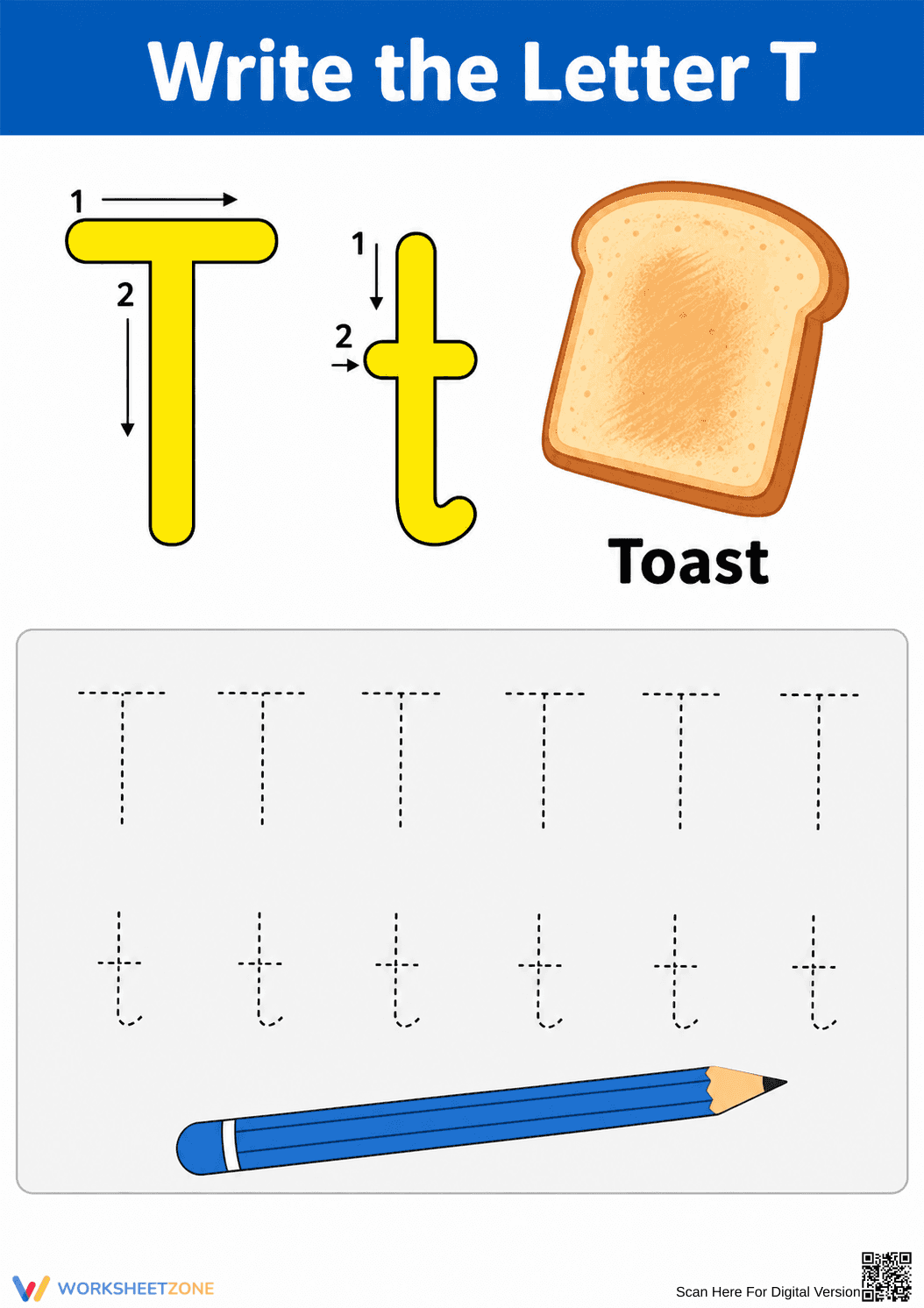

Letter T Tracing Printable Worksheet | Grade K ELA

Paste this activity's link or code into your existing LMS (Google Classroom, Canvas, Teams, Schoology, Moodle, etc.).
Students can open and work on the activity right away, with no student login required.
You'll still be able to track student progress and results from your teacher account.
This single-page handwriting and phonics worksheet helps early learners master the formation of the uppercase and lowercase letter T. By combining guided tracing paths with a familiar beginning sound vocabulary word, students build essential fine motor skills and letter-sound correspondence required for foundational reading success.
At a Glance
- Grade: K · Subject: ELA
- Standard:
CCSS.ELA-LITERACY.L.K.1.A— Print many upper- and lowercase letters- Skill Focus: Letter Formation and Beginning Sounds
- Format: 1 page · 12 problems · Answer key included · PDF
- Best For: Morning work or literacy centers
- Time: 5–10 minutes
This resource features a clear, distraction-free layout designed specifically for early childhood education. The top section provides a large, numbered directional guide for both the uppercase "T" and lowercase "t", alongside an illustrated vocabulary word ("Toast") to reinforce the beginning sound. The bottom section includes twelve dotted tracing tasks—six uppercase and six lowercase—giving students ample repetition to practice proper stroke order and pencil control.
Zero-Prep Workflow
This worksheet requires under two minutes of teacher preparation.
- Print (1 minute): The PDF prints clearly, making it easy to run off a class set quickly.
- Distribute (1 minute): Hand out the single page during morning routines or center transitions. The visual instructions mean non-readers can begin immediately.
- Review (Ongoing): Monitor students as they trace, providing immediate corrective feedback on pencil grip and stroke direction.
Requiring no complex setup, this page is highly suitable for emergency sub plans.
Standards Alignment
This worksheet is directly aligned to CCSS.ELA-LITERACY.L.K.1.A, which requires students to print many upper- and lowercase letters. It also supports foundational phonics skills by associating the letter with its primary sound, as seen in the vocabulary example. Both standard codes can be copied directly into lesson plans, IEP goals, or district curriculum mapping tools.
How to Use It
Deploy this worksheet during morning work or place it in a literacy center for independent practice. As a formative assessment observation tip, watch the starting point of each student's pencil stroke; ensure they are pulling down from the top line rather than pushing up from the bottom. Expected completion time ranges from five to ten minutes, depending on the student's fine motor development.
Who It's For
This resource is primarily designed for Kindergarten students, though it serves as an excellent intervention tool for first or second graders struggling with handwriting legibility. For differentiation, provide students with textured surfaces under the paper to increase tactile feedback, or have them trace the letters with highlighters before using a pencil. Pair this worksheet with a tactile alphabet anchor chart or a whole-group phonics lesson focusing on the /t/ sound.
Mastering letter formation through explicit, guided practice is a critical component of early literacy instruction. According to a 2024 report by EdReports, systematic handwriting instruction that pairs motor execution with phoneme-grapheme mapping significantly improves both spelling and reading fluency in early elementary grades. This resource directly targets CCSS.ELA-LITERACY.L.K.1.A, ensuring students can print many upper- and lowercase letters accurately and efficiently. By providing numbered directional arrows and dotted tracing lines, the worksheet reduces cognitive load, allowing young learners to focus entirely on motor control and proper stroke sequence. Integrating the beginning sound visual further anchors the letter's identity in the student's memory, bridging the gap between physical writing and early reading comprehension. This evidence-based approach ensures foundational skills are solidified early, setting the stage for more complex writing tasks as students progress through the primary grades.


