




























Views
Downloads
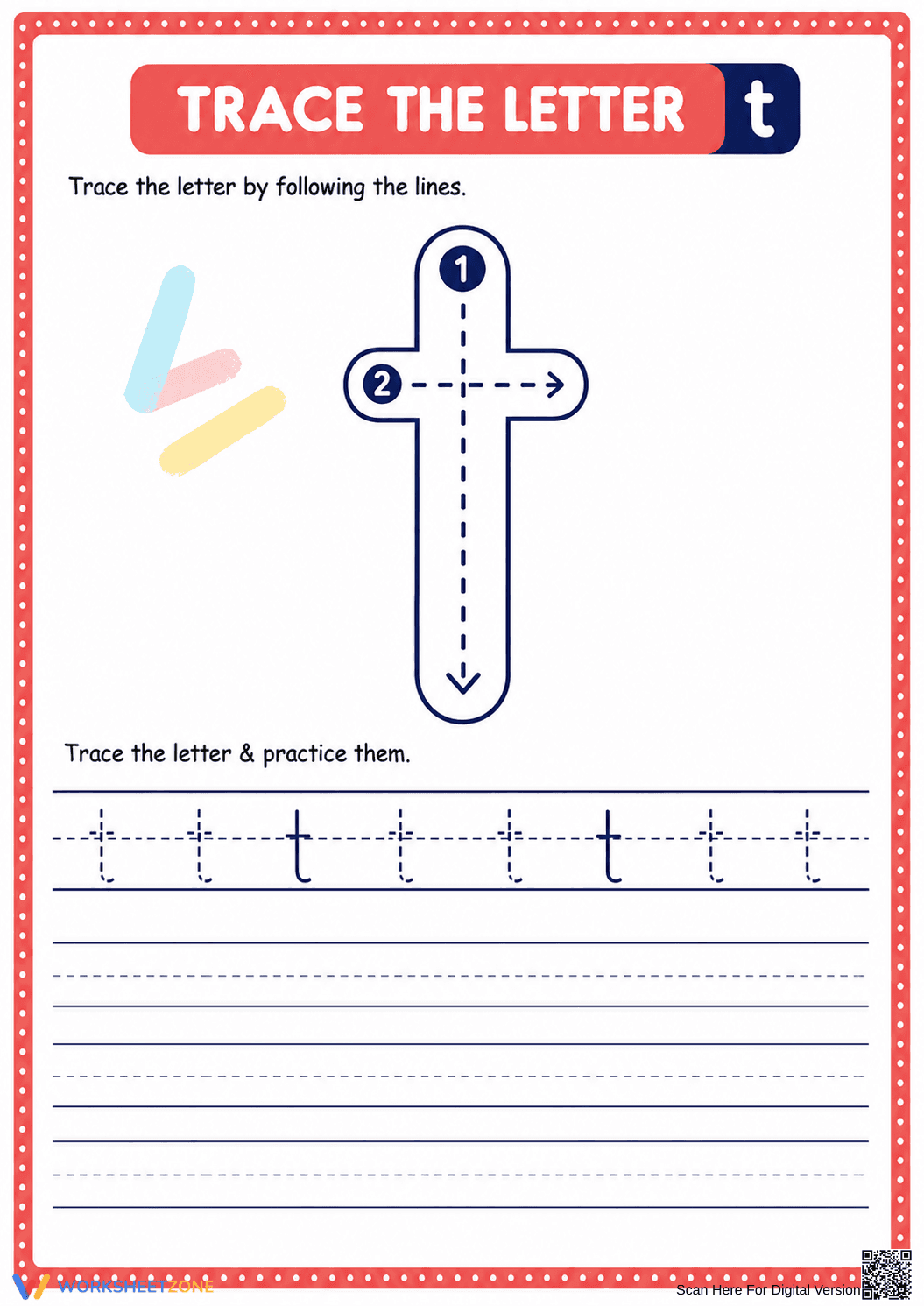

Printable Letter T Tracing Worksheet | Kindergarten ELA

Paste this activity's link or code into your existing LMS (Google Classroom, Canvas, Teams, Schoology, Moodle, etc.).
Students can open and work on the activity right away, with no student login required.
You'll still be able to track student progress and results from your teacher account.
This foundational handwriting worksheet helps early learners master the formation of the lowercase letter t. By providing clear directional arrows and structured practice lines, students develop the fine motor skills necessary for fluent writing. The straightforward layout ensures young writers can focus entirely on proper letter construction and pencil control.
At a Glance
- Grade: Kindergarten · Subject: ELA
- Standard:
CCSS.ELA-LITERACY.L.K.1.A— Print many upper- and lowercase letters- Skill Focus: Letter t formation and tracing
- Format: 1 page · 8 tracing problems · No answer key · PDF
- Best For: Independent handwriting practice
- Time: 10–15 minutes
This single-page resource features a large, guided model of the lowercase letter t with numbered directional arrows to establish correct stroke order. Below the model, students find one line containing eight dashed letters for guided tracing practice. The bottom half of the page provides four blank primary-ruled lines, allowing students to transition from tracing to independent letter formation. The clean, distraction-free design supports focused skill building.
Zero-Prep Workflow
- Print (1 minute): Download the PDF and print copies for your entire class or a specific small group.
- Distribute (1 minute): Hand out the worksheets along with pencils or crayons. The visual instructions are self-explanatory for early readers.
- Review (1 minute): Quickly check student work to ensure they are following the directional arrows and staying within the primary lines.
With under two minutes of total teacher prep time, this resource is highly suitable for morning work, literacy centers, or emergency sub plans.
This worksheet aligns directly with CCSS.ELA-LITERACY.L.K.1.A: Print many upper- and lowercase letters. It specifically targets the motor memory and stroke sequence required for the lowercase t. Both standard codes can be copied directly into lesson plans, IEP goals, or district curriculum mapping tools.
Teachers can utilize this worksheet during morning work routines to reinforce letter of the week instruction. It also serves as an effective literacy center activity where students can practice independently after direct instruction on letter formation. While students work, observe their pencil grip and starting points to ensure they begin the vertical stroke at the top line before crossing the middle. Expected completion time ranges from 10 to 15 minutes depending on the student's fine motor development.
This resource is designed for Kindergarten students, though it provides excellent remediation for first-grade students who struggle with letter reversals or improper stroke order. Occupational therapists can also use this structured format for students requiring targeted fine motor interventions. Pair this tracing sheet with a tactile activity, such as forming the letter t with playdough or tracing it in a sand tray, to solidify the motor pathway.
Developing automaticity in handwriting is a critical precursor to expressive writing and reading fluency. This worksheet targets CCSS.ELA-LITERACY.L.K.1.A, helping students print many upper- and lowercase letters with accuracy. According to Fisher & Frey (2014), providing explicit instruction and structured, repetitive practice in foundational skills reduces cognitive load, allowing students to eventually focus on higher-order tasks like composition and comprehension. By guiding students through the specific stroke sequence of the lowercase t, this resource builds the essential motor memory required for efficient writing. The gradual release from tracing a large model to independent production on blank lines ensures that students internalize the correct formation. Consistent practice with targeted materials like this supports long-term literacy development and prevents the formation of incorrect handwriting habits that can impede future academic success.


