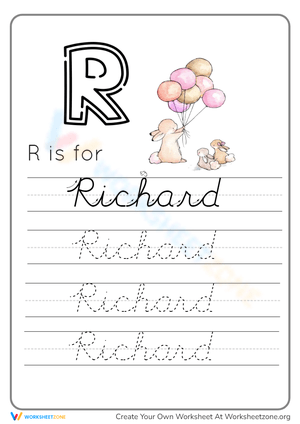
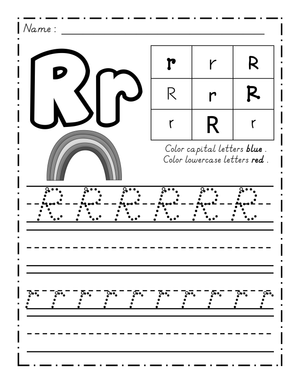
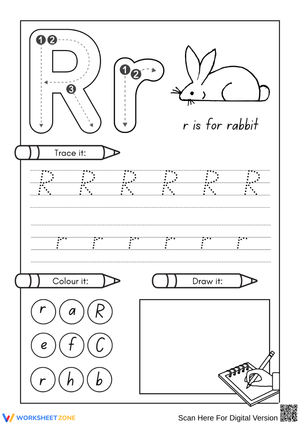
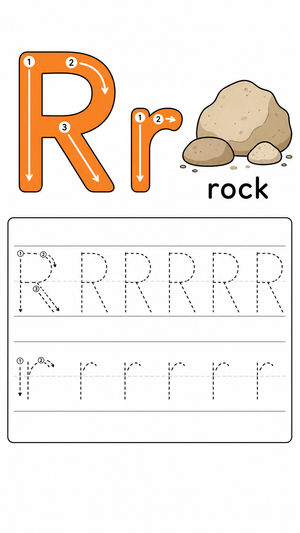
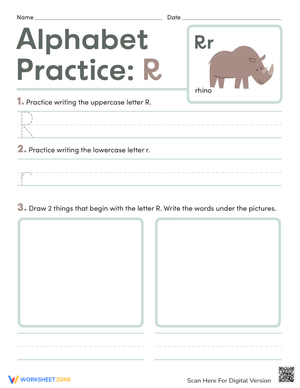
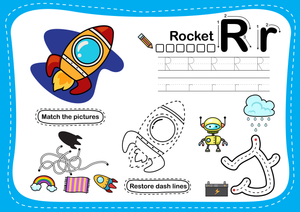
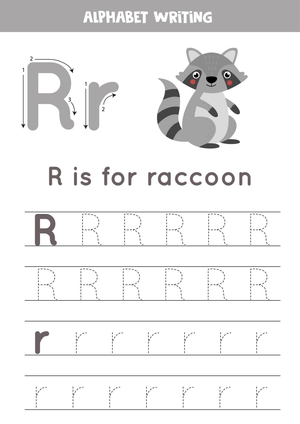
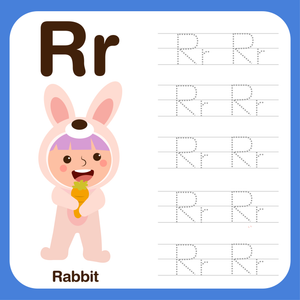
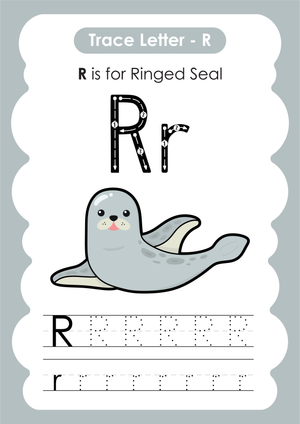
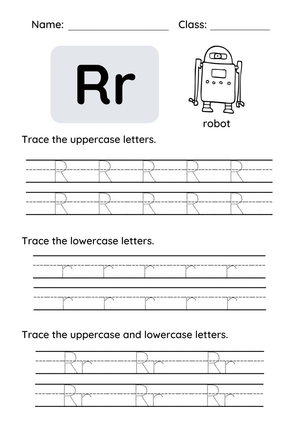
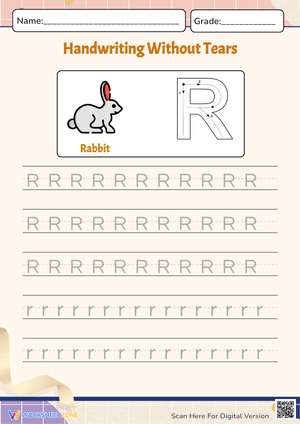
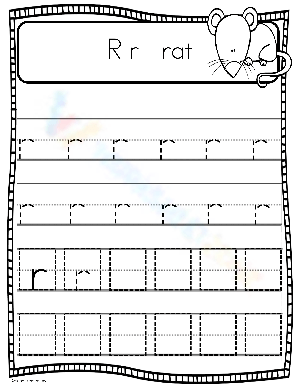
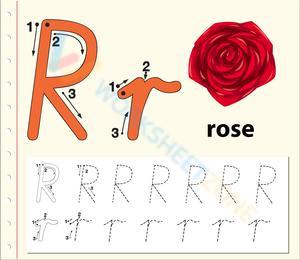
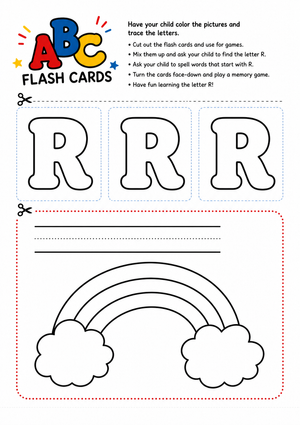
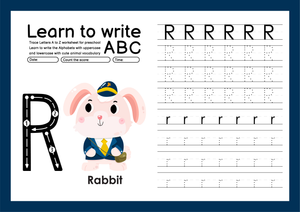
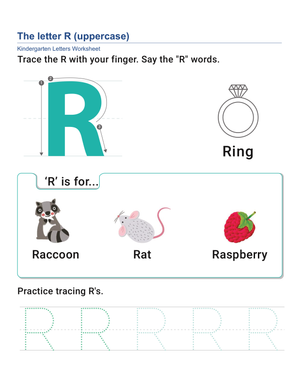
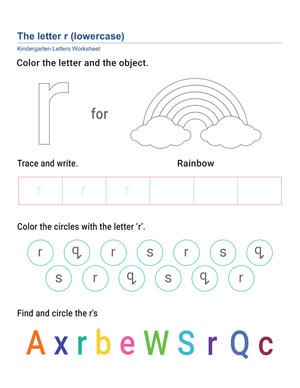
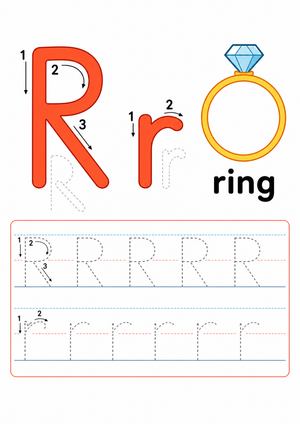
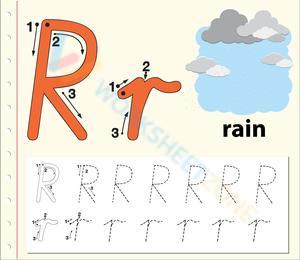
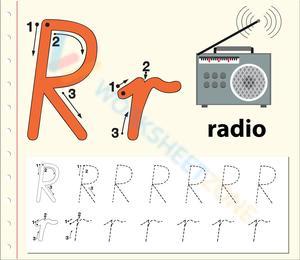
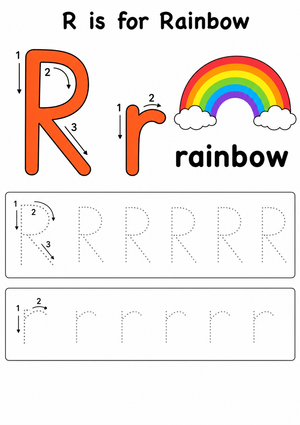
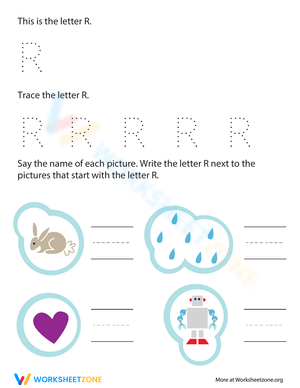
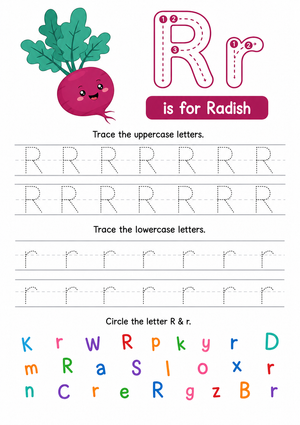
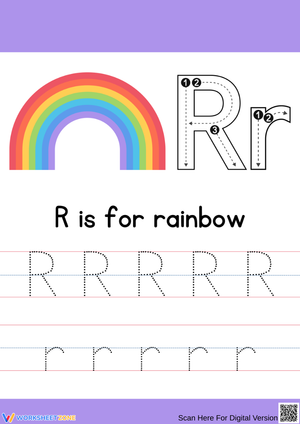
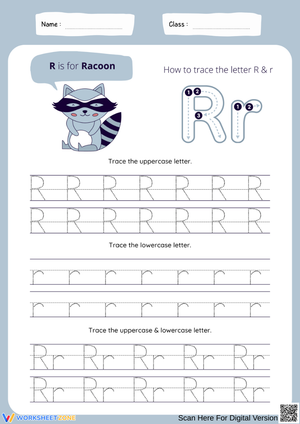
These letter r tracing handwriting printable worksheets for kindergarten give teachers a focused, low-prep entry point for the stretch of instruction when students are learning to form letters for the first time — a stage where clear models and guided stroke practice matter more than variety or novelty. Each worksheet shows uppercase R and lowercase r with starting points marked, guided tracing rows, and a final line for independent writing.
What Students Practice Across the Set
The core task is stroke-by-stroke tracing of both letter cases. Uppercase R gets the most attention at this level because the formation is genuinely complex — students must execute three distinct movements (downstroke, bump, diagonal leg) in sequence. Lowercase r is shorter but comes with its own confusion: many children overshoot the small bump at the top and produce something that looks closer to an n than an r.
Beyond tracing, each worksheet connects the letter to its sound through picture cues. Familiar /r/ images — rabbit, rocket, rainbow — give students something to name aloud before and after they write. That naming step is not decorative. When a child says "rocket" and immediately writes r, they are rehearsing the letter-sound pairing that early phonics instruction depends on.
- Uppercase R formation: Three-stroke sequence with directional arrows at the starting point
- Lowercase r formation: Two-movement sequence — downstroke followed by a small rightward bump
- Guided tracing rows: Multiple lines with dotted or dashed letter outlines and enough space for comfortable pencil movement
- Independent writing row: A final line with no outline — students write from recall
- Beginning sound recognition: /r/ picture cues that tie letter knowledge to spoken language
Frequent Student Errors Worth Watching For
The leg on uppercase R disappears more often than you might expect. A child who traces the first part carefully — downstroke, then curve — will sometimes stop there and turn in something that looks like a P. They've formed a complete-looking letter and don't realize anything is missing. The independent writing row at the bottom of each worksheet reveals this immediately: without the tracing outline to follow, the leg is either there or it isn't.
Lowercase r causes a different problem. The bump is small and requires the pencil to reverse slightly upward before curving right. Students who haven't internalized that reversal tend to extend the curve too far. Watching students trace in real time — rather than just collecting finished worksheets — is the fastest way to catch this before it calcifies into a habit. If the pencil moves too far right, the verbal cue helps: "go up just a little, then make a tiny shelf." That image lands better for most five-year-olds than directional language alone.
Building These Worksheets Into Your Literacy Routine
The most natural slot is the handwriting block that follows phonics or morning meeting, when the letter of the week is already in the room. Students who have just heard /r/ words during a read-aloud are primed to connect that sound to its written form. Tracing immediately after oral phonics work lets the two skills reinforce each other instead of sitting in separate mental compartments.
For morning tubs, slip each worksheet into a dry-erase pocket sleeve before the day starts. Students who arrive early trace with a marker, wipe it clean, then complete the paper copy during the handwriting block proper. That double pass — marker first, pencil second — gives hesitant writers an extra rehearsal without any extra prep on your end. It also reduces the number of students who freeze when they pick up a pencil for the first time on a new letter.
Small-group intervention time is another strong fit. When three or four students are still forming R incorrectly after whole-class instruction, a table with a single worksheet gives you the chance to model the stroke sequence up close, narrate each movement, and watch each child's pencil before they reach the independent row. That in-the-moment feedback does more in eight minutes than another whole-class lesson would.
Standard Alignment
These worksheets address CCSS.ELA-LITERACY.L.K.1.A, which calls for kindergartners to print many upper- and lowercase letters. Within the classroom year, letter R typically lands mid-year in most scope-and-sequence plans — after students have worked through simpler stroke sequences like I, T, L, and H. By mid-year, students have enough pencil control to handle R's three-part uppercase formation without it feeling out of reach. The standard doesn't specify order, but most teachers find R fits best once the straight-line letters are reasonably secure.
Adapting the Set for Different Writers in the Room
Students who are still building finger strength benefit from tracing the large model letter with a finger before they pick up a pencil. Air-writing the stroke sequence — starting at the top, pulling down, returning for the bump and leg — gives motor memory a running start. Some teachers offer a chunky crayon or golf pencil for students who struggle with a standard grip; the thicker barrel reduces the precision demand so children can focus on the shape rather than just holding the tool.
For students who have already internalized both cases and find standard tracing unchallenging, the independent writing row becomes the starting point rather than the finish line. Give those students a blank space at the top and ask them to write the letter from memory before looking at the model, then compare their version to the worksheet's example and name one thing that matches and one thing to adjust. That self-assessment habit pushes letter knowledge into a more deliberate, transferable form — and it takes thirty seconds.
English language learners sometimes need a moment with the picture cues before the handwriting task begins. A quick check — "What is this? What sound does it start with?" — confirms they have the oral vocabulary attached to the /r/ images, so the letter-sound pairing connects to language they already know rather than just to a symbol on a page.
Frequently Asked Questions
How many times should a kindergartner trace before writing independently?
Three to five guided traces are usually enough for one session. Beyond that, students tend to go through the motions without attending to the shape. A second short session the next day — spaced practice rather than extended repetition in one sitting — produces more durable letter memory than a longer single block ever does.
Can these worksheets function as a formative check?
The independent writing row at the bottom of each worksheet works well for quick formative information. After a student completes the full tracing sequence, their writing on that final row shows whether they can reproduce the letter without a model. It won't replace a formal assessment, but it tells you in thirty seconds who has internalized the formation and who still needs more guided practice.
Should uppercase R come before lowercase r in instruction?
Most teachers introduce uppercase first because it appears at the start of sentences and in students' names — contexts where children encounter it every day. Introducing both cases together on the same worksheet lets students see the visual relationship from the start, though if a child is confused by seeing both at once, a day or two with uppercase only before adding lowercase r usually resolves it.
Are these worksheets appropriate for pre-K or first grade?
Pre-K students with strong fine-motor development can work through the guided tracing rows with support, though the independent writing row may be premature. First graders who are behind on letter formation — especially students still missing the uppercase R leg or producing a malformed lowercase r — use letter r tracing handwriting printable worksheets for kindergarten as targeted catch-up practice with no modification needed.
How should these worksheets be sent home for family practice?
Include a brief note with the same directional language used in class — "start at the top, pull down, go back up and make the bump, then the slanting leg" — so families reinforce the same stroke sequence rather than introducing a different one. When the verbal cues match between home and school, children build the formation habit faster because the language anchors the movement the same way every time. That consistency is where letter r tracing handwriting printable worksheets for kindergarten pay off beyond the classroom.