


























Views
Downloads
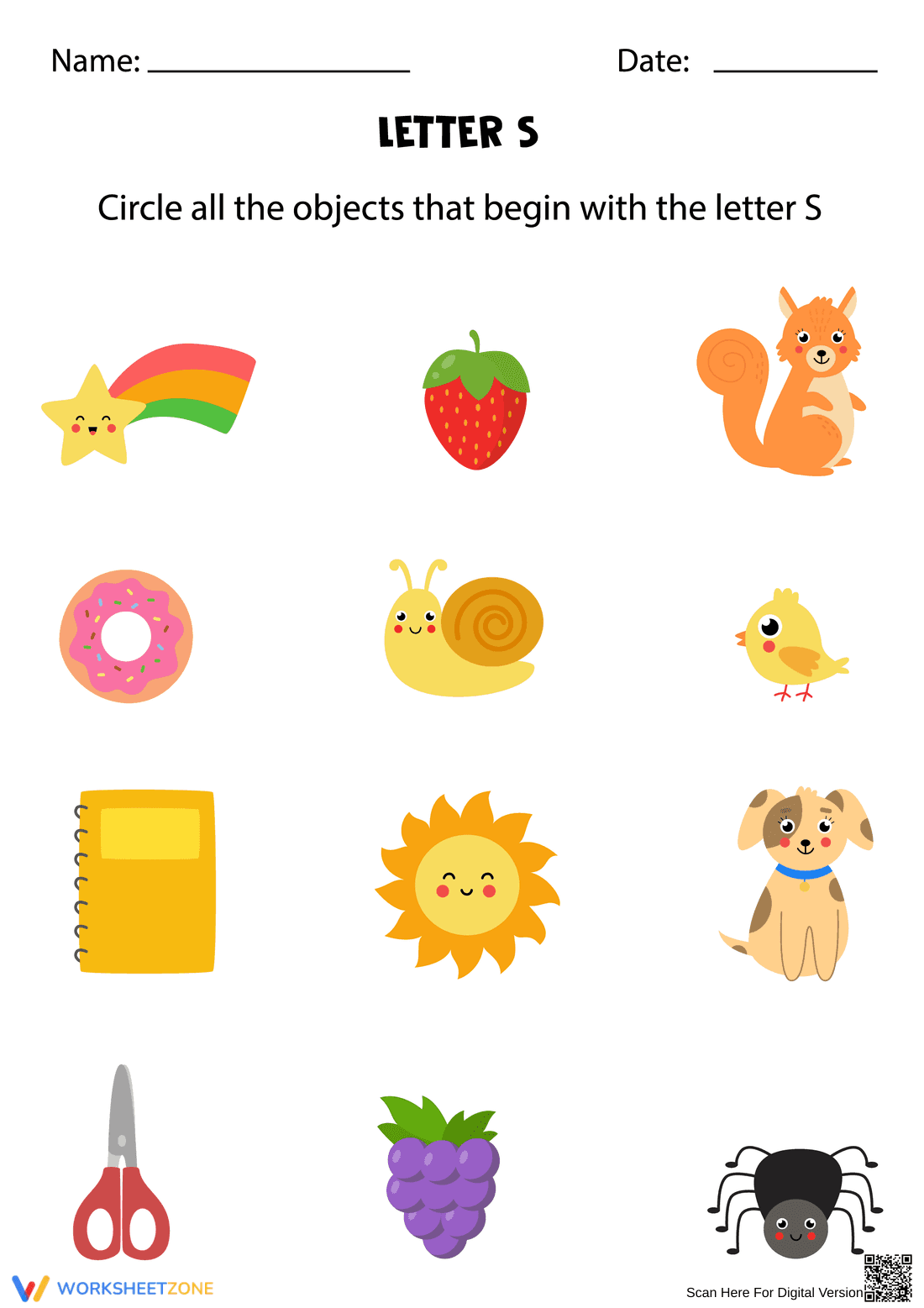

Letter S Beginning Sounds Printable Worksheet
Paste this activity's link or code into your existing LMS (Google Classroom, Canvas, Teams, Schoology, Moodle, etc.).
Students can open and work on the activity right away, with no student login required.
You'll still be able to track student progress and results from your teacher account.
This foundational phonics worksheet helps early learners master letter-sound correspondence by identifying objects that begin with the letter S. Students evaluate twelve colorful images and circle the correct items, building critical phonemic awareness and visual discrimination skills necessary for reading readiness.
At a Glance
- Grade: Kindergarten · Subject: ELA
- Standard:
CCSS.ELA-LITERACY.RF.K.3.A— Identify primary sounds for consonants- Skill Focus: Beginning Sounds (Letter S)
- Format: 1 page · 12 problems · No answer key · PDF
- Best For: Independent practice
- Time: 10–15 minutes
This single-page resource features twelve distinct, easily recognizable illustrations, including a strawberry, squirrel, snail, sun, and spider. Students are tasked with naming each picture aloud and determining if the initial phoneme matches the /s/ sound. The clean layout minimizes visual clutter, allowing young learners to focus entirely on the phonics task without distraction.
Designed for immediate classroom implementation, this resource requires minimal teacher preparation:
- Print (1 minute): Generate enough copies for the class or small group directly from the PDF file.
- Distribute (1 minute): Hand out the sheets along with crayons or markers for circling.
- Review (3 minutes): Quickly go over the correct answers as a group, having students chorally chant the /s/ words.
Total teacher prep time is under two minutes, making this an excellent option for emergency sub plans or spontaneous phonics review.
This activity is directly aligned to CCSS.ELA-LITERACY.RF.K.3.A, requiring students to demonstrate basic knowledge of one-to-one letter-sound correspondences by producing the primary sound for consonants. It also supports early vocabulary development as students name the various objects pictured. Both standard codes can be copied directly into lesson plans, IEP goals, or district curriculum mapping tools.
Teachers can utilize this worksheet during morning work to activate prior knowledge before a formal phonics lesson. Alternatively, it serves as an effective literacy center activity where students can work independently or with a peer. As a formative assessment tip, listen to students as they name the pictures aloud; note whether they are accurately producing the /s/ sound or confusing it with similar fricatives. Expected completion time ranges from ten to fifteen minutes.
This printable is ideal for Preschool, Kindergarten, and first-grade students who are currently mastering the alphabet and initial phonemes. For students needing extra support, teachers can pre-teach the vocabulary by naming all twelve images together before independent work begins. This worksheet pairs perfectly with a tactile letter S anchor chart or a direct instruction lesson on consonant sounds.
Developing strong phonemic awareness, specifically the ability to isolate and identify initial phonemes, is a critical predictor of future reading success in early education. According to Fisher & Frey (2014), explicit instruction in letter-sound correspondence, combined with targeted independent practice, significantly improves early decoding skills and overall literacy outcomes. This resource directly targets CCSS.ELA-LITERACY.RF.K.3.A by having students identify primary sounds for consonants through visual and auditory association. By evaluating twelve distinct images and isolating the beginning sound of each spoken word, learners strengthen the neural pathways required for fluent reading and writing. Regular engagement with focused phonics tasks ensures that students build the automaticity necessary to transition from recognizing individual letters to blending sounds into complete words. This foundational practice provides educators with a highly reliable, evidence-based tool to reinforce core literacy concepts in early childhood classrooms.


