


























Views
Downloads

Missing Letter Printable | Preschool Phonics Worksheet
Paste this activity's link or code into your existing LMS (Google Classroom, Canvas, Teams, Schoology, Moodle, etc.).
Students can open and work on the activity right away, with no student login required.
You'll still be able to track student progress and results from your teacher account.
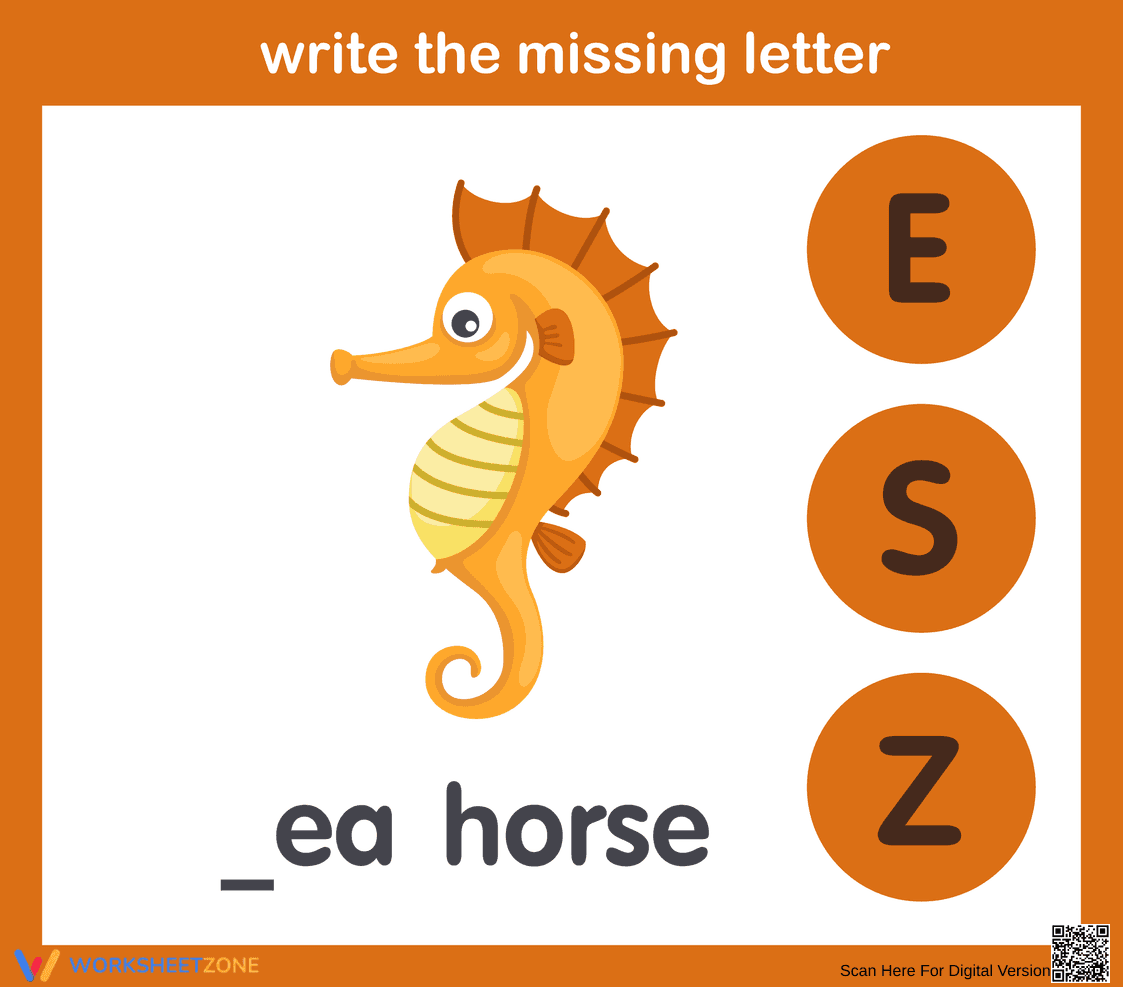
This Preschool beginning sounds worksheet requires students to identify the missing initial letter for a familiar word. By matching the correct consonant to the picture of a seahorse, early learners practice one-to-one letter-sound correspondence. This targeted activity builds foundational phonics skills essential for early reading success.
At a Glance
- Grade: Preschool · Subject: ELA
- Standard:
CCSS.ELA-LITERACY.RF.K.3.A— Match letters to their primary consonant sounds- Skill Focus: Beginning sounds
- Format: 1 page · 1 problem · No answer key · PDF
- Best For: Morning work or centers
- Time: 5–10 minutes
This single-page resource features a vibrant illustration of a seahorse alongside a partial word with a missing initial letter. Students are presented with three distinct letter choices in large, easy-to-read circles. The visual layout minimizes distractions, focusing the child's attention entirely on isolating the beginning sound and selecting the matching grapheme.
Zero-Prep Workflow
- Print (1 minute): Simply download the PDF and print the page. The bold colors and clear text render beautifully on standard classroom printers.
- Distribute (1 minute): Hand out the sheet during morning arrival or place it at a literacy center with a crayon or marker.
- Review (1 minute): Quickly check the student's selected letter. The single-problem format allows for immediate feedback.
Total teacher preparation requires under two minutes, making this an ideal addition to emergency sub plans or spontaneous phonics review sessions.
This activity aligns with CCSS.ELA-LITERACY.RF.K.3.A: Demonstrate basic knowledge of one-to-one letter-sound correspondences by producing the primary sound or many of the most frequent sounds for each consonant. It also supports early vocabulary development by pairing the target word with a clear visual cue. Both standard codes can be copied directly into lesson plans, IEP goals, or district curriculum mapping tools.
Deploy this worksheet as a quick warm-up before direct instruction in phonics, or use it as an independent literacy center activity. While students work, observe whether they vocalize the word "seahorse" to isolate the /s/ sound before selecting their answer. This formative assessment provides immediate insight into their phonemic awareness. Expected completion time ranges from five to ten minutes, depending on the child's familiarity with the alphabet.
This resource is designed for Preschool and early Kindergarten students mastering initial consonant sounds. The large text and clear visual choices provide built-in scaffolding for early learners and students receiving specialized reading interventions. Pair this worksheet with a tactile alphabet chart or a direct instruction lesson on the letter S to reinforce the concept.
Developing strong phonemic awareness through targeted practice is a critical predictor of future reading proficiency. This resource aligns with CCSS.ELA-LITERACY.RF.K.3.A, requiring students to match letters to their primary consonant sounds. According to Fisher & Frey (2014), providing students with focused, single-skill tasks reduces cognitive load and allows early learners to consolidate their understanding of letter-sound correspondence more effectively. By isolating the beginning sound of a familiar word and offering a limited field of choices, this worksheet supports foundational literacy development without overwhelming the student. The clear visual cues and straightforward task structure ensure that children can practice this essential skill independently or with minimal guidance. Consistent exposure to these types of phonics activities builds the automaticity necessary for decoding, setting a strong foundation for early reading success in the primary grades.


