


























Views
Downloads

Beginning Sounds Worksheet | Essential Preschool ELA
Paste this activity's link or code into your existing LMS (Google Classroom, Canvas, Teams, Schoology, Moodle, etc.).
Students can open and work on the activity right away, with no student login required.
You'll still be able to track student progress and results from your teacher account.
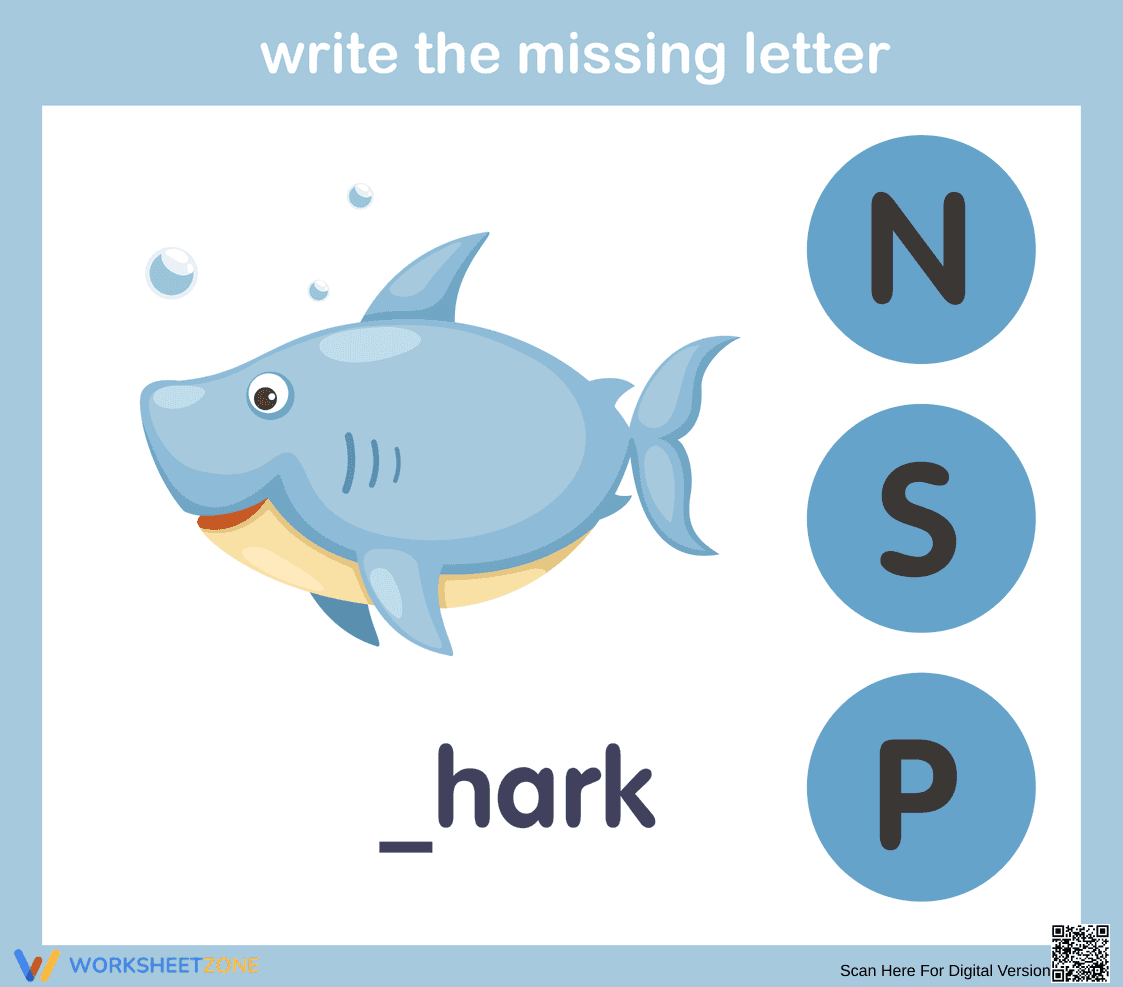
This Preschool beginning sounds worksheet helps early learners master initial consonant identification through visual cues. By connecting the image of a shark to the missing letter 'S', students develop the phonemic awareness necessary for early reading success. It provides a clear, focused task that builds confidence in letter-sound correspondence before formal reading begins.
At a Glance
- Grade: Preschool · Subject: ELA Phonics
- Standard:
CCSS.ELA-LITERACY.RF.K.2.D— Isolate and pronounce the initial sounds in spoken words- Skill Focus: Beginning Consonant Identification
- Format: 1 page · 1 primary task · Answer key included · PDF
- Best For: Early phonemic awareness morning work
- Time: 5–10 minutes
The worksheet features a high-quality illustration of a shark paired with a partial word string ("_hark"). On the right side, three large, clear letter options (N, S, and P) are provided in circular frames. This layout minimizes visual clutter, making it accessible for three- and four-year-olds who are just beginning to navigate printed materials. The PDF is ready for immediate printing and distribution.
Skill Progression
- Guided practice: The teacher models the sound of the 'sh' blend or the letter 'S' while pointing to the shark image to establish the phoneme-grapheme connection.
- Supported practice: Students look at the three letter choices and eliminate the incorrect sounds (N and P) through verbal prompting and auditory discrimination.
- Independent practice: The learner writes the letter 'S' on the provided line to complete the word, demonstrating mastery of the initial sound identification.
This sequence follows the gradual-release model, ensuring students feel supported before being asked to produce the written letter independently on the page.
Standards Alignment
This resource aligns with `CCSS.ELA-LITERACY.RF.K.2.D`, which requires students to isolate and pronounce the initial, medial vowel, and final sounds (phonemes) in three-phoneme words. While "shark" contains a digraph, the focus remains on the primary initial sound identification suitable for early learners. This standard code can be copied directly into lesson plans, IEP goals, or district curriculum mapping tools.
How to Use It
Use this worksheet during small-group literacy centers after a direct instruction lesson on the letter 'S'. It serves as an excellent formative assessment tool; observe if the student can vocally produce the /s/ sound before writing. The expected completion time is approximately 5 to 10 minutes, depending on the child's fine motor development and familiarity with the vocabulary.
Who It's For
This is designed for preschool students, English Language Learners (ELLs) needing vocabulary support, and kindergarteners requiring remedial phonics practice. It pairs naturally with an alphabet anchor chart or a picture book about ocean life to provide context for the vocabulary word and reinforce the learning objective.
Phonemic awareness is a foundational predictor of long-term reading proficiency, as highlighted in the RAND AIRS 2024 report on early literacy interventions. This worksheet targets the specific skill of initial sound isolation, which is the first step in the phonological awareness hierarchy. By using a single, clear image like a shark, the resource reduces cognitive load, allowing the preschool learner to focus entirely on the relationship between the spoken phoneme and the written grapheme. Research from Fisher & Frey (2014) emphasizes that visual scaffolding in early ELA tasks supports the transition from oral language to print literacy. This worksheet provides that necessary scaffold through its multiple-choice letter format and high-contrast design. Educators can use this tool to meet CCSS.ELA-LITERACY.RF.K.2.D requirements, ensuring that students can accurately identify beginning sounds before moving toward complex decoding and blending tasks in later grades.


