


























Views
Downloads
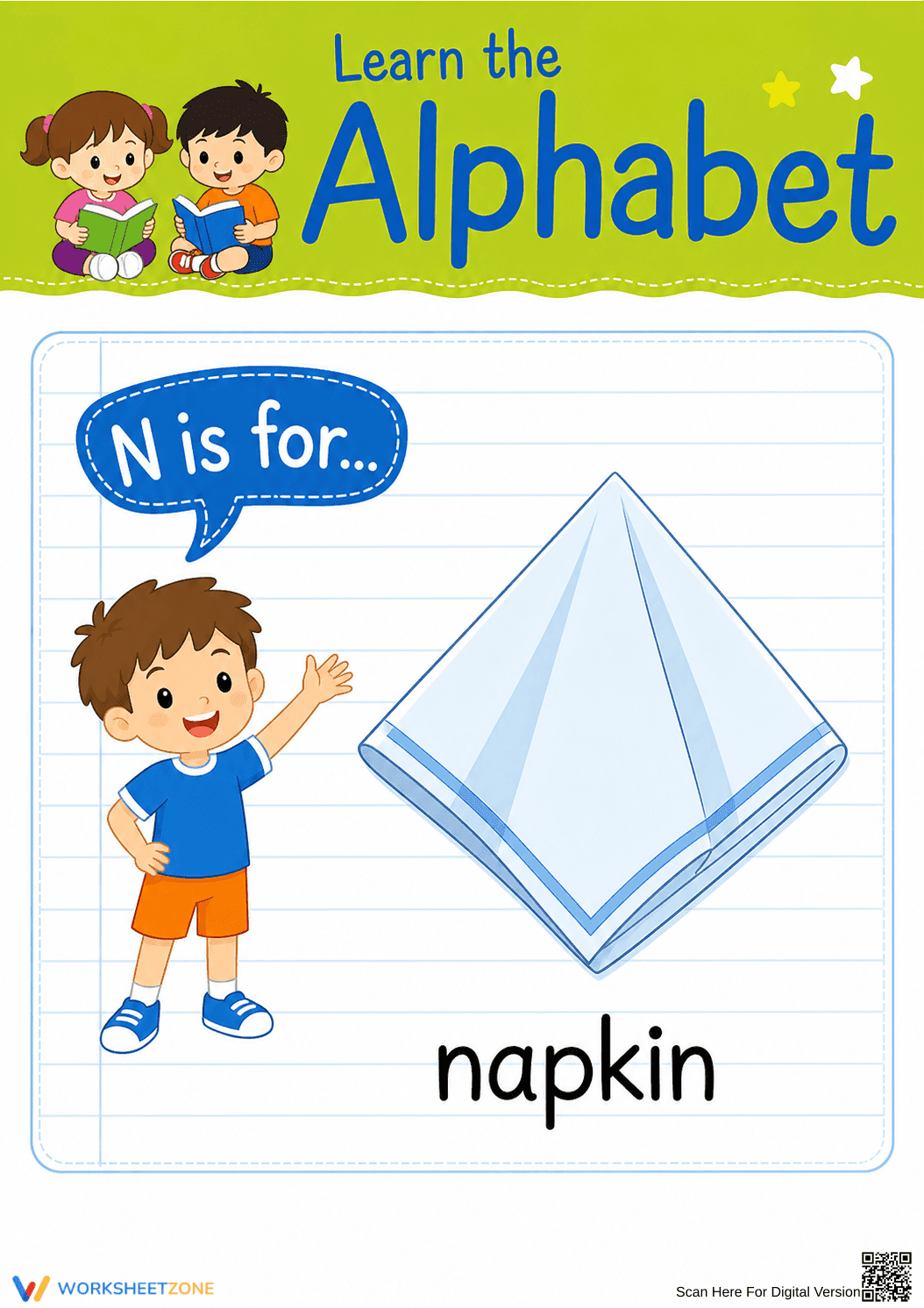

Letter N Beginning Sound Worksheet | Grade K Essential
Paste this activity's link or code into your existing LMS (Google Classroom, Canvas, Teams, Schoology, Moodle, etc.).
Students can open and work on the activity right away, with no student login required.
You'll still be able to track student progress and results from your teacher account.
This Kindergarten phonics worksheet helps early learners master the letter N beginning sound through clear visual association. By connecting the letter shape to a familiar object like a napkin, students build the phonemic awareness necessary for early reading success. This resource provides a foundational step in alphabet recognition and pronunciation.
At a Glance
- Grade: Kindergarten · Subject: ELA Phonics
- Standard:
CCSS.ELA-LITERACY.RF.K.3.A— Demonstrate basic knowledge of one-to-one letter-sound correspondences by producing the primary sound- Skill Focus: Letter N Beginning Sound
- Format: 1 page · 1 primary task · Visual anchor included · PDF
- Best For: Initial phonics instruction and letter recognition
- Time: 5–10 minutes
This single-page PDF features a high-contrast illustration of a napkin paired with the letter N. The layout includes a large "N is for..." speech bubble and the word "napkin" in a clear, primary-grade font. This structure serves as both a coloring activity and a visual anchor chart for classroom displays or student notebooks.
The zero-prep workflow for this resource is designed for maximum efficiency in busy early childhood classrooms. First, print the single-page PDF in under 30 seconds. Second, distribute the sheets to students during your morning meeting or phonics block, requiring zero additional materials beyond crayons or pencils. Third, review the beginning sound as a group, taking less than 2 minutes to reinforce the "nnn" sound. This resource is an ideal sub-plan addition.
This worksheet aligns with `CCSS.ELA-LITERACY.RF.K.3.A`, which requires students to demonstrate basic knowledge of one-to-one letter-sound correspondences. It also supports RF.K.1.D by helping students recognize and name lowercase letters in context. Both standard codes can be copied directly into lesson plans, IEP goals, or district curriculum mapping tools.
Use this worksheet during the "I Do" phase of a phonics lesson to introduce the letter N. Teachers can project the image and model the correct pronunciation of the "n" sound. As a formative assessment, observe students as they color the napkin, asking them to repeat the word and identify the starting sound. Expected completion time is 8 minutes.
This resource is designed for Kindergarten students beginning their phonics journey, but it also serves Grade 1 students needing remedial support. It is particularly effective for English Language Learners (ELLs) who benefit from the direct image-to-word pairing. Pair this with a letter N anchor chart or a tactile sand-tray writing activity for a multi-sensory experience.
According to Fisher & Frey (2014), visual anchors and graphic supports are critical for developing phonemic awareness in early childhood education. This worksheet utilizes the "N is for Napkin" association to solidify the relationship between the grapheme 'N' and its corresponding phoneme. Research indicates that early mastery of letter-sound correspondence is one of the strongest predictors of later reading proficiency. By providing a clear, uncluttered visual representation, this resource reduces cognitive load, allowing students to focus entirely on the phonetic target. The inclusion of `CCSS.ELA-LITERACY.RF.K.3.A` ensures that the activity meets rigorous academic expectations while remaining developmentally appropriate for five- and six-year-olds. Educators can use this tool to bridge the gap between simple letter recognition and active decoding, creating a stable foundation for future literacy development and phonological processing skills in the primary classroom.


