


























Views
Downloads

Printable Letter N Beginning Sound Worksheet | Grade K
Paste this activity's link or code into your existing LMS (Google Classroom, Canvas, Teams, Schoology, Moodle, etc.).
Students can open and work on the activity right away, with no student login required.
You'll still be able to track student progress and results from your teacher account.
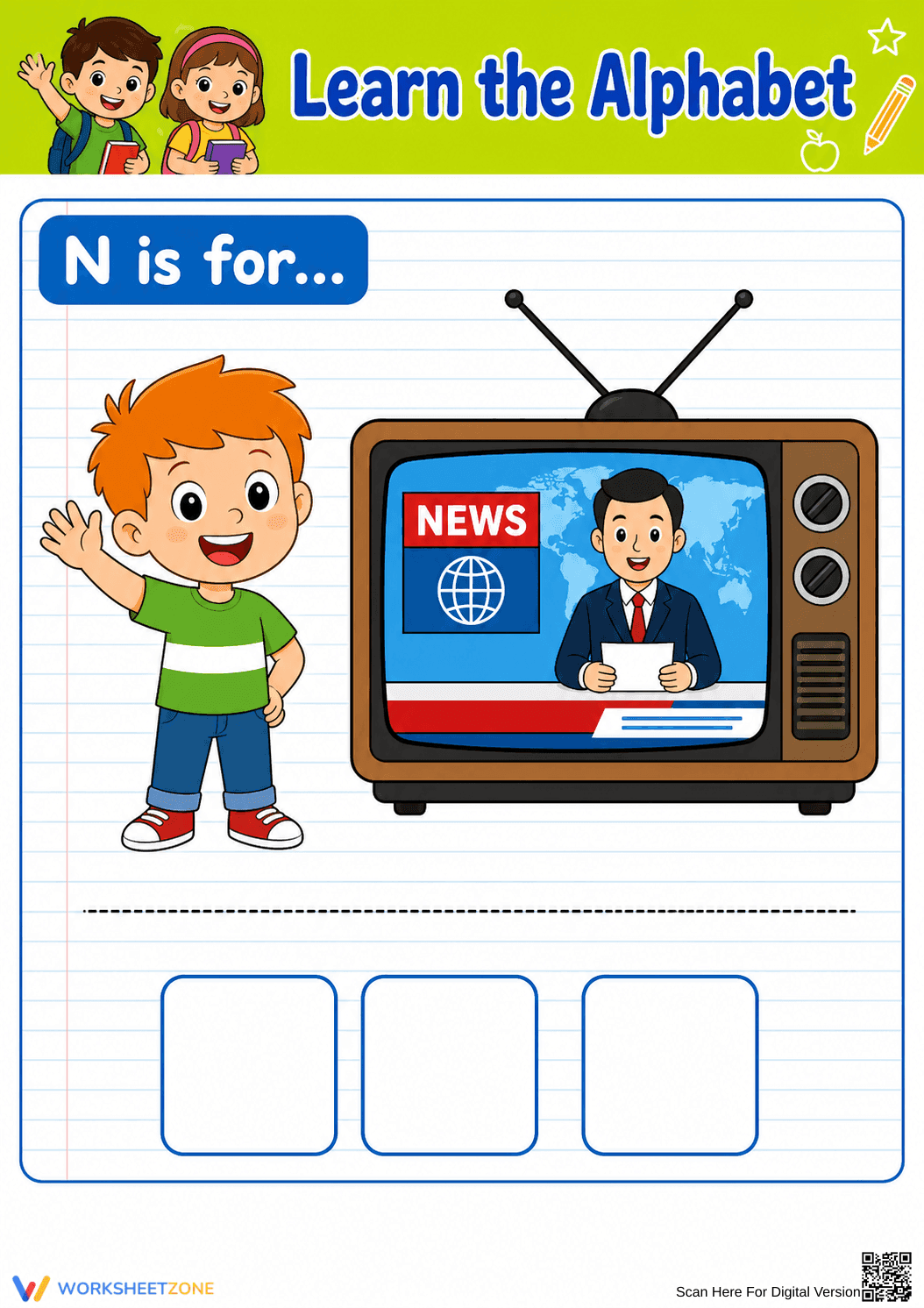
This foundational phonics worksheet helps early learners master the beginning sound of the letter N. By connecting the visual cue of a news broadcast to the target letter, students strengthen phonemic awareness and alphabet recognition. The simple layout ensures young readers focus entirely on letter-sound correspondence.
At a Glance
- Grade: K · Subject: ELA
- Standard:
CCSS.ELA-LITERACY.RF.K.3.A— Produce primary sounds for consonants- Skill Focus: Letter N Beginning Sound
- Format: 1 page · 1 problem · No answer key · PDF
- Best For: Independent phonics practice
- Time: 5–10 minutes
Inside this single-page resource, educators will find a highly visual activity centered around "N is for News." The page features a colorful illustration of a news anchor, providing a strong contextual anchor for the target phoneme. A dotted handwriting line offers space for letter tracing, followed by three blank boxes for drawing other N-word items or pasting letter tiles.
This resource is designed for immediate classroom implementation with a streamlined workflow:
- Print (1 minute): The single-page PDF format requires no special formatting or double-sided printing.
- Distribute (1 minute): Hand out the sheets along with pencils, crayons, or letter stamps.
- Review (3 minutes): Briefly model the "N" sound and point to the news illustration before letting students complete the writing and drawing tasks.
Total teacher preparation time is under two minutes, making this an excellent addition to emergency sub plans or morning work routines.
This worksheet is aligned to CCSS.ELA-LITERACY.RF.K.3.A: Demonstrate basic knowledge of one-to-one letter-sound correspondences by producing the primary sound or many of the most frequent sounds for each consonant. It also supports early handwriting and fine motor skill development. Both standard codes can be copied directly into lesson plans, IEP goals, or district curriculum mapping tools.
Teachers can utilize this worksheet during morning work to activate prior knowledge before formal literacy instruction. Alternatively, it serves as an effective literacy center activity where students independently practice writing the letter N. As a formative assessment tip, observe students as they articulate the word "news" to ensure they produce the correct nasal /n/ sound rather than confusing it with /m/. Expected completion time is five to ten minutes.
This resource is primarily designed for kindergarten and first-grade students developing foundational phonics skills. It is also highly beneficial for English Language Learners (ELLs) who need explicit vocabulary building paired with visual supports. For differentiation, teachers can provide pre-cut letter magazines for students who struggle with handwriting to paste into the boxes. This worksheet pairs perfectly with a whole-group read-aloud focusing on the letter N or a classroom alphabet anchor chart.
Effective phonics instruction relies heavily on explicit, systematic teaching of letter-sound correspondences, such as the foundational skills practiced in this CCSS.ELA-LITERACY.RF.K.3.A aligned resource. When students produce primary sounds for consonants, they build the necessary decoding skills required for fluent reading. According to the RAND AIRS 2024 report on early literacy interventions, integrating visual mnemonics—like associating the letter N with a familiar, real-world concept such as a television "news" broadcast—significantly increases phoneme retention in early childhood learners. The comprehensive report emphasizes that multimodal activities combining visual cues, verbal articulation, and fine motor practice yield substantially higher mastery rates in alphabet recognition. By providing a highly focused, single-phoneme activity, educators can effectively isolate the target skill, reduce unnecessary cognitive load, and ensure young students establish a robust, lasting foundation for future reading comprehension and spelling proficiency.


