


























Views
Downloads
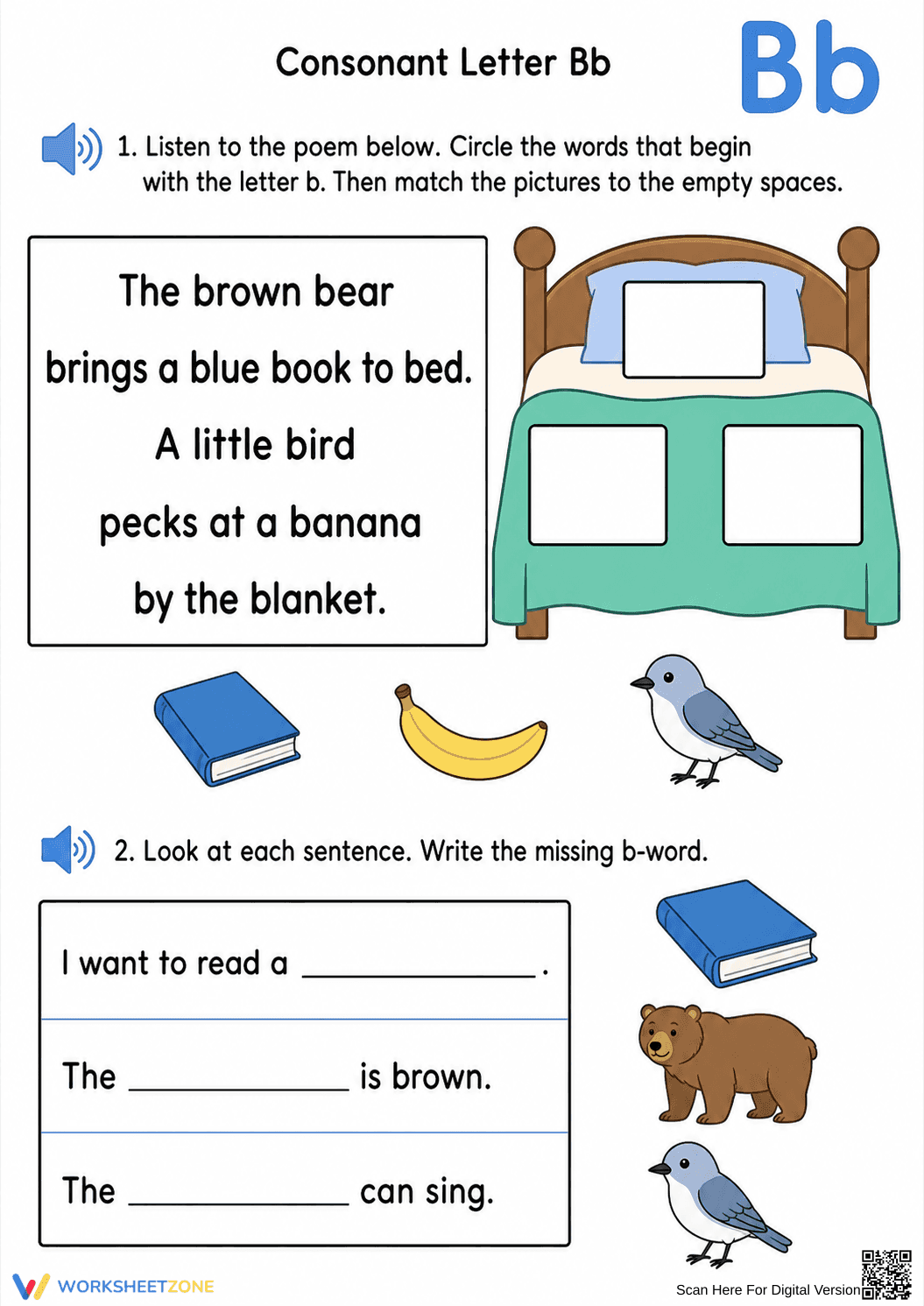

Grade K Letter Bb — Printable No-Prep Worksheet
Paste this activity's link or code into your existing LMS (Google Classroom, Canvas, Teams, Schoology, Moodle, etc.).
Students can open and work on the activity right away, with no student login required.
You'll still be able to track student progress and results from your teacher account.
This Grade K phonics worksheet builds foundational literacy by helping students recognize the consonant letter Bb. Through visual tasks and word-picture associations, learners identify the /b/ sound in context, ensuring they master letter-sound correspondence. It is a highly effective tool for developing phonological awareness in emerging readers and preschool students.
At a Glance
- Grade: Kindergarten · Subject: ELA
- Standard:
CCSS.ELA-LITERACY.RF.K.3.A— Produce the primary sound for each consonant and recognize letter-sound correspondences- Skill Focus: Consonant Letter Bb Phonics
- Format: 1 page · 2 sections · Answer key included · PDF
- Best For: Daily phonics practice or morning work
- Time: 10–15 minutes
What's Inside
The worksheet features two primary sections for independent practice. The first includes a rhyming poem where students identify words starting with 'b', such as "bear," "book," and "banana." This is followed by an interactive component where students complete a scene by matching images. The second section provides three sentences for completion, requiring students to associate verbal cues with visual representations of 'b' words.
Zero-Prep Workflow
This resource follows a straightforward three-step process. First, print the single-page PDF (under 30 seconds). Second, distribute the worksheet as morning work or a phonics center activity (1 minute). Finally, review the answers using the included key during a whole-group wrap-up (5 minutes). Total teacher prep time is under two minutes, making it an ideal choice for emergency sub plans or quick transitions.
Standards Alignment
This resource aligns to `CCSS.ELA-LITERACY.RF.K.3.A`, which requires students to demonstrate knowledge of letter-sound correspondences by producing the primary sound for each consonant. By focusing on the letter Bb, the worksheet ensures students isolate the specific phoneme within text. This standard code can be copied directly into lesson plans or district curriculum mapping tools to track student progress toward foundational literacy benchmarks.
How to Use It
Use the worksheet as guided practice immediately following a lesson on the letter B. Read the poem aloud while students follow along, identifying initial /b/ sounds. Alternatively, assign it as a formative assessment during literacy centers. Observe students as they work to ensure correct pronunciation of words like "bread." The expected completion time is roughly 15 minutes with minimal teacher support.
Who It's For
This worksheet is tailored for preschool and kindergarten students in early stages of letter recognition. It provides scaffolds, such as visual icons and repetitive structures, to support English Language Learners and students with IEPs. The resource pairs naturally with a classroom anchor chart or a shared reading passage. It ensures all learners can participate in meaningful phonics work at their own pace.
Research from Fisher & Frey (2014) demonstrates that systematic instruction in letter-sound correspondence provides the scaffolding for students to transition to word decoding. This worksheet addresses CCSS.ELA-LITERACY.RF.K.3.A by focusing on the consonant letter Bb, allowing students to produce the primary sound in a supported environment. By integrating visual tasks with phonological practice, the resource mirrors multi-sensory approaches for emerging readers. Schools using targeted practice tools see significant improvements in literacy scores as students develop the "alphabetic principle." The rhyme-based task specifically strengthens auditory discrimination, a key prerequisite for phonemic awareness. This printable resource ensures every student masters essential consonant sounds through structured, repeatable exercises that are easy to implement in any early childhood classroom setting.


