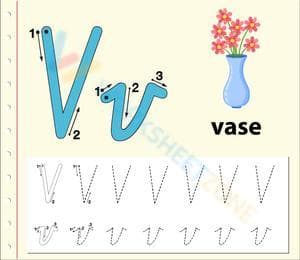
V is two diagonal strokes meeting in a point, and because the capital and lowercase forms are identical apart from size, one traced movement teaches both. These letter V tracing worksheets print free with the angle and the meeting point marked.
Tracing the two strokes
Start at the top left, pull down to a point on the baseline, then go back up to the top right, finishing level with where you began. Both strokes should be the same length and lean by the same amount.
The dotted guide does the hard part, which is the angle. Freehand, children usually make the first stroke steeper than the second, so the letter leans, or they splay the two so far apart that the v becomes a shallow dish.
Stopping at the point
The corner at the bottom is what makes a v a v rather than a u. It comes from stopping the pencil at the baseline before starting the second stroke, not from trying to turn in one smooth movement.
Say stop, then up as the child traces. A deliberate pause at the bottom produces a sharp point almost every time, and a child who sweeps through the turn will round it off however carefully they follow the dots.
Where V sits among the diagonal letters
V is the simplest of the diagonal group, which also includes k, w, x, y and z. Two strokes, no crossing, no tail and no stem to meet at a precise point.
That makes it the sensible one to trace first. A child who can manage v has most of what they need for w, which is two v shapes joined, and the angle control transfers to y, whose top half is a small v.
Watching the paper, not just the pencil
Children often rotate the page when tracing diagonals, turning the slanted stroke into a comfortable straight pull. It works, and it produces letters that lean once the page is put straight again.
Keep the paper at a slight steady tilt and ask for it to stay there. If the angle is genuinely too hard, trace much larger v shapes first, on a whiteboard or a big sheet, where the shoulder and elbow do the work rather than the fingers.
When both strokes match and the point is sharp, move to the letter V worksheets for writing from a model. The letter tracing worksheets cover every letter.
Tracing v in words
V is uncommon enough that children get little practice from ordinary writing, so moving into words early is useful. Van, vet and vest are short and clear once the single letter is steady.
Watch what happens to the point inside a word. A child who traces a sharp isolated v often rounds it off when there is a letter waiting on the right, because the hand starts moving towards the next shape before finishing this one. If that happens, trace the word more slowly rather than returning to the letter alone.
Frequently Asked Questions
1. How do I stop a traced v coming out like a u?
Ask for a full stop at the bottom before the second stroke begins. Pausing produces the corner; sweeping through the turn rounds it off.
2. Are capital V and lowercase v traced the same way?
Yes, apart from size. The capital fills the writing space and the lowercase sits in the lower half, so a single traced movement covers both forms.
3. Should v be traced before w?
It makes sense to, since w is two v shapes sharing a peak. A child who can trace a clean v has most of the movement w requires.