


























Views
Downloads

Uppercase Letter V Worksheet | Essential Kindergarten ELA
Paste this activity's link or code into your existing LMS (Google Classroom, Canvas, Teams, Schoology, Moodle, etc.).
Students can open and work on the activity right away, with no student login required.
You'll still be able to track student progress and results from your teacher account.
This uppercase letter V worksheet helps early learners master alphabet recognition and fine motor control through structured tracing and phonemic association. By connecting the visual shape of the letter to familiar objects like a van or violin, students build the foundational literacy skills necessary for reading fluency and handwriting in primary grades.
At a Glance
- Grade: Kindergarten · Subject: ELA Alphabet
- Standard:
CCSS.ELA-LITERACY.RF.K.1.D— Recognize and name all upper- and lowercase letters of the alphabet- Skill Focus: Uppercase V formation
- Format: 1 page · 10 tasks · Answer key included · PDF
- Best For: Initial letter introduction and handwriting practice
- Time: 10–15 minutes
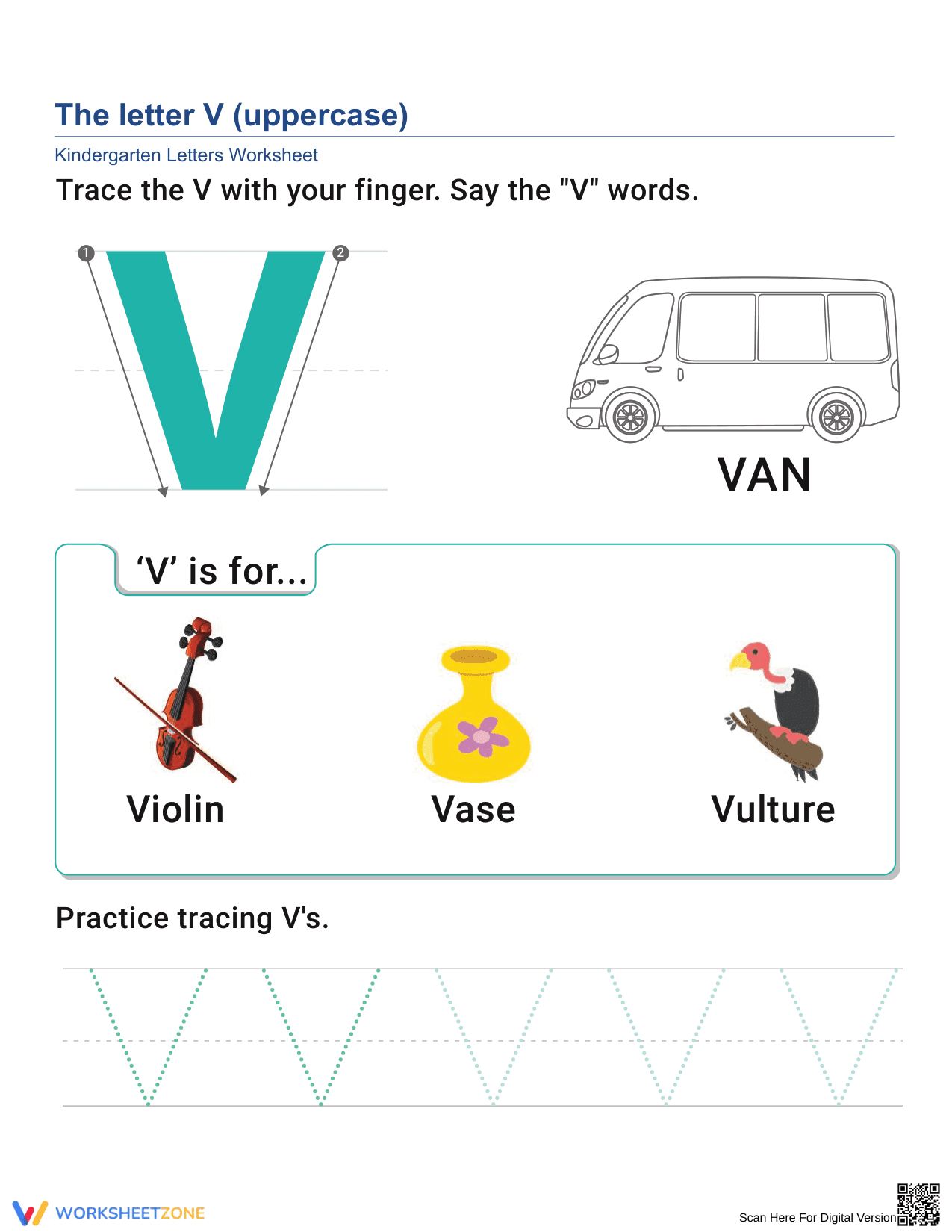
The worksheet features a large finger-tracing guide with directional arrows to ensure correct stroke order. It includes four high-quality illustrations (van, violin, vase, vulture) to reinforce initial letter sounds. The bottom section provides a dedicated row for pencil-to-paper tracing practice, allowing students to transition from tactile exploration to independent writing.
The activity follows a gradual release model. First, students engage in guided practice by tracing the large letter V with their fingers, following numbered paths. Next, they participate in supported practice by identifying the letter within the context of vocabulary words. Finally, they move to independent practice by tracing five dotted-line letters to solidify their handwriting muscle memory.
This resource is aligned with `CCSS.ELA-LITERACY.RF.K.1.D`, which requires students to recognize and name all uppercase and lowercase letters. It also supports foundational writing standards by focusing on legible letter formation. Both standard codes can be copied directly into lesson plans, IEP goals, or district curriculum mapping tools.
Use this worksheet during your morning meeting or as a center activity during your "Letter of the Week" curriculum. For a formative assessment, observe the student's stroke direction during the tracing phase to ensure they are starting from the top. Completion typically takes 10 to 15 minutes depending on the student's fine motor development.
This printable is designed for preschool, kindergarten, and first-grade students who are developing letter-sound correspondence. It is particularly effective for English Language Learners (ELLs) due to the clear visual cues. Pair this with a physical alphabet tray or a letter V read-aloud book for a comprehensive multisensory lesson.
According to the RAND AIRS 2024 report, early exposure to systematic letter recognition and tactile tracing activities significantly predicts later reading achievement in elementary school. This worksheet addresses the critical need for uppercase letter mastery by combining visual, auditory, and kinesthetic learning modalities. By focusing on the specific geometry of the letter V, students learn to distinguish it from similar shapes, a key component of orthographic processing. Research from Fisher & Frey (2014) emphasizes that the gradual release of responsibility—moving from finger tracing to independent pencil work—is essential for developing the fine motor skills required for legible handwriting. This resource provides the structured repetition necessary for students to internalize the letter's form while simultaneously expanding their vocabulary through phonemic association. Implementing this CCSS.ELA-LITERACY.RF.K.1.D aligned tool ensures that students meet foundational literacy benchmarks through evidence-based instructional design and targeted skill practice.


