


























Views
Downloads
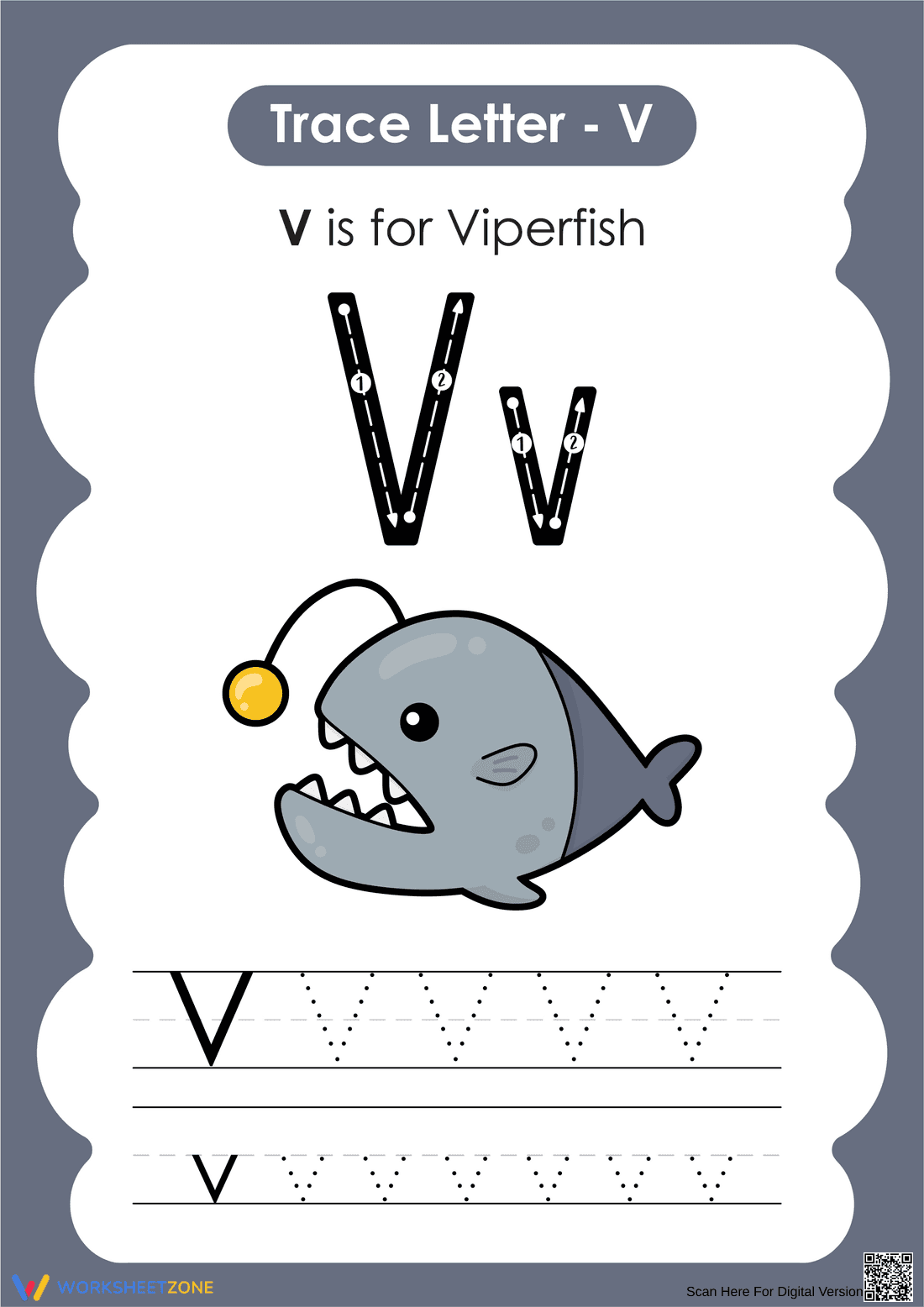

Letter V Tracing Worksheet | Essential Alphabet Practice
Paste this activity's link or code into your existing LMS (Google Classroom, Canvas, Teams, Schoology, Moodle, etc.).
Students can open and work on the activity right away, with no student login required.
You'll still be able to track student progress and results from your teacher account.
This printable Letter V tracing worksheet provides early learners with a structured way to master uppercase and lowercase letter formation. By combining visual cues with repetitive motor practice, students develop the muscle memory needed for fluent handwriting. The inclusion of a viperfish illustration reinforces the initial /v/ sound for phonemic awareness.
At a Glance
- Grade: Kindergarten · Subject: ELA
- Standard:
CCSS.ELA-LITERACY.L.K.1.A— Print many upper- and lowercase letters accurately and legibly- Skill Focus: Letter V Formation
- Format: 1 page · 12 tasks · Visual guides included · PDF
- Best For: Daily morning work or literacy centers
- Time: 5–10 minutes
What's Inside
The worksheet features a large-scale model of both uppercase 'V' and lowercase 'v' with numbered arrows indicating correct stroke sequence. Below the models, two dedicated rows provide dotted-line tracing practice for 12 individual letters. The page is designed with a clean, distraction-free layout to help young children focus on the specific motor task of drawing diagonal lines without visual clutter.
Skill Progression
- Guided Practice: Students begin by observing the large-scale letter models which use numbered directional arrows to demonstrate the "down-up" diagonal motion.
- Supported Practice: The two tracing rows provide high-contrast dotted lines, allowing students to trace the letter 12 times to build tactile familiarity.
- Independent Practice: As students move across the row, they transition from following the dots to internalizing the stroke order for future free-hand writing.
This sequence follows the gradual-release instructional framework, ensuring students move from observation to execution with confidence.
Standards Alignment
This resource aligns with CCSS.ELA-LITERACY.L.K.1.A, which requires students to print many upper- and lowercase letters. It also supports phonological awareness by connecting the letter shape to the /v/ sound in "Viperfish." Both standard codes can be copied directly into lesson plans, IEP goals, or district curriculum mapping tools.
How to Use It
Use this worksheet during the independent practice portion of a handwriting lesson. After demonstrating the letter on the board, distribute the page for quiet desk work. Teachers should circulate to observe the "top-down" stroke direction, providing immediate corrective feedback if a student starts from the bottom. This activity typically takes 5 to 10 minutes to complete and serves as an excellent formative assessment for fine motor control.
Who It's For
This resource is ideal for preschool, kindergarten, and first-grade students who are beginning their literacy journey. It is particularly helpful for students requiring occupational therapy support or English Language Learners (ELLs) who are familiarizing themselves with the Latin alphabet. Pair this with a "Letter V" anchor chart or a phonics song for a multi-sensory experience.
According to the RAND AIRS 2024 report on early literacy, explicit instruction in letter formation is a critical precursor to writing fluency and overall reading success. Research by Fisher & Frey (2014) emphasizes that the gradual release of responsibility—moving from modeled stroke order to independent tracing—allows students to internalize the spatial relationships of characters. This worksheet applies these principles by providing clear directional cues and repetitive practice opportunities. By mastering the specific diagonal strokes required for the letter V, students build the foundational fine motor skills necessary for more complex writing tasks. Systematic practice with high-frequency letters like V, when paired with phonemic anchors like the viperfish, ensures that the connection between grapheme and phoneme is solidified early in the instructional cycle. This approach is consistent with NAEP findings regarding the importance of early handwriting mastery in predicting later academic achievement.


