


























Views
Downloads
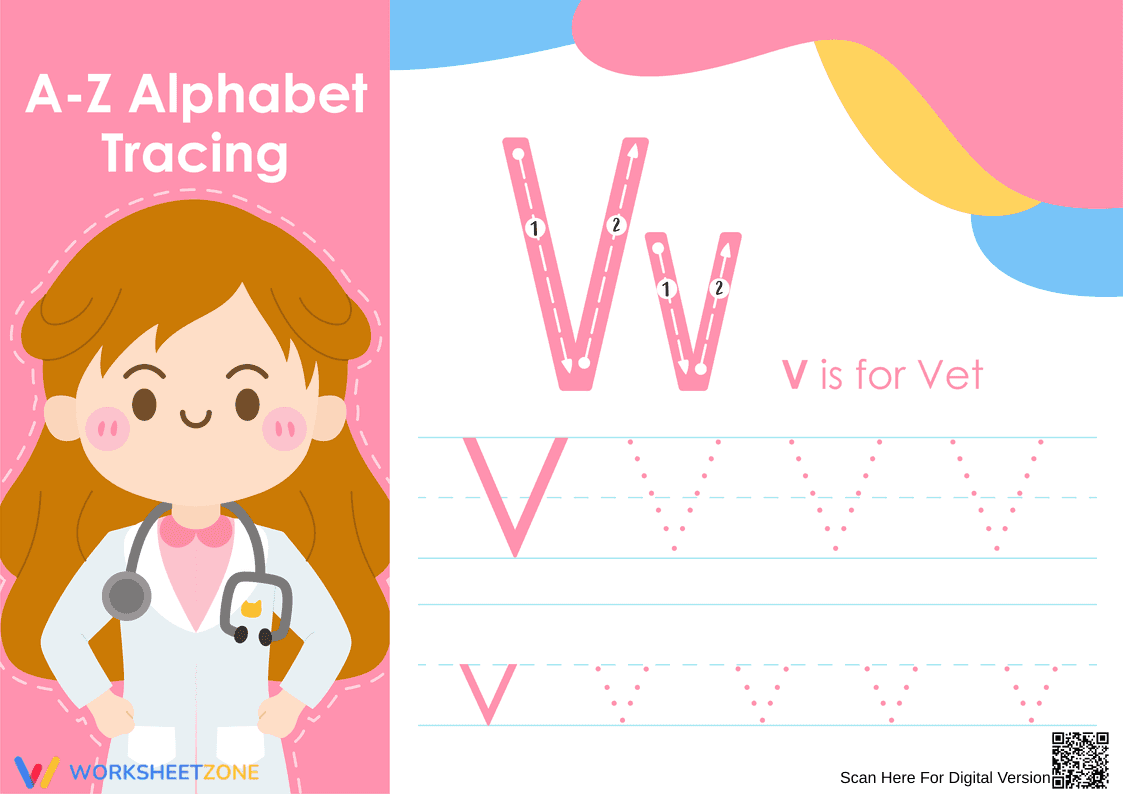

Pre-K Letter V Tracing — Printable No-Prep Worksheet
Paste this activity's link or code into your existing LMS (Google Classroom, Canvas, Teams, Schoology, Moodle, etc.).
Students can open and work on the activity right away, with no student login required.
You'll still be able to track student progress and results from your teacher account.
This foundational letter tracing worksheet helps early learners master the uppercase and lowercase letter V. By practicing guided strokes and independent tracing, students develop essential fine motor skills and letter recognition. The engaging "V is for Vet" visual context connects the letter symbol to a familiar vocabulary word, reinforcing early phonics concepts.
At a Glance
- Grade: Pre-K · Subject: ELA
- Standard:
CCSS.ELA-LITERACY.L.K.1.A— Print many upper- and lowercase letters- Skill Focus: Letter V Tracing
- Format: 1 page · 8 problems · No answer key · PDF
- Best For: Independent practice
- Time: 5–10 minutes
Inside this single-page resource, educators will find a clear, structured approach to handwriting practice. The page features large, numbered directional arrows demonstrating the correct stroke order for both uppercase and lowercase V. Below the instructional model, students complete eight dotted-line tracing tasks across two primary writing lines. A colorful illustration of a veterinarian provides a helpful visual anchor for the target letter.
Zero-Prep Workflow
- Print (1 minute): Simply download the PDF and print the desired number of copies. The high-contrast design ensures clear dotted lines even in black and white.
- Distribute (1 minute): Hand out the worksheets along with pencils or crayons. The visual instructions make the task immediately obvious to young learners.
- Review (1 minute): Quickly check student grip and stroke direction as they work. Total teacher prep time is under two minutes, making this an ideal, stress-free addition to any morning work routine or emergency sub plan.
This resource is directly aligned to CCSS.ELA-LITERACY.L.K.1.A, requiring students to print many upper- and lowercase letters. The structured tracing lines support the development of consistent letter formation and spatial awareness on the page. Both standard codes can be copied directly into lesson plans, IEP goals, or district curriculum mapping tools.
Use this worksheet during morning work to establish a calm, focused start to the day. It serves as an excellent independent station activity while the teacher conducts small group reading instruction. As a formative assessment tip, observe students while they trace the large model letters at the top; ensure they are starting at the top line and pulling down, rather than pushing up from the bottom. Expected completion time is a brief 5 to 10 minutes.
This worksheet is designed for preschool and kindergarten students who are transitioning from basic line tracing to formal letter formation. It provides necessary scaffolding for early writers who need explicit stroke direction cues. Pair this printable with a read-aloud book featuring a veterinarian or a tactile sand-tray activity to reinforce the letter V shape through multiple sensory pathways.
Effective handwriting instruction requires explicit modeling and guided repetition to build automaticity in early learners. According to Fisher & Frey (2014), providing clear visual cues and structured practice opportunities significantly improves students' ability to transfer isolated skills into independent writing tasks. This resource targets CCSS.ELA-LITERACY.L.K.1.A by requiring students to print many upper- and lowercase letters with correct stroke sequence. The inclusion of numbered directional arrows ensures that students do not practice incorrect habits, which can be difficult to unlearn later in their academic journey. By combining visual vocabulary anchors, such as the veterinarian illustration, with targeted motor skill repetition, this worksheet supports both phonemic awareness and physical writing stamina. Consistent, daily practice with these foundational elements is critical for long-term literacy success, reading fluency, and overall confidence in early childhood education settings.


