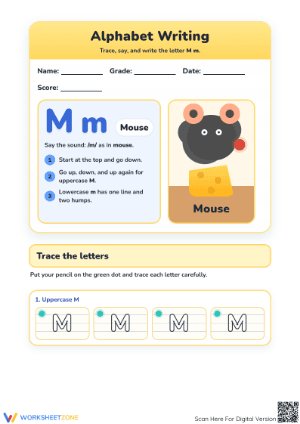
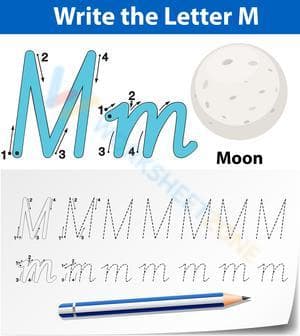
Letter M tracing worksheets give pre-K and kindergarten teachers a print-ready resource for the stroke-by-stroke practice that moves students from wobbly approximations toward recognizable letterforms. This set covers uppercase and lowercase M across a range of line sizes, so teachers have the right worksheet for the student who needs a thick, high-contrast guide and the one who is almost ready to write without a dotted path.
Skills These Worksheets Build
The set addresses letter M in stages rather than treating tracing as a single undifferentiated activity. A letter M tracing worksheets at the early stage asks students to follow a broad stroke path while rehearsing the stroke-name sequence aloud — down, diagonal in, diagonal out, down — before hand strength and pencil control are consistent enough to stay on a standard line. Later worksheets in the set reduce the line width and remove directional arrows. That shift reveals whether a student has genuinely internalized the formation or has been relying on the arrow cues the whole time.
The skills targeted across the set include:
- Correct four-stroke sequence for uppercase M, with a proper pencil lift between each stroke
- Equal-height hump formation in lowercase m, starting from a single downstroke before each arch
- Diagonal line control — which is harder for four- and five-year-olds than vertical or horizontal work because it requires the wrist to move in an unfamiliar plane
- Letter-sound connection reinforced by M-word illustrations students can name or label during practice
Mistakes Students Make That These Worksheets Surface
The most common uppercase error is reversing the stroke direction — starting from the bottom left and working upward, which is the mirror of correct M formation. A student's finished letter may look roughly right to a quick scan, but if the pencil moved bottom-to-top, the habit needs direct correction. The test is to watch the pencil, not the product. There should be four pencil lifts in uppercase M; a student who lifts twice or draws it in one continuous stroke has the shape but not the structure.
Lowercase m produces a specific and consistent error: the second hump ends up shorter than the first. After the hand completes the first arch and returns to the baseline, fatigue or inattention causes the second arch to flatten. The result looks like an n with an extra feature — close enough that teachers sometimes let it pass, but far enough off that it becomes harder to correct later. Each worksheet generates multiple instances of the letter in one sitting, which means this pattern becomes visible quickly rather than surfacing one letter at a time in student writing samples.
Building These Worksheets Into Your Literacy Block
Letter of the Week structures fit naturally here. During M week, one worksheet at the start of morning meeting or the first five minutes of center time gives students brief, low-stakes repetition of the letter before they encounter it in phonics or shared reading. Short daily sessions build motor memory more reliably than a single long tracing period — this is the same principle behind spaced retrieval in memory research, applied to physical skill acquisition.
Small group instruction is where these worksheets earn their diagnostic value. With three or four students at a table, the teacher watches pencil grip and stroke direction in real time rather than reviewing finished papers later. The letter M tracing worksheets also works as a morning arrival settler — one worksheet at each seat gives students an immediate task and produces a quick formative read on retention from the previous week.
Differentiating the Set Across Ability Levels
Students who lack reliable pencil control do better starting with finger tracing on the worksheet before switching to a crayon or pencil. The direction change at the M's two peaks — where the stroke shifts from diagonal-down to diagonal-up — registers more clearly as a full-arm movement than as a wrist movement, and students who are struggling kinesthetically often need to feel that shift at a larger scale before it translates to fine motor work on paper.
For students ahead of the class on letter formation, a letter M tracing worksheets with the dotted path removed and only a starting dot on the baseline asks them to produce the letter from memory and compare each attempt to the model. That self-monitoring layer adds meaningful challenge without requiring an entirely different resource. Students receiving occupational therapy support can use these worksheets as a carryover activity — the format is direct enough that an OT can incorporate it into a session without learning a new material from scratch.
Standard Alignment
These worksheets support CCSS.ELA-LITERACY.L.K.1.A, which requires kindergartners to print many upper- and lowercase letters. In most kindergarten pacing guides, letter M instruction falls in the first trimester, after the most common high-frequency letters have been introduced. At this stage, tracing is the primary instructional mode — teachers use it before copy-from-model practice and then independent production from memory. The three-phase arc from tracing to copying to writing from memory is exactly the sequence this standard assumes, and this set addresses the first phase in full.
Frequently Asked Questions
My students race through the tracing path without lifting their pencils between strokes. How do I fix that?
The dotted path is making the task too easy to complete without thinking. Print a worksheet that shows numbered starting points but no dotted guide connecting them. Before students pick up their pencils, do a verbal rehearsal — say the stroke names together out loud. Having students tap the paper once at the start of each stroke forces the four-part structure and breaks the single-drag habit within a few sessions.
How many repetitions does a kindergartner usually need before stopping reliance on the tracing path?
The more useful benchmark is not a number of repetitions but whether a student can narrate the stroke sequence while writing it without looking at the model. Once a student says "down, diagonal in, diagonal out, down" in real time while producing a recognizable letter, the tracing phase has done its job. For most kindergartners, daily five-minute sessions over one to two weeks reach that point. Students who take longer are often showing a grip or coordination issue worth documenting.
Is it appropriate to use these worksheets with first- or second-graders who formed M incorrectly in kindergarten?
Yes, and earlier is better. Students who formed M incorrectly will not self-correct through volume of writing alone — they need explicit re-instruction on stroke sequence, which is what these worksheets provide directly. The format looks appropriate for older students, especially when the teacher frames the activity as a letter-habit check rather than a remedial task. The re-teaching takes far less time than the intervention required if the error is left to calcify through second grade.