


























Views
Downloads
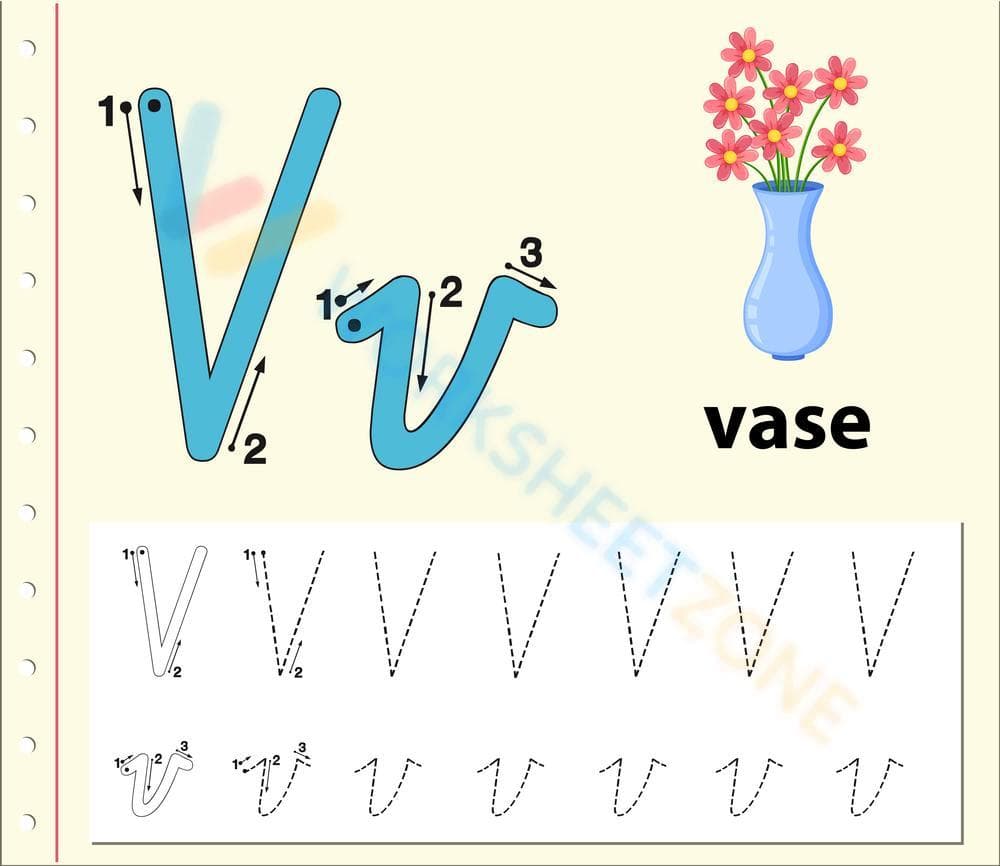

Grade K Letter V Tracing — Printable No-Prep Worksheet
Paste this activity's link or code into your existing LMS (Google Classroom, Canvas, Teams, Schoology, Moodle, etc.).
Students can open and work on the activity right away, with no student login required.
You'll still be able to track student progress and results from your teacher account.
This Grade K handwriting worksheet gives students focused practice to master printing the letter V. Students trace both uppercase and lowercase forms using guided directional arrows, building fine motor skills and letter recognition. The visual anchor of a vase reinforces beginning sounds for early readers.
At a Glance
- Grade: K · Subject: ELA
- Standard:
CCSS.ELA-LITERACY.L.K.1.A— Print many upper- and lowercase letters- Skill Focus: Letter V Tracing
- Format: 1 page · 14 problems · PDF
- Best For: Independent practice
- Time: 5–10 minutes
This single-page resource features two large instructional letters with numbered directional arrows to model proper stroke sequence. Below the models, students complete 14 dashed-line tracing tasks, evenly split between uppercase and lowercase V. A colorful illustration of a vase with the corresponding word provides a helpful vocabulary connection. No answer key is required for this straightforward handwriting task.
Teachers can deploy this resource instantly with a simple three-step workflow. Print the PDF copies (1 minute). Distribute to student desks or literacy centers (1 minute). Review the directional arrows together before independent work (2 minutes). Total teacher prep time is under five minutes, making this an ideal, self-explanatory activity for emergency sub plans or morning work routines.
Aligned to CCSS.ELA-LITERACY.L.K.1.A, this worksheet requires students to print many upper- and lowercase letters. It also supports foundational phonics by linking the letter symbol to the beginning sound of a familiar word. Both standard codes can be copied directly into lesson plans, IEP goals, or district curriculum mapping tools.
Use this worksheet during morning work to establish a calm, focused start to the day. Alternatively, place it in a literacy center for independent handwriting practice while the teacher pulls small groups. Observe students as they trace to ensure they follow the numbered stroke order rather than drawing the letter from the bottom up. Expected completion time is 5 to 10 minutes.
This resource is designed for Kindergarten students developing basic handwriting and fine motor skills. It provides necessary scaffolding for students who struggle with letter formation by offering clear, dashed guidelines and numbered stroke paths. Pair this worksheet with a tactile sand-tray activity or a whole-class phonics lesson on the /v/ sound.
Explicit handwriting instruction remains a critical component of early literacy development. According to Fisher & Frey (2014), structured practice with letter formation directly supports broader reading and writing fluency by reducing the cognitive load required for transcription. This worksheet targets CCSS.ELA-LITERACY.L.K.1.A, requiring students to print many upper- and lowercase letters. By combining numbered stroke models with repetitive tracing tasks, the activity builds the muscle memory necessary for automaticity. The inclusion of a visual vocabulary word further bridges the gap between physical letter formation and phonemic awareness. Educators can rely on this targeted practice to reinforce foundational skills efficiently, ensuring students develop the transcription automaticity needed for higher-order composition tasks in later grades.


