The Specific Motor Challenges of Teaching Letter J
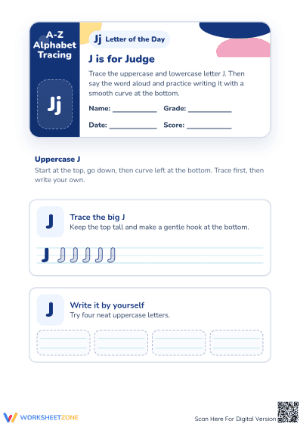
When preschool and kindergarten students encounter letter J consonant, they must execute a combination of straight lines and sweeping curves that can feel counterintuitive to small hands. Capital J requires a confident downward stroke that terminates in a left-facing hook. Lowercase j adds another layer of complexity by introducing a descender that drops below the baseline, along with a precise dot suspended above the midline. For teachers, introducing letter J tracing worksheets provides a structured way to guide students through these specific directional changes.
Unlike simpler letters composed entirely of straight lines, the letter J demands continuous fluid movement. The transition from the vertical drop to the upward curve requires a shift in hand pressure and wrist positioning. Without targeted tracing practice, students often create a jagged right angle instead of a smooth hook. By utilizing specialized letter J tracing worksheets, teachers can isolate these movements. Tracing sheets offer the visual boundaries necessary to build muscle memory correctly from the first attempt.
Furthermore, spacing and alignment become immediate issues when dealing with descenders. Young writers frequently struggle to understand that the lowercase j must hang below the line they are writing on. The guided dashed lines on quality tracing materials serve as immediate feedback mechanisms, showing students exactly where the letter should start and how far the tail should extend.
How Tracing Bridges the Gap in Handwriting Development
The cognitive leap from recognizing a shape to reproducing it is substantial. Tracing acts as the essential scaffold in this developmental process, allowing students to focus entirely on the physical mechanics of writing. Letter J tracing worksheets break down the complex visual input into manageable, repeatable actions. When a child traces over a dotted line, they are experiencing the kinesthetic reality of the letter shape.
This physical experience is essential for developing the proper grip and establishing a dominant hand preference. As students work through tracing exercises, they naturally adjust their pencil hold to accommodate the sweeping motion of the J hook. Teachers observing this process can quickly identify and correct awkward grips before they solidify. The structured environment of a tracing worksheet means that the student's attention remains focused on the path of the pencil, making it an ideal setting for targeted instructional feedback.
In addition to grip development, tracing builds the stamina necessary for independent writing. The repeated, guided motions strengthen the small muscles in the hand and fingers. By incorporating tracing activities into daily literacy centers, teachers provide a controlled workout for these muscles. The predictable nature of tracing allows students to pace themselves, gradually increasing their endurance.
Pairing Letter J Formation with Phonics Instruction
Handwriting should rarely exist in a vacuum, separated from broader literacy goals. Integrating phonics instruction with letter J tracing worksheets maximizes instructional time and deepens student comprehension. When a student traces the letter J while simultaneously vocalizing the /j/ sound, they create a multisensory connection that reinforces both skills simultaneously.
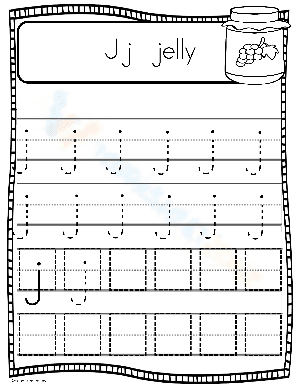
Teachers can actively encourage this connection by selecting tracing materials that feature phonetically appropriate imagery. A worksheet that pairs tracing exercises with pictures of a jellyfish, a jar of jam, or a jet airplane provides immediate context. Before the student even picks up their pencil, the educator can lead a brief phonemic awareness activity, having the class identify the initial sound in each picture.
This integrated approach also helps to clarify common phonetic confusions. The /j/ sound is frequently confused with the soft 'g' sound in early spelling attempts. By explicitly practicing the letter J through tracing while reinforcing its specific sound profile, teachers provide a clear anchor point for students.
Strategies for Teaching the Lowercase J Hook and Descender
The lowercase j is notoriously difficult for early writers to write, primarily due to the descender. Understanding spatial organization on lined paper requires abstract thinking that is still developing in preschool and kindergarten students. Letter J tracing worksheets that feature prominent, color-coded, or heavily weighted baselines are essential tools for teaching this concept. Teachers must explicitly teach that the lowercase j is a "rule-breaker" that hangs down below the main writing space.
To address the hook specifically, targeted verbal pathways are highly effective when combined with tracing. As students follow the dotted lines on their worksheets, teachers can use consistent, rhythmic language to guide the motion. Phrases like "Pull down, down, down, and curve back up" help synchronize the physical action with the instructional cue. When students use these tracing sheets, the visual guides ensure the hook is formed with the correct curvature.
The dot on the lowercase j also requires specific attention. Early learners often struggle with the proportion and placement of the dot, either drawing a large circle or placing it too high above the stem. Teachers should instruct students to "tap" the paper rather than draw a circle.
Why Short and Consistent Practice Sessions Work Best
When planning instruction around handwriting, frequency consistently outperforms duration. Expecting early learners to sit for extended periods completing page after page of letter J tracing worksheets is counterproductive and often leads to fatigue, poor form, and frustration. Instead, teachers should aim for short, focused bursts of practice that happen daily. A five-to-ten minute session allows the student to concentrate fully on their pencil grip and stroke direction without experiencing muscle fatigue.
These brief sessions are easily integrated into established classroom routines. Tracing can serve as a calm, focused morning work activity as students transition into the learning environment. Alternatively, it can be utilized as a dedicated station during literacy rotations. The goal is to provide repeated exposure to the correct motor pathways, allowing the brain to consolidate the learning over time.
Research indicates that distributed practice—spacing out short sessions over several days—results in significantly higher retention of motor skills in young children compared to massed practice blocks that attempt to drill the skill all at once.
By keeping the practice sessions short, teachers also maintain a higher standard of quality control. It is easier to monitor a small group of students for five minutes, ensuring every child is executing the downward stroke correctly.
Teacher Tips
Implementing letter J tracing worksheets effectively requires strategic planning to maximize student engagement and skill retention. One of the most successful approaches is to use a variety of tracing mediums before moving to standard pencil and paper. Encourage students to trace large letter templates using their fingers or dry-erase markers on laminated sheets. This multisensory input solidifies the shape of the letter in the student's mind before fine motor control is heavily taxed.
Another important tip for teachers is to establish a clear and consistent starting point for every letter. The letter J must always begin at the top and pull down. When students use tracing worksheets, closely monitor their initial pencil placement. If a child begins at the bottom of the hook and pushes upward, immediately pause their work and redirect them to the top starting dot.
Finally, differentiate the tracing materials based on student readiness. Providing the right level of challenge keeps students engaged and prevents frustration. Always pair tracing with positive reinforcement that praises effort.
Frequently Asked Questions
1. Should children learn Capital J or lowercase j first?
Most early childhood teachers recommend introducing the capital J first, as it is generally easier for young learners to conceptualize and execute. Capital letters sit neatly on the baseline and do not require the spatial awareness needed for descenders. Once students are comfortable with the capital form, teachers can introduce the lowercase j, focusing specifically on the concept of the tail dropping below the line and the precise placement of the dot.
2. How can I help a child who struggles with the curve of the 'j' hook?
If a student is struggling with the hook on the letter J, provide tracing worksheets that have larger, more exaggerated curves. You can also use physical objects, like having them trace the curve of a physical hook or a curved toy, to build the gross motor understanding of the shape. Additionally, verbal cues are very helpful. Using a phrase like "slide down the pole and swing up" provides a strong mental image to guide their hand.
3. How do I make tracing worksheets more fun for reluctant learners?
To increase engagement with letter J tracing worksheets, introduce novelty through different writing tools. Allow students to use colored pencils, gel pens, or thin markers instead of standard graphite pencils. You can also turn tracing into a game by using "rainbow writing," where the student traces the same letter multiple times using a different color for each pass. Pairing the tracing activity with a relevant storybook or song about the letter J also helps build enthusiasm.