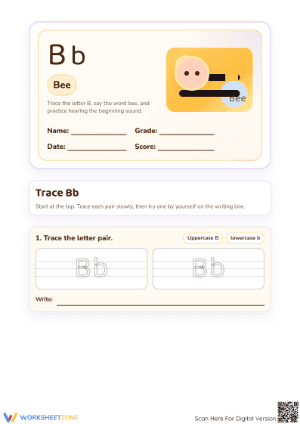
Tracing is particularly valuable for b, because the letter is a mirror image of d and the stroke order is what keeps the two apart. These traceable letter B worksheets mark the starting point and the direction for both forms, and print free.
Stroke order is the point of these pages
For lowercase b, the tall line is traced first, from the top of the writing space down to the baseline. Only then does the pencil go back up and push out into the bump on the right. A child who always traces the line first cannot accidentally produce a d, because the curve has only one place left to go.
This is why the arrows on a tracing page matter more than staying inside the dots. If a child is tracing the bump first and adding the line afterwards, the page looks fine and the habit being learned is the wrong one.
Tracing capital B
Capital B is a straight line down the left, then two bumps on the right: a smaller one at the top and a larger one below. Children tracing it tend to make the top bump too big, which leaves the second one squashed. The dotted guide helps here, since the sizes are set for them, and repeating the traced version a few times gives the hand a sense of the proportions before it has to judge them alone.
Using tracing to fix reversals
If a child is already reversing b, go back to tracing rather than correcting finished letters. Correction tells a child they got it wrong; tracing shows them what right feels like. Say the stroke order out loud as they go, line then ball, so the words and the movement are learned together.
Keep b and d apart during this period. Tracing them on the same page while the confusion is live tends to cement it rather than resolve it. Come back to comparison work once b alone is reliable.
Moving from tracing to writing
Once the stroke order is automatic, move to the letter B worksheets where the child writes from a model. Watch the first few unaided attempts carefully, because reversals often reappear the moment the guide is removed. If that happens, a short return to tracing is more useful than repeated correction.
The letter tracing worksheets have a dotted page for every letter, with letter A before and letter C after.
Which form of b to trace first
Most handwriting programmes introduce lowercase b before the capital, because lowercase is what children meet on almost every page they read. For tracing, though, there is an argument for starting with capital B: it has no mirror-image twin, so a child can practise the line-then-curve movement without any risk of building the wrong habit.
A practical compromise is to trace both on the same page, capital first, naming them as the big b and the small b. The hand learns one sequence, the eye learns two shapes, and the lowercase form arrives with the stroke order already in place.
Frequently Asked Questions
1. Does tracing really help with b and d confusion?
It helps when the arrows are followed, because it builds a fixed stroke order that makes the reversal impossible. Tracing without attention to the starting point does very little for it.
2. Should the bump on b be traced in one movement?
Yes, as a single curve out and back to the stem. Tracing it as two separate arcs tends to leave a flat spot in the middle of the bump.
3. How do I know my child is ready to stop tracing b?
When the line is always drawn before the bump, without a reminder, and the letter comes out the right way round several times in a row. That is the habit the tracing was for.