


























Views
Downloads

Letter V Tracing Worksheet | Essential Grade K-1 Phonics
Paste this activity's link or code into your existing LMS (Google Classroom, Canvas, Teams, Schoology, Moodle, etc.).
Students can open and work on the activity right away, with no student login required.
You'll still be able to track student progress and results from your teacher account.
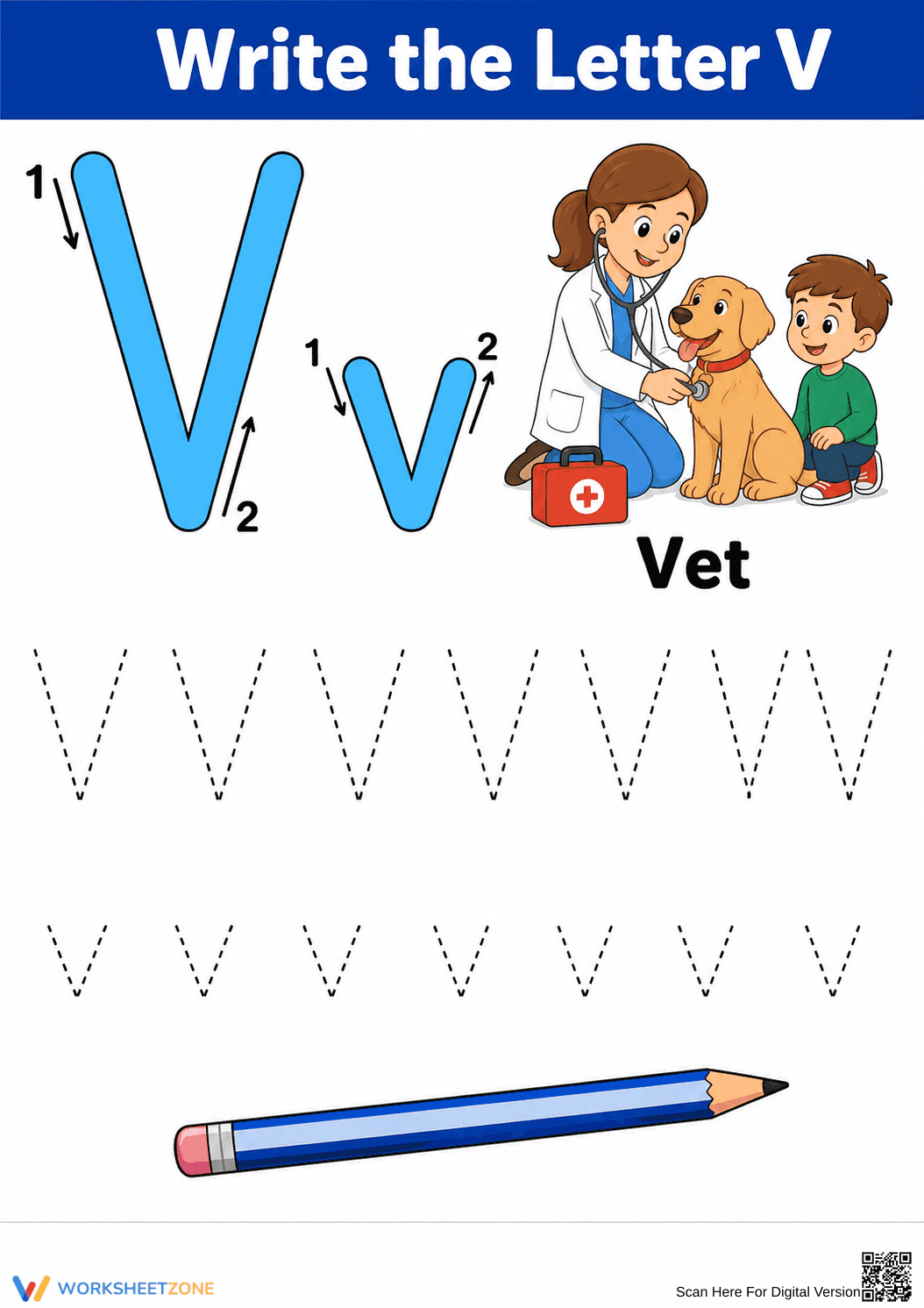
This Grade K-1 Letter V worksheet helps early learners master letter formation and phonemic awareness through structured tracing. Students develop the fine motor control necessary for handwriting while connecting the letter V to the "Vet" beginning sound. It provides a clear, visual path for stroke order to ensure proper letter construction.
At a Glance
- Grade: K-1 · Subject: ELA Phonics
- Standard:
CCSS.ELA-LITERACY.L.K.1.A— Print many upper- and lowercase letters accurately- Skill Focus: Letter V formation
- Format: 1 page · 14 tasks · No key needed · PDF
- Best For: Morning work or literacy centers
- Time: 5–10 minutes
Inside this resource, you will find a single-page layout featuring a large visual anchor of a veterinarian to reinforce the /v/ sound. The worksheet includes 7 uppercase "V" tracing prompts and 7 lowercase "v" tracing prompts. Directional arrows guide students through the two-stroke process for each character, ensuring they learn the correct top-to-bottom motion.
The zero-prep workflow for this resource is designed for maximum efficiency in busy classrooms. First, print the single-page PDF (30 seconds). Second, distribute the sheets to students during your phonics block or as a transition activity (1 minute). Finally, provide immediate verbal feedback as you circulate the room to check for proper grip and stroke direction (2 minutes). This makes it an ideal choice for emergency sub plans or quick morning work.
This activity aligns with `CCSS.ELA-LITERACY.L.K.1.A`, which requires students to print many upper- and lowercase letters. It also supports `CCSS.ELA-LITERACY.RF.K.1.B` by helping students recognize that spoken words are represented in written language by specific sequences of letters. Both standard codes can be copied directly into lesson plans, IEP goals, or district curriculum mapping tools.
Use this worksheet as a formative assessment after introducing the letter V sound. It works exceptionally well during small-group rotations where the teacher can observe pencil grip. For a quick check, look for students who start their strokes from the bottom instead of the top, as this indicates a need for further modeling. The 14 tasks provide enough repetition to build muscle memory without causing fatigue.
This resource is ideal for Kindergarten students beginning their handwriting journey and Grade 1 students needing remedial fine motor practice. It pairs naturally with a "Letter of the Week" anchor chart or a phonics reader focused on community helpers like veterinarians. The clean design ensures that students with sensory processing needs are not overwhelmed by excessive visual clutter.
Handwriting remains a foundational pillar of literacy development, as evidenced by research from Fisher & Frey (2014) regarding the importance of guided practice in early childhood education. This worksheet targets `CCSS.ELA-LITERACY.L.K.1.A` by providing 14 specific tracing opportunities that bridge the gap between visual recognition and motor execution. By focusing on the letter V and its association with the "Vet" beginning sound, the resource reinforces phonemic awareness alongside orthographic mapping. According to the RAND AIRS 2024 report, consistent, short-burst practice sessions are more effective for letter mastery than infrequent, long-duration tasks. This printable PDF offers a structured, low-stakes environment for students to build the muscle memory required for fluent writing. Educators can utilize this tool to ensure that every student meets the foundational benchmarks for letter production before moving into complex word construction.


