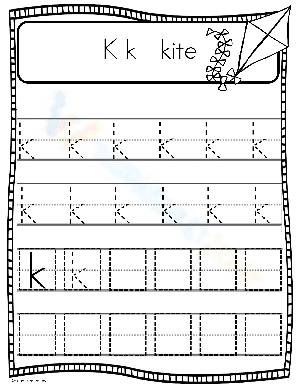
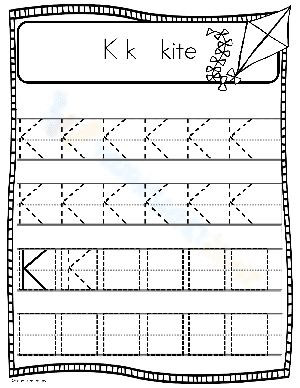
A good set of letter K tracing worksheets addresses something that generic alphabet printables often skip: the letter K requires three distinct strokes in a specific sequence, not a casual run along a dotted outline. These worksheets cover both uppercase and lowercase formation, build in starting-point cues and directional arrows, and connect the letter shape to the /k/ sound through labeled illustrations. They are built for preschool through early kindergarten and fit the handwriting instruction window most teachers run during the first eight to ten weeks of the school year.
What the Letter K Actually Demands
The letter K is harder to form than most early alphabet letters. The vertical stroke is a pull-straight-down motion that children often manage without much trouble, but the diagonals are a different matter. The upper-right diagonal starts at the top line and meets the vertical at its exact midpoint. The lower-right diagonal starts from that same midpoint and angles toward the baseline. Young children consistently misjudge that midpoint — they place the meeting point too high, producing a shape that looks more like F's top crossbar attached to an upright than a properly proportioned K.
The lowercase k introduces a second wrinkle. Its second stroke involves a short inward curve that barely clears the midline before kicking away toward the baseline — a two-beat motion that many four- and five-year-olds flatten into a single straight diagonal, drawing something closer to a lowercase y than a k. Each worksheet in the set addresses uppercase and lowercase separately, so teachers can target whichever form needs more attention before combining both in review practice.
Connecting Letter Shape to Sound During Tracing
The most productive tracing sessions double as phonics reinforcement. When a worksheet places a kite, a king, or a kangaroo beside the tracing lines, the child's eyes move between the image and the letter repeatedly — that pairing does letter-sound mapping work while the hand does the motor work. Rather than treating the phonics connection as a separate activity that follows the tracing, teachers can ask students to say the /k/ sound each time they complete a full letter stroke. That small shift keeps the auditory channel active throughout the session instead of letting it sit idle while hands are busy.
Fitting These Worksheets Into the Daily Schedule
The ten minutes before a transition — after morning meeting ends, before the read-aloud begins — is exactly the right window for letter K tracing worksheets. Students are still seated, focus is fresh, and the structured task keeps the group settled while the teacher does a quick visual sweep of pencil grips and stroke direction. That sweep is where the real formative data lives: a teacher circulating during independent tracing can spot the child drawing the diagonal from bottom to top in under thirty seconds.
For small groups who need repeated practice, slipping each worksheet into a dry-erase pocket gives students four or five repetitions on the same model without additional printing. Whole-group introduction works well with a projected version on a whiteboard, where the teacher traces each stroke in the air and students mirror the motion before touching pencil to paper. That air-tracing step gives students a full-body rehearsal of the stroke sequence before the fine motor task begins.
Errors Worth Catching Before They Harden Into Habit
The most common error is the bottom-to-top vertical stroke. Children who learned certain shapes starting at the bottom carry that habit into letter formation, and the resulting K can look acceptable while the muscle memory is wrong. The directional arrows and starting dots on each worksheet make the top-to-bottom pull explicit and give students a self-correction tool that functions without teacher intervention on every repetition.
A subtler error: students who complete the upper diagonal correctly will sometimes begin the lower diagonal from the top of the vertical line rather than the midpoint, essentially drawing a full letter V attached to the upright. The resulting shape resembles a K at first glance, but the proportions are off and the error compounds when students encounter cursive or mixed-case writing later. The verbal cue "touch the middle, then kick away" — said quietly while students trace — reduces this mistake significantly during guided practice and gives students the language to self-coach during independent work.
Standard Alignment
These worksheets align to CCSS.ELA-LITERACY.L.K.1.A, which requires kindergartners to print many upper- and lowercase letters. In classroom terms, this standard sits at the center of the first marking period, when teachers are building stroke-formation habits that students will carry forward into connected writing. Pre-K programs drawing on state early learning standards typically address the same skill under print awareness and emergent writing domains, so the worksheets serve both populations without modification to the core task.
Adjusting the Worksheets for Different Learners in the Same Room
Students who are still developing pencil control benefit from working with the letter K tracing worksheets printed at 125 percent scale — the wider tracing paths are more forgiving of small motor variability and reduce the frustration that comes from a pencil drifting repeatedly outside a narrow guide. For students whose grip and line control are already solid, adding a free-write line at the bottom of each worksheet — where they produce the letter without any tracing guide — shifts the task from imitation to recall and moves them toward independent production without requiring a separate, more advanced resource.
For students receiving occupational therapy services, it is worth flagging the diagonal strokes of the uppercase K with the OT specifically. Diagonal-line production is among the last pre-writing stroke types children master before consistent letter formation becomes possible, so the K's intersecting angles sit at the edge of what many four-year-olds can execute with reliable control. Completed worksheets saved across several weeks give the OT concrete evidence of motor progress that anecdotal check-ins cannot replicate.
Frequently Asked Questions
When do children typically have the fine motor readiness for letter K formation?
Most children develop the control needed for formal letter tracing between ages four and five, though readiness varies considerably. Before introducing K formation, a child should be able to trace isolated straight lines and simple diagonal lines without significant drift off the path. If a student cannot hold the pencil without tensing the entire hand, the intersecting diagonals will produce frustration rather than learning. Pre-writing line practice — isolated diagonals, crosses, and intersecting lines — is the right preparation before the letter itself is introduced.
How should I correct a student who traces the vertical stroke from bottom to top?
Physical hand-over-hand guidance for two or three repetitions, paired with a clear verbal cue, resets the motion faster than repeated verbal instruction alone. Selecting a letter K tracing worksheets that includes a large, color-coded starting dot — green is the standard classroom cue for "begin here" — gives students an independent anchor that functions when the teacher is across the room with another student. The verbal cue "start at the top, pull down" gives students consistent language to rehearse internally during unguided practice.
How long should a daily tracing session last for preschool and kindergarten students?
Eight to twelve minutes is the practical ceiling for productive pencil-control practice at these ages. Beyond that point, hand fatigue sets in and letter quality deteriorates — which means students are practicing imprecise formation, the opposite of the session's purpose. Short, daily sessions build motor memory more reliably than longer sessions held two or three times a week. Ending each session by having students hold up their completed work and compare it to the model builds the internal standard that eventually makes independent writing self-correcting.