


























Views
Downloads

Letter V Tracing Worksheet | Essential Kindergarten ELA
Paste this activity's link or code into your existing LMS (Google Classroom, Canvas, Teams, Schoology, Moodle, etc.).
Students can open and work on the activity right away, with no student login required.
You'll still be able to track student progress and results from your teacher account.
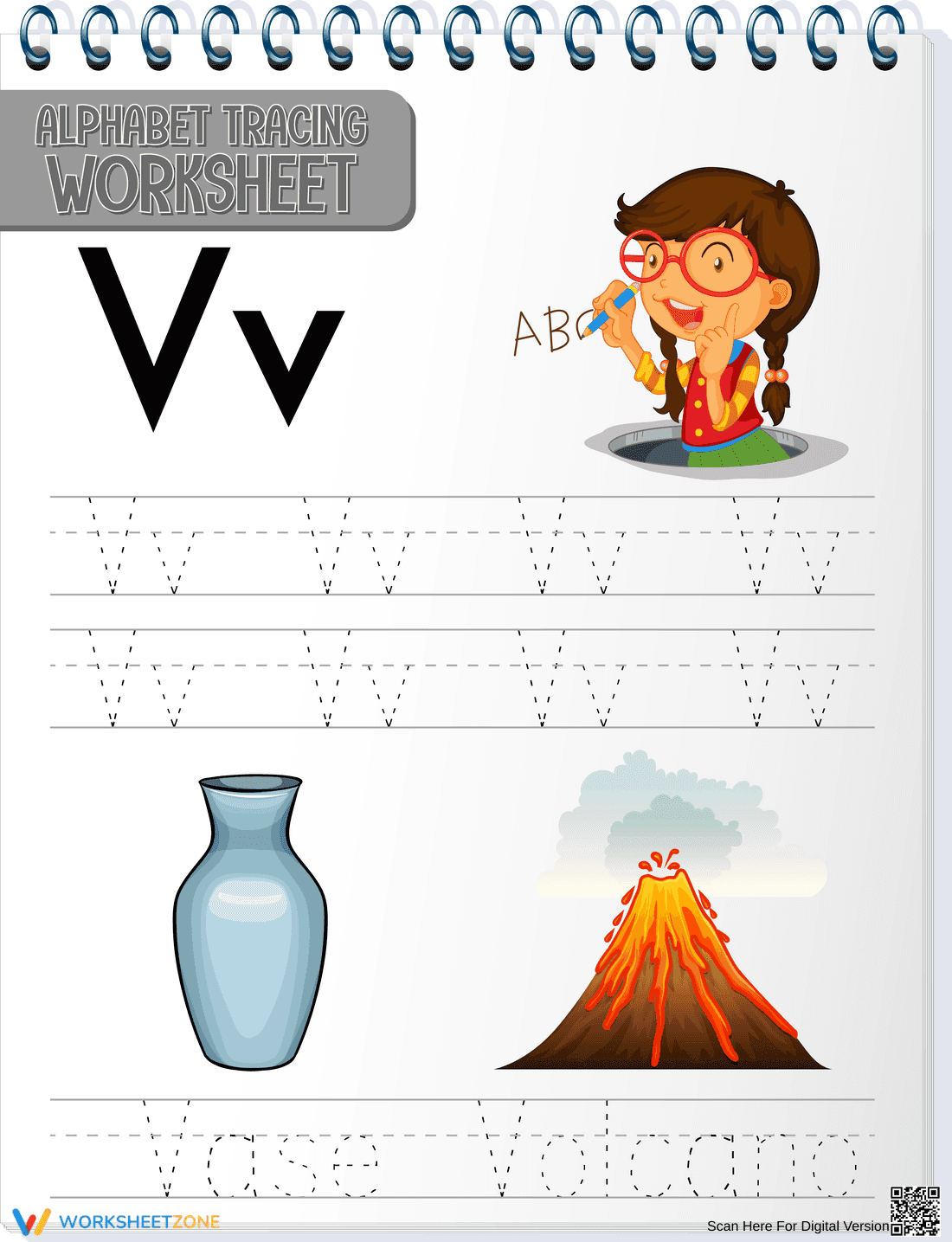
This printable Letter V worksheet helps early learners master uppercase and lowercase letter formation through guided tracing. By connecting the visual shape of the letter with the physical motion of writing, students build the fine motor skills necessary for literacy success. It provides immediate practice with initial consonant sounds using familiar vocabulary.
At a Glance
- Grade: Kindergarten · Subject: ELA
- Standard:
CCSS.ELA-LITERACY.L.K.1.A— Print many upper- and lowercase letters correctly- Skill Focus: Letter V formation and phonics
- Format: 1 page · 16 tasks · Answer key included · PDF
- Best For: Morning work or literacy centers
- Time: 10–15 minutes
Inside this resource, you will find a structured layout featuring large reference letters for visual recognition. The worksheet includes two dedicated rows for tracing uppercase "V" and lowercase "v," followed by two vocabulary words—"Vase" and "Volcano"—accompanied by high-quality illustrations. The dotted-line font provides clear paths for young writers to follow as they develop muscle memory.
The zero-prep workflow is designed for busy classrooms. First, print the single-page PDF (30 seconds). Next, distribute the sheets to students during your phonics block (1 minute). Finally, review the letter strokes as a group or check for proper pencil grip as students work independently (5 minutes). Total teacher preparation time is under 2 minutes, making this an ideal choice for sub plans or unexpected schedule changes.
This worksheet aligns with CCSS.ELA-LITERACY.L.K.1.A, which requires students to print many upper- and lowercase letters. It also supports phonological awareness by linking the letter "V" to its corresponding sound in common nouns. Both standard codes can be copied directly into lesson plans, IEP goals, or district curriculum mapping tools to ensure instructional compliance.
Use this worksheet as a formative assessment after introducing the letter "V" on an anchor chart. Observe students to ensure they start their strokes at the top line, which is a key indicator of handwriting readiness. It also serves as an excellent quiet activity for students who finish their primary literacy tasks early or as a homework assignment to reinforce classroom learning.
This resource is ideal for preschool, kindergarten, and first-grade students who are developing fine motor control. It is particularly helpful for English Language Learners (ELLs) who benefit from the visual cues of the vase and volcano. Pair this with a tactile sand tray or "sky writing" exercise for a multi-sensory lesson that caters to different learning styles.
According to the RAND AIRS 2024 report on early literacy, consistent handwriting practice is a foundational component of orthographic mapping, which allows children to recognize words automatically. This Letter V worksheet provides the repetitive, high-frequency exposure required for students to move from conscious letter construction to fluid writing. By focusing on CCSS.ELA-LITERACY.L.K.1.A, the resource ensures that students meet national benchmarks for letter production. Research from Fisher & Frey (2014) emphasizes that guided practice with visual scaffolds, such as the dotted lines used here, significantly reduces cognitive load for novice writers. This allows the student to focus on the precision of the stroke rather than memorizing the shape in isolation. Integrating phonics-based vocabulary like "vase" and "volcano" further reinforces the alphabetic principle, making this a comprehensive tool for early childhood ELA instruction and literacy development.


