


























Views
Downloads
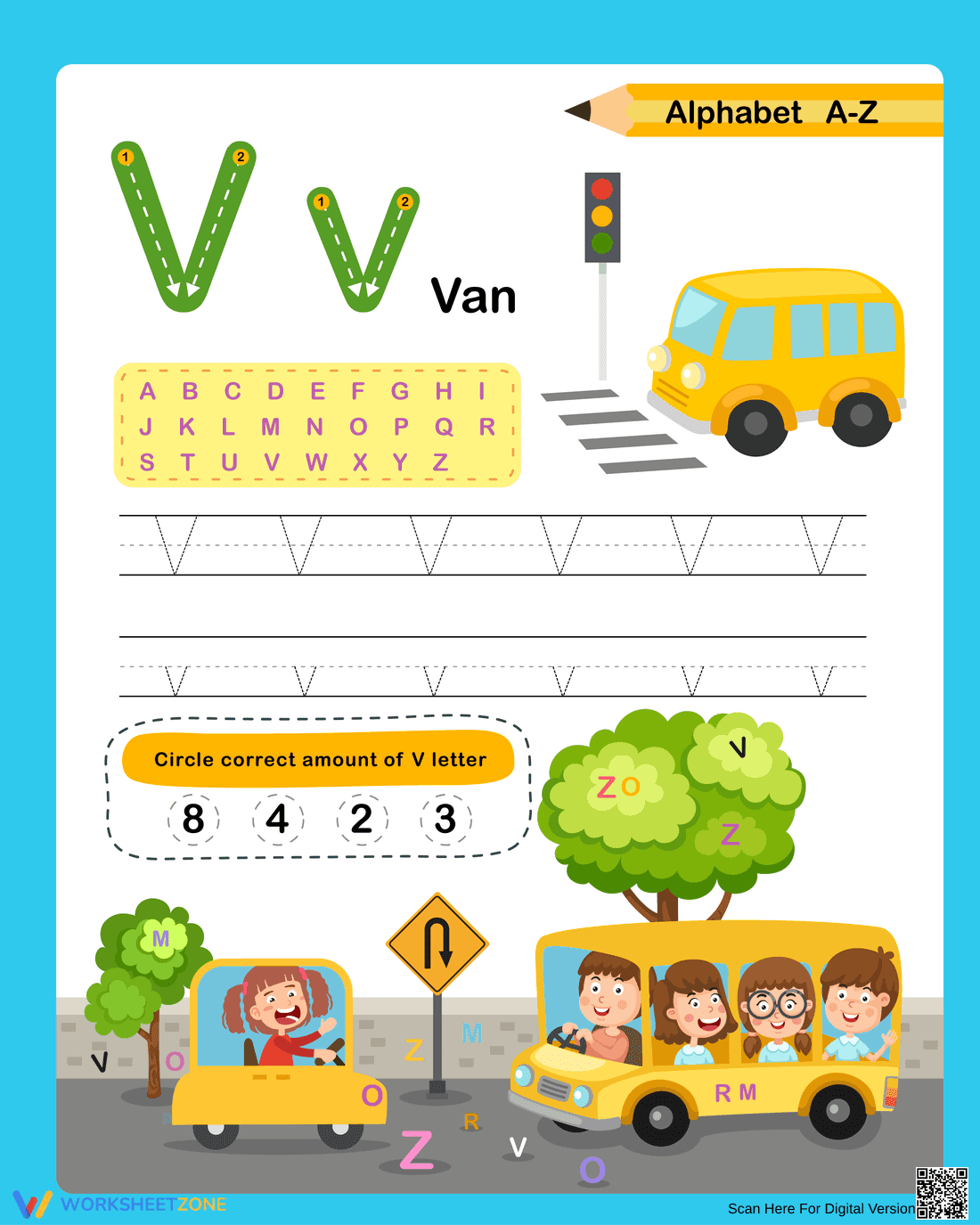

Letter V Alphabet Worksheet | Grade K Printable
Paste this activity's link or code into your existing LMS (Google Classroom, Canvas, Teams, Schoology, Moodle, etc.).
Students can open and work on the activity right away, with no student login required.
You'll still be able to track student progress and results from your teacher account.
This Letter V worksheet provides early learners with a structured path to mastering alphabet recognition and handwriting. By combining visual cues like a "Van" with tactile tracing practice, students build the muscle memory and phonemic awareness necessary for reading readiness. It is a complete resource for foundational literacy.
At a Glance
- Grade: Kindergarten · Subject: ELA Alphabet
- Standard:
CCSS.ELA-LITERACY.RF.K.1.D— Recognize and name all upper- and lowercase letters of the alphabet- Skill Focus: Letter V formation and identification
- Format: 1 page · 14 tasks · Answer key included · PDF
- Best For: Independent morning work or literacy centers
- Time: 10–15 minutes
The worksheet features a clear uppercase and lowercase "V" guide with numbered directional arrows to ensure proper stroke order. Below the instructional header, students find two rows of tracing practice to refine fine motor skills. The bottom half contains an engaging "letter hunt" illustration where students must identify and count the letter "V" hidden within a vibrant school bus scene.
This resource is designed for a zero-prep classroom workflow. Teachers can print the single-page PDF in less than 30 seconds. Distribution takes 1 minute during transition periods. Reviewing the counting task as a whole group takes approximately 2 minutes, allowing for immediate feedback. It is an ideal solution for substitute folders or unexpected schedule gaps that require high-quality instructional content.
Aligned to `CCSS.ELA-LITERACY.RF.K.1.D`, this worksheet focuses on the essential skill of recognizing and naming all upper- and lowercase letters. It also supports `CCSS.ELA-LITERACY.L.K.1.A` by encouraging students to print many upper- and lowercase letters. Both standard codes can be copied directly into lesson plans, IEP goals, or district curriculum mapping tools.
Use this worksheet during the independent practice phase of a lesson on the letter V. It works exceptionally well as a formative assessment tool; observe students as they trace to identify those struggling with top-to-bottom stroke direction. Expected completion time is 10 to 15 minutes depending on the student's fine motor development and familiarity with the alphabet.
This printable is tailored for Preschool, Kindergarten, and Grade 1 students who are beginning their phonics journey. It provides necessary scaffolding for English Language Learners (ELLs) through visual associations. Pair this with a physical alphabet manipulative or a short reading passage featuring "V" words like "vest" or "vase" for a comprehensive literacy lesson.
Research from Fisher & Frey (2014) emphasizes the importance of multi-modal alphabet instruction, combining visual and kinesthetic tasks to solidify letter-sound correspondence. This worksheet adheres to these principles by integrating directional tracing with visual identification in a complex scene. According to the RAND AIRS 2024 report, consistent exposure to letter-naming tasks in early childhood is one of the strongest predictors of later reading fluency. By providing 14 distinct opportunities for interaction with the letter V, this resource ensures that students move beyond rote memorization toward mastery. The inclusion of both upper and lowercase forms aligns with current best practices in early literacy, ensuring students recognize the letter in various typographic contexts. This structured approach supports the development of the orthographic processor, a critical component of the brain's reading network as identified in recent neuroscientific studies of literacy acquisition.


