


























Views
Downloads
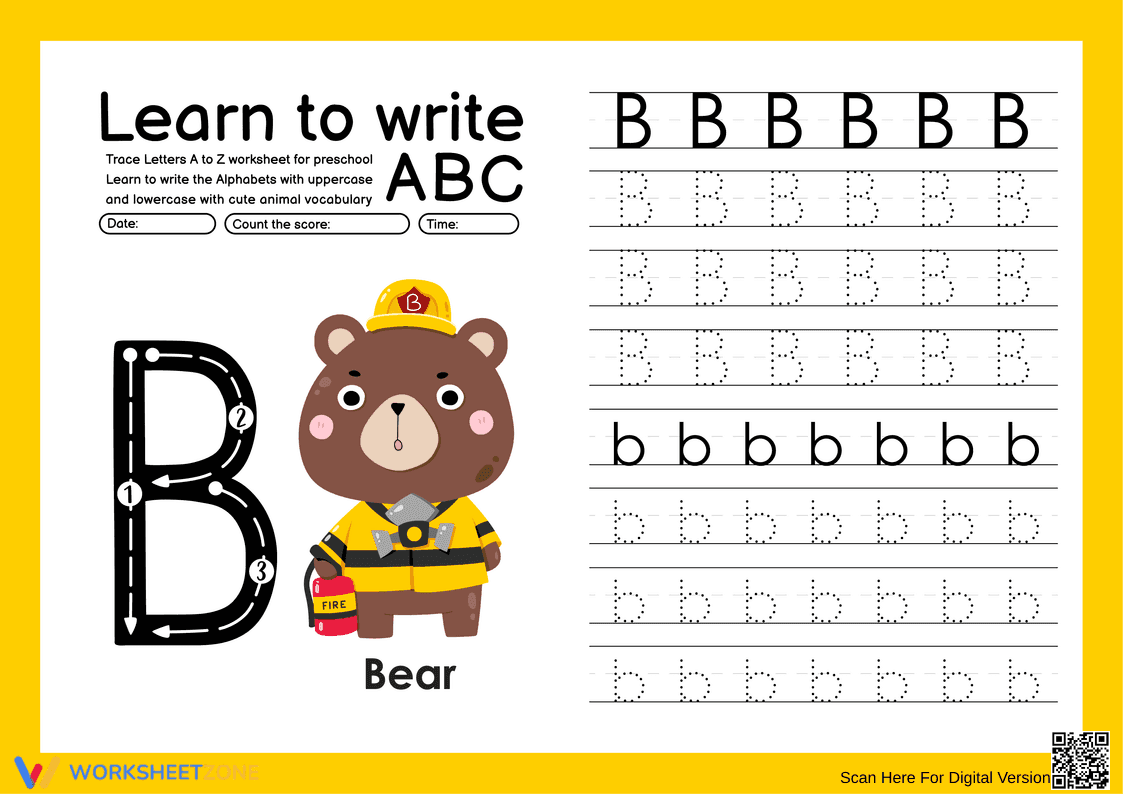

Letter B Tracing Worksheet | Essential Grade K ELA
Paste this activity's link or code into your existing LMS (Google Classroom, Canvas, Teams, Schoology, Moodle, etc.).
Students can open and work on the activity right away, with no student login required.
You'll still be able to track student progress and results from your teacher account.
This essential Letter B tracing worksheet helps early learners master uppercase and lowercase letter formation through repetitive, guided practice. By focusing on stroke order and visual recognition, students develop the fine motor skills necessary for legible handwriting. This resource ensures students can confidently identify and write the second letter of the alphabet.
At a Glance
- Grade: Kindergarten · Subject: ELA Alphabet
- Standard:
CCSS.ELA-LITERACY.L.K.1.A— Print many upper- and lowercase letters accurately- Skill Focus: Letter B formation
- Format: 1 page · 48 tasks · No answer key required · PDF
- Best For: Morning work or literacy centers
- Time: 10–15 minutes
The worksheet features a large instructional graphic showing the numbered stroke order for the letter B, paired with a Bear illustration for phonemic awareness. It includes four rows of uppercase B tracing and four rows of lowercase b tracing. The layout provides ample white space to prevent visual overwhelm for young writers.
This resource is designed for a zero-prep workflow. First, print the single-page PDF in approximately 30 seconds. Second, distribute to students with a pencil or crayon. Third, provide a quick verbal prompt regarding the Bear sound and monitor stroke direction. Total teacher preparation time is under two minutes, making it an ideal sub plan addition.
This activity aligns with CCSS.ELA-LITERACY.L.K.1.A, which requires students to print many upper- and lowercase letters. It also supports phonological awareness by linking the letter shape to the initial /b/ sound in Bear. This standard code can be copied directly into lesson plans, IEP goals, or district curriculum mapping tools.
Use this worksheet during the independent practice phase of a handwriting lesson or as a quiet morning work activity. For a formative assessment, observe if students follow the numbered stroke guides (1, 2, 3) or if they draw the letter haphazardly. Expected completion typically takes between 10 and 15 minutes for most students.
This is ideal for preschool, kindergarten, and first-grade students who need tactile practice with alphabet mechanics. It serves as a perfect companion to an alphabet anchor chart or a read-aloud book featuring animals. It is also suitable for occupational therapy sessions focusing on pencil grip and fine motor control.
According to the RAND AIRS 2024 report on early literacy, repetitive tracing exercises are foundational for developing the graphomotor skills required for later writing fluency. This worksheet targets CCSS.ELA-LITERACY.L.K.1.A by providing 48 specific opportunities for students to practice the distinct curves and lines of the letter B. Research from Fisher & Frey (2014) emphasizes that guided practice with clear visual cues, such as the numbered stroke order provided here, reduces cognitive load for novice learners. By integrating a pictorial mnemonic like the Bear, the resource bridges the gap between letter recognition and phonemic production. This structured approach ensures that students move from simple imitation to independent letter production. Educators can utilize this data-backed method to ensure that foundational handwriting milestones are met within the standard kindergarten curriculum framework.


