


























Views
Downloads
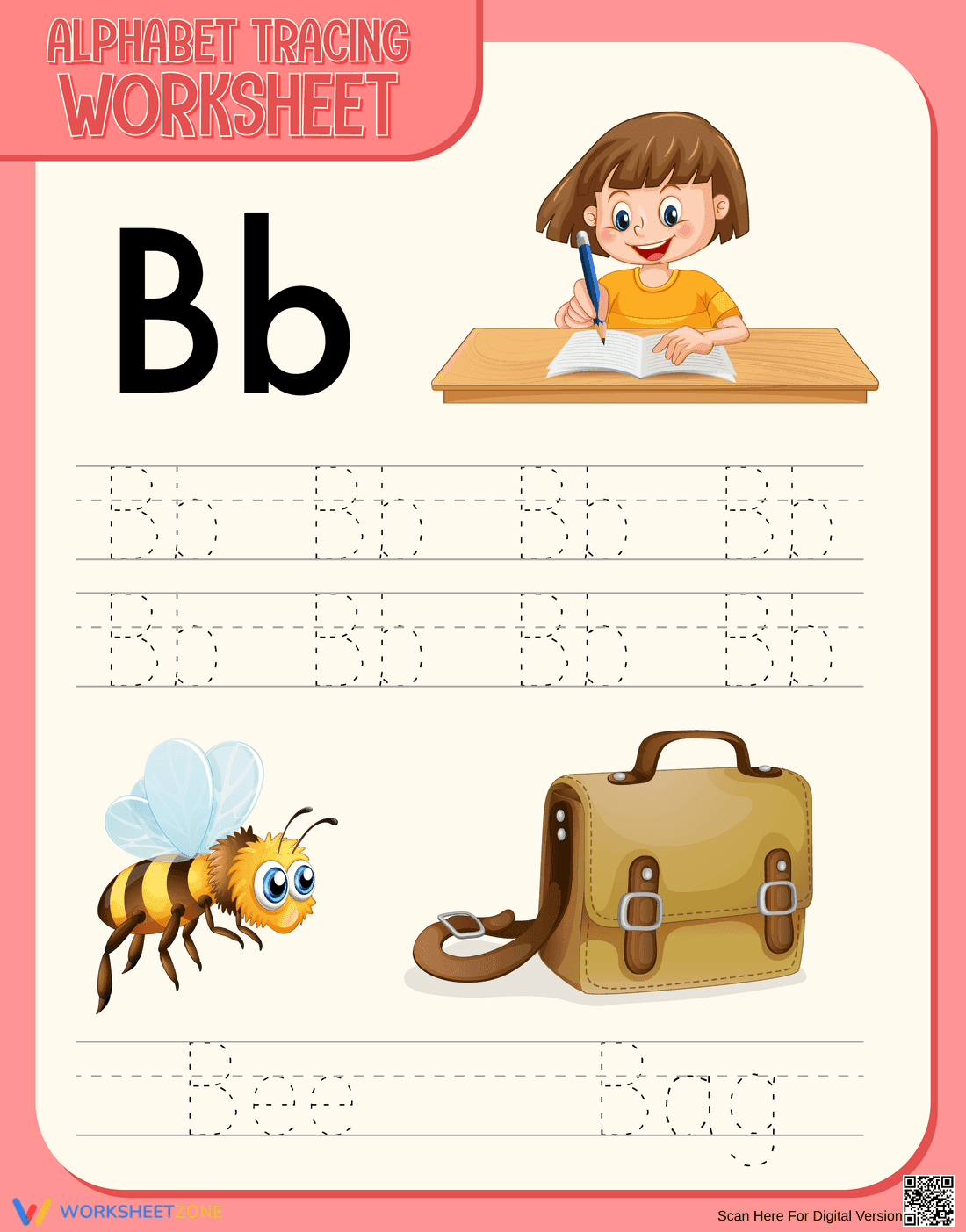

Letter B Tracing Worksheet | Grade K Essential
Paste this activity's link or code into your existing LMS (Google Classroom, Canvas, Teams, Schoology, Moodle, etc.).
Students can open and work on the activity right away, with no student login required.
You'll still be able to track student progress and results from your teacher account.
This Grade K letter B tracing worksheet helps early learners master uppercase and lowercase letter formation through repetitive, guided practice. By tracing the letter B and associated vocabulary words, students build the fine motor control and phonemic awareness necessary for early literacy success.
At a Glance
- Grade: Kindergarten · Subject: ELA · Level: Early Literacy
- Standard:
CCSS.ELA-LITERACY.L.K.1.A— Print many upper- and lowercase letters correctly- Skill Focus: Letter B formation and initial sound recognition
- Format: 1 page · 10 tracing tasks · Visual guide included · PDF
- Best For: Daily morning work, literacy centers, or homework
- Time: 10–15 minutes of focused practice
This single-page PDF features large reference letters, two rows of dotted-line tracing for "Bb" pairs, and two vocabulary words ("Bee" and "Bag") with corresponding illustrations. The clear, uncluttered layout ensures young students can focus entirely on their pencil grip and stroke order without distraction.
Skill Progression
- Guided Practice: Students begin by tracing 8 sets of uppercase and lowercase "Bb" pairs to establish muscle memory and stroke directionality.
- Supported Practice: Learners transition to tracing full words, "Bee" and "Bag," which provides immediate context for the letter's sound.
- Independent Practice: The final section allows students to demonstrate control by completing the words without additional letter-by-letter scaffolding.
This worksheet utilizes a gradual-release approach, moving from isolated character formation to functional word application.
Standards Alignment
This resource aligns with `CCSS.ELA-LITERACY.L.K.1.A`, which requires students to print many upper- and lowercase letters. It also supports phonological awareness by linking the letter shape to the /b/ sound in "Bee" and "Bag." Both standard codes can be copied directly into lesson plans, IEP goals, or district curriculum mapping tools.
How to Use It
Use this worksheet during small-group instruction to observe pencil grip and stroke directionality. It also serves as an excellent formative assessment tool; teachers can quickly check for consistent letter sizing and alignment. Expected completion time is approximately 12 minutes for most Kindergarten students.
Who It's For
This resource is designed for Preschool, Kindergarten, and Grade 1 students who are developing fine motor skills. It is particularly effective for English Language Learners (ELLs) who benefit from the visual cues. Pair this with a letter B anchor chart or a tactile sand-tracing activity for a multi-sensory experience.
According to the RAND AIRS 2024 report, repetitive tracing exercises are fundamental for developing the muscle memory required for fluent handwriting in early childhood. This worksheet targets the CCSS.ELA-LITERACY.L.K.1.A standard by providing 10 specific tracing opportunities that bridge the gap between letter recognition and production. By integrating phonics-based vocabulary like "Bee" and "Bag," the resource reinforces the alphabetic principle, ensuring students connect visual symbols with their corresponding auditory sounds. Research from Fisher & Frey (2014) emphasizes that such guided practice is essential for scaffolding independent writing skills. Educators can utilize this structured format to ensure all students, including those requiring additional fine motor support, achieve mastery in letter formation. This printable PDF provides a reliable, evidence-based method for early literacy intervention and daily classroom practice.


