


























Views
Downloads

Printable Letter B Tracing Worksheet | Kindergarten ELA
Paste this activity's link or code into your existing LMS (Google Classroom, Canvas, Teams, Schoology, Moodle, etc.).
Students can open and work on the activity right away, with no student login required.
You'll still be able to track student progress and results from your teacher account.
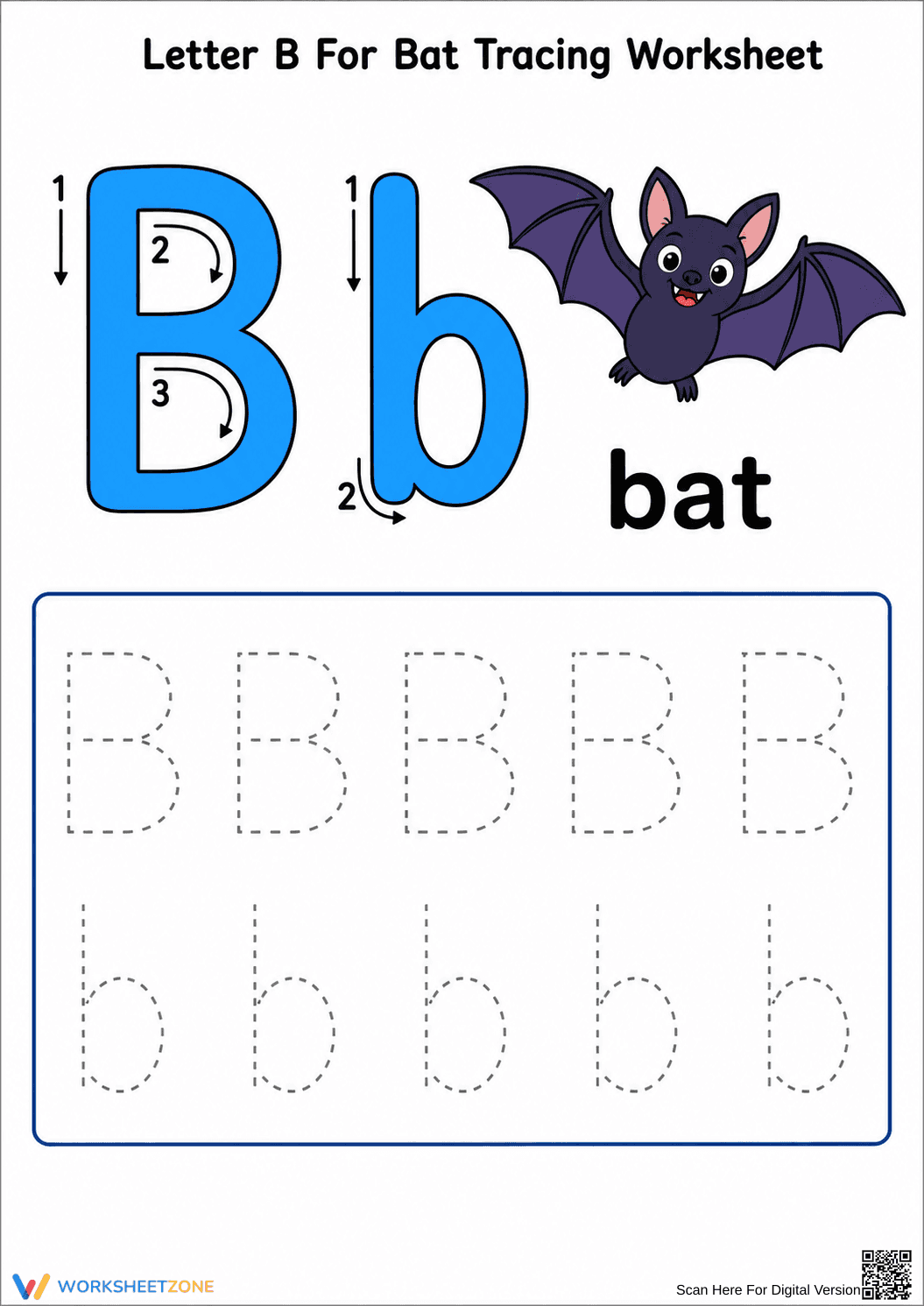
This printable Letter B tracing worksheet helps early learners master handwriting and letter recognition. By practicing guided strokes for both uppercase and lowercase letters, students develop fine motor skills and reinforce beginning sound associations with a fun bat illustration. Perfect for foundational literacy development.
At a Glance
- Grade: Kindergarten · Subject: ELA
- Standard:
CCSS.ELA-LITERACY.L.K.1.a— Print many upper- and lowercase letters- Skill Focus: Letter B Tracing and Recognition
- Format: 1 page · 10 problems · No answer key needed · PDF
- Best For: Independent practice and centers
- Time: 10–15 minutes
This single-page resource features a clear layout for young learners. The top section provides a guided example of uppercase and lowercase B, with numbered directional arrows ensuring proper stroke order. A vibrant bat illustration helps solidify the beginning sound connection. The bottom half contains a practice area with five dashed uppercase and five dashed lowercase letters for independent tracing.
This resource offers a zero-prep workflow, ideal for busy mornings:
- Print (1 minute): Simply download the PDF and print the required number of copies. The high-contrast design ensures crisp lines on standard school printers.
- Distribute (1 minute): Hand out the sheets along with pencils or crayons. The visual instructions are intuitive enough that students can begin immediately.
- Review (1 minute): Quickly scan student work to check for proper stroke direction and pencil grip.
With under two minutes of total teacher prep time, this worksheet is an excellent addition to any emergency sub plan or morning work binder.
This activity is directly aligned with CCSS.ELA-LITERACY.L.K.1.a, requiring students to print many upper- and lowercase letters. It also supports foundational phonics skills by connecting the visual letter form to its corresponding initial sound. Both standard codes can be copied directly into lesson plans, IEP goals, or district curriculum mapping tools.
Teachers can utilize this tracing page during morning work to establish a calm start to the day. It also serves as an excellent literacy center activity following direct instruction. Educators can conduct quick formative assessments by observing pencil grip and verifying that children follow the numbered directional arrows rather than drawing letters backward. Expect students to complete this task within 10 to 15 minutes.
This printable is designed for Kindergarten and early Grade 1 students developing foundational handwriting and phonics skills. It provides essential scaffolding for learners struggling with fine motor control, offering large dashed lines to guide pencil movements. Pair this worksheet with a read-aloud book featuring prominent B vocabulary or a classroom anchor chart displaying words sharing the same beginning sound.
Developing automaticity in letter formation is a critical stepping stone for early literacy. According to Fisher & Frey (2014), providing explicit instruction and structured practice in handwriting significantly reduces the cognitive load required for writing, allowing young students to focus their mental energy on composing ideas and applying phonics knowledge. This worksheet targets CCSS.ELA-LITERACY.L.K.1.a by helping students print many upper- and lowercase letters with correct stroke sequences. By integrating visual cues like directional arrows and the bat illustration, the activity reinforces both the mechanical skill of writing and the phonological awareness of beginning sounds. Consistent, targeted practice with resources like this ensures that foundational skills become automatic, paving the way for more advanced reading and writing tasks as students progress through early elementary grades. This evidence-based approach supports long-term academic success.


