


























Views
Downloads
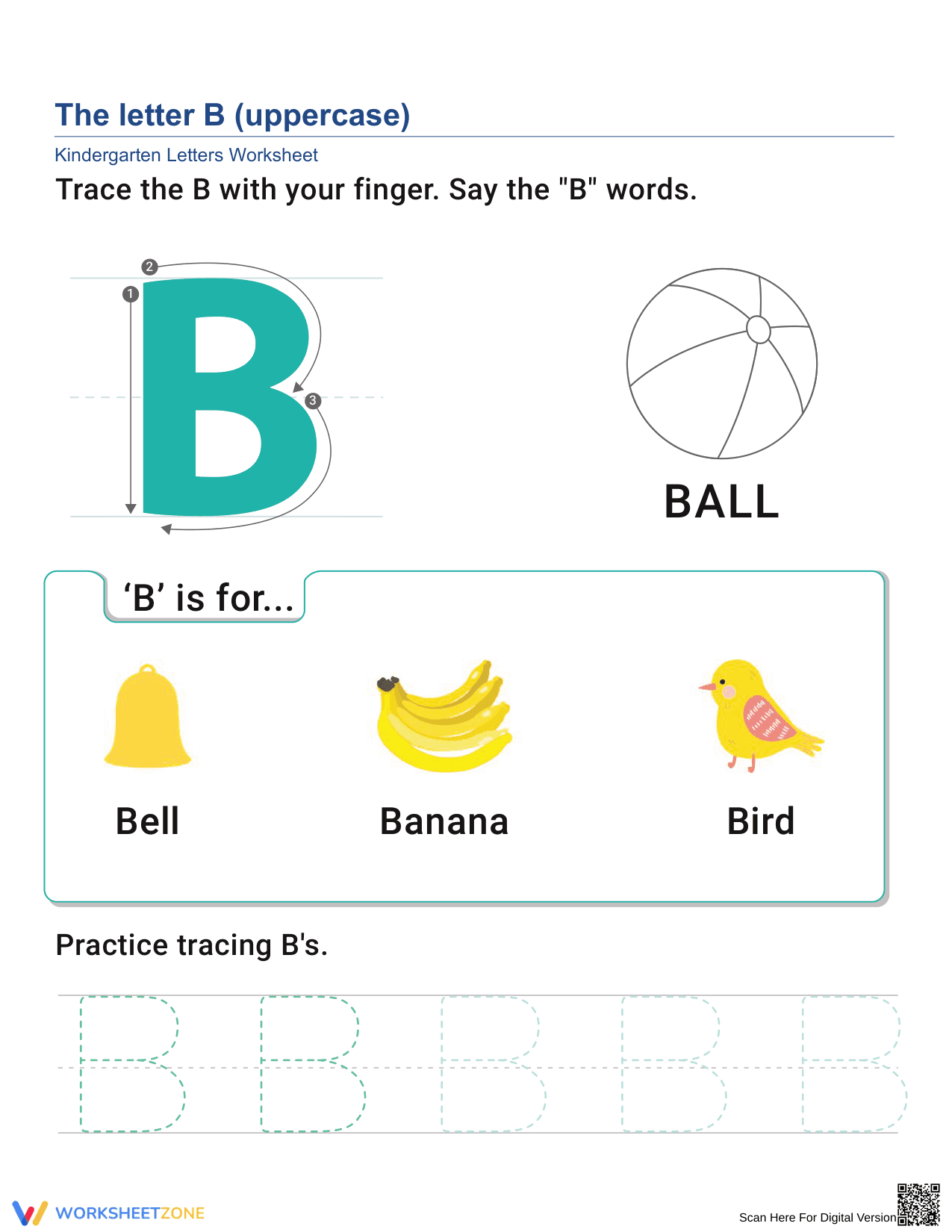

Grade K Uppercase Letter B — Printable No-Prep Worksheet
Paste this activity's link or code into your existing LMS (Google Classroom, Canvas, Teams, Schoology, Moodle, etc.).
Students can open and work on the activity right away, with no student login required.
You'll still be able to track student progress and results from your teacher account.
This uppercase letter B worksheet provides foundational alphabet practice for early learners. Students develop letter recognition and fine motor control through guided tracing and phonics association. By connecting the visual form of the letter to familiar objects, children build the essential pre-reading skills necessary for literacy success in kindergarten and beyond.
At a Glance
- Grade: Kindergarten · Subject: ELA
- Standard:
CCSS.ELA-LITERACY.RF.K.1.D— Recognize and name all upper- and lowercase letters of the alphabet- Skill Focus: Uppercase Letter B Recognition
- Format: 1 page · 10 tasks · Answer key not required · PDF
- Best For: Morning work or literacy centers
- Time: 10–15 minutes
What's Inside
The worksheet features a large, numbered guide for finger-tracing to establish correct stroke order. It includes four high-quality illustrations—a ball, bell, banana, and bird—to reinforce the initial "B" sound. The bottom section provides five dashed-line uppercase B's for independent pencil practice, ensuring students transition from tactile learning to written production.
Zero-Prep Workflow
- Print: Select the single-page PDF and print enough copies for your group in under 30 seconds.
- Distribute: Hand out the sheets during morning arrival or literacy rotations with zero teacher setup.
- Review: Monitor student stroke order and have them recite the "B" words aloud to check phonemic awareness.
This resource is an ideal sub-plan addition, requiring no prior instruction for students to begin the tracing tasks.
Standards Alignment
This resource is aligned to CCSS.ELA-LITERACY.RF.K.1.D, which requires students to recognize and name all upper- and lowercase letters of the alphabet. This worksheet specifically targets the uppercase form of the second letter. This standard code can be copied directly into lesson plans, IEP goals, or district curriculum mapping tools.
How to Use It
Use this worksheet during direct instruction as a follow-along activity while modeling letter formation on the whiteboard. It also serves as an excellent formative assessment tool; observe students as they trace to identify those struggling with grip or directional movement. Expected completion time is 10 to 15 minutes depending on the student's fine motor development.
Who It's For
This resource is ideal for preschool, kindergarten, and first-grade students who are mastering the alphabet. It is particularly helpful for English Language Learners (ELLs) due to the clear visual vocabulary support. Pair this worksheet with a letter B anchor chart or a tactile salt tray activity for a multi-sensory learning experience.
Research from Fisher & Frey (2014) emphasizes the importance of the gradual release of responsibility, which this worksheet facilitates through its transition from guided finger-tracing to independent pencil practice. Early letter recognition is a primary predictor of later reading achievement, as noted in the NAEP frameworks. By focusing on the uppercase letter B through both visual and kinesthetic modalities, this resource supports the development of the orthographic processing skills required for fluent reading. The inclusion of phonics-based vocabulary (ball, bell, banana, bird) aligns with evidence-based practices for early literacy, ensuring that students do not just memorize shapes but connect them to spoken language. This structured approach provides the repetition necessary for mastery of CCSS.ELA-LITERACY.RF.K.1.D, making it a reliable tool for early childhood educators seeking to build a strong literacy foundation.


