


























Views
Downloads
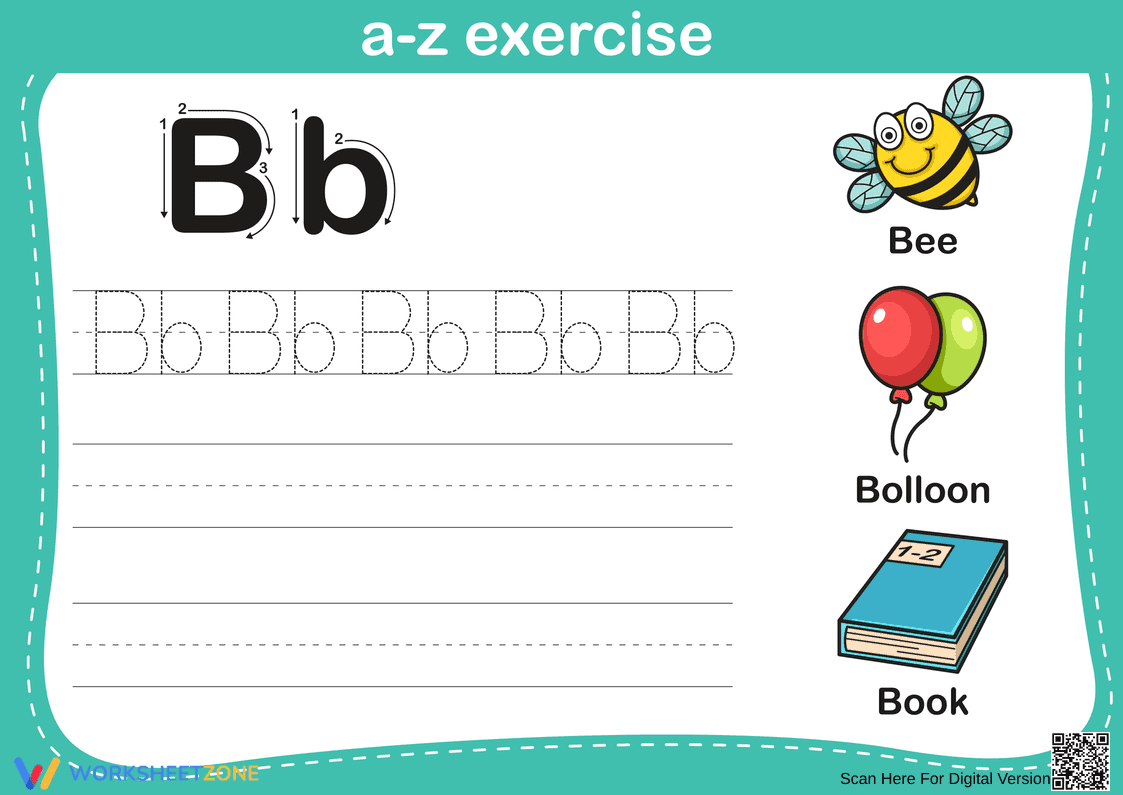

Letter B Tracing Worksheet | Essential Grade K ELA
Paste this activity's link or code into your existing LMS (Google Classroom, Canvas, Teams, Schoology, Moodle, etc.).
Students can open and work on the activity right away, with no student login required.
You'll still be able to track student progress and results from your teacher account.
This essential Letter B worksheet helps early learners master uppercase and lowercase letter formation through guided tracing and independent writing. Students develop fine motor control while connecting the letter shape to its phonetic sound using familiar visual cues like a bee, balloon, and book. This resource ensures students build the foundational muscle memory required for fluent handwriting.
At a Glance
- Grade: Kindergarten · Subject: ELA Alphabet
- Standard:
CCSS.ELA-LITERACY.L.K.1.A— Print upper- and lowercase letters of the alphabet correctly- Skill Focus: Letter B Formation
- Format: 1 page · 15 tasks · Answer key included · PDF
- Best For: Morning work or literacy centers
- Time: 10–15 minutes
Inside this single-page PDF, you will find a large directional model for both capital 'B' and lowercase 'b' with numbered stroke guides. The worksheet includes one full row of dotted-line tracing pairs and two additional primary-ruled lines for independent practice. Three colorful illustrations reinforce initial consonant sounds, helping students bridge the gap between phonics and writing.
Skill Progression
- Guided practice: Students follow numbered arrows on large models to understand the specific stroke order for the letter B.
- Supported practice: Five pairs of dotted-line letters provide a scaffold for developing consistent letter size and spacing.
- Independent practice: Two blank primary lines allow students to demonstrate mastery by writing the letters without tracing aids.
This sequence follows the gradual-release model, moving from high-support tracing to independent production for both cases.
Standards Alignment
This resource aligns with `CCSS.ELA-LITERACY.L.K.1.A`, which requires students to print many upper- and lowercase letters. It also supports `CCSS.ELA-LITERACY.RF.K.1.D` by reinforcing letter recognition through visual association. Both standard codes can be copied directly into lesson plans, IEP goals, or district curriculum mapping tools to ensure compliance with state and national frameworks.
How to Use It
Use this worksheet during the "You Do" phase of a phonics lesson after demonstrating the letter on a whiteboard. It is also an effective formative assessment tool; observe if students start their strokes from the top line to ensure proper habits. This activity is ideal for small group instruction or as a quiet morning work task. Expected completion time is 10 to 15 minutes.
Who It's For
This worksheet is designed for preschool, kindergarten, and first-grade students who need targeted handwriting practice. It is particularly helpful for English Language Learners (ELLs) who benefit from the visual vocabulary support provided by the labeled images. Pair this with a tactile sand tray or an alphabet anchor chart for a multi-sensory learning experience.
According to Fisher & Frey (2014), the gradual release of responsibility is vital for early literacy skills like handwriting. This worksheet implements that framework by transitioning students from guided tracing to independent writing of the letter B. By focusing on CCSS.ELA-LITERACY.L.K.1.A, the resource ensures that students meet foundational printing standards necessary for later writing fluency. Research from the NAEP suggests that early mastery of letter formation is a strong predictor of future writing success. This printable provides 15 specific opportunities for students to practice the correct stroke sequence, reinforcing the connection between phonemic awareness and orthographic representation. Educators can use this tool to bridge the gap between recognizing the letter B and producing it accurately on primary-ruled lines. The inclusion of visual cues further supports the cognitive association between the grapheme and its corresponding phoneme in a classroom setting.


