


























Views
Downloads

Single Replacement Reaction Worksheet | Essential Chemistry
Paste this activity's link or code into your existing LMS (Google Classroom, Canvas, Teams, Schoology, Moodle, etc.).
Students can open and work on the activity right away, with no student login required.
You'll still be able to track student progress and results from your teacher account.
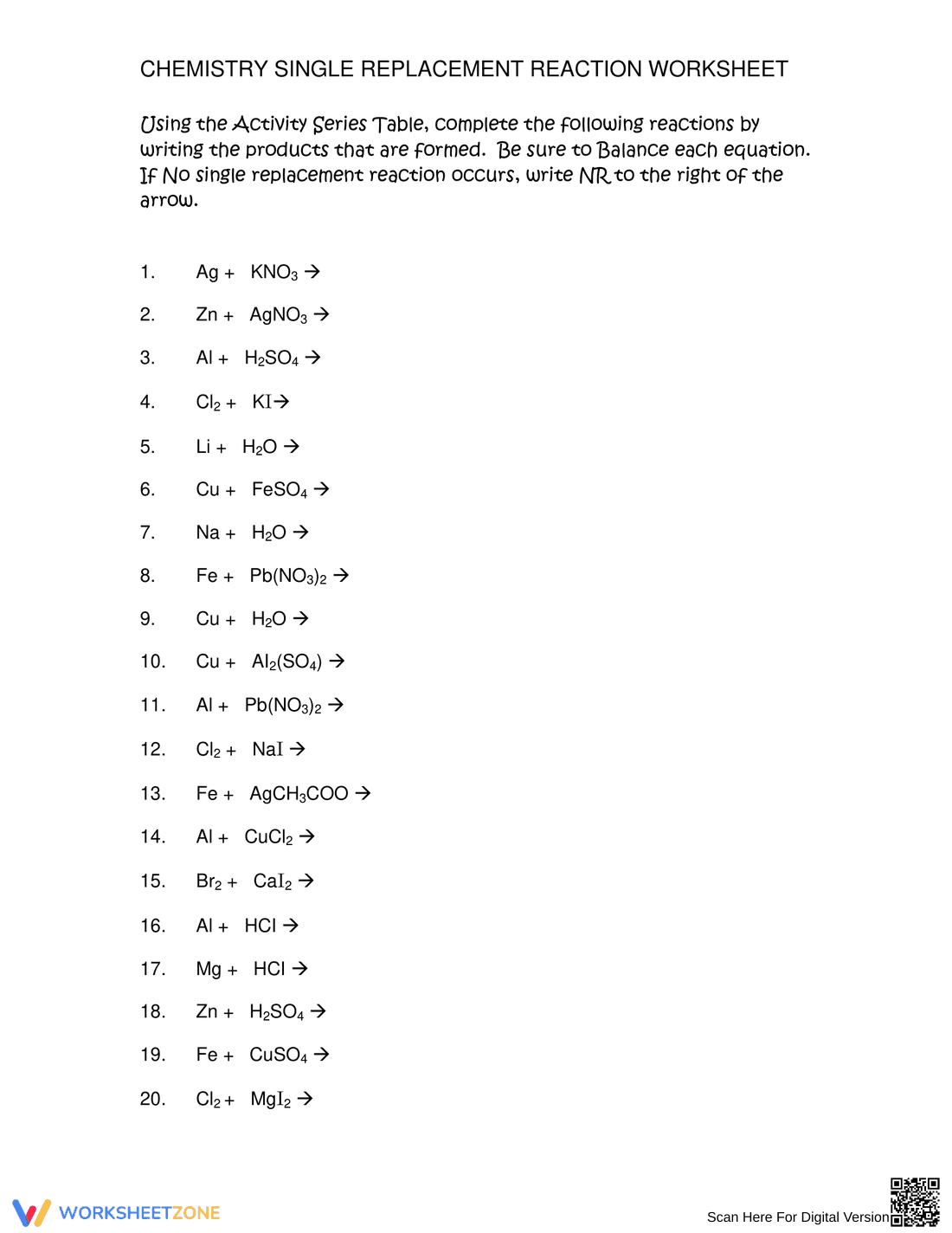
This high school chemistry worksheet provides students with targeted practice in predicting and balancing single replacement reactions. By utilizing the provided activity series, learners determine if a reaction will occur and then write the resulting balanced chemical equations. It is designed to solidify understanding of chemical reactivity and the conservation of mass in a laboratory context.
At a Glance
- Grade: High School · Subject: Chemistry
- Standard:
HS-PS1-2— Predict reaction outcomes based on patterns of chemical properties and reactivity- Skill Focus: Single Replacement Reactions & Activity Series
- Format: 4 pages · 20 problems · Answer key included · PDF
- Best For: Independent practice or sub plans
- Time: 30–45 minutes
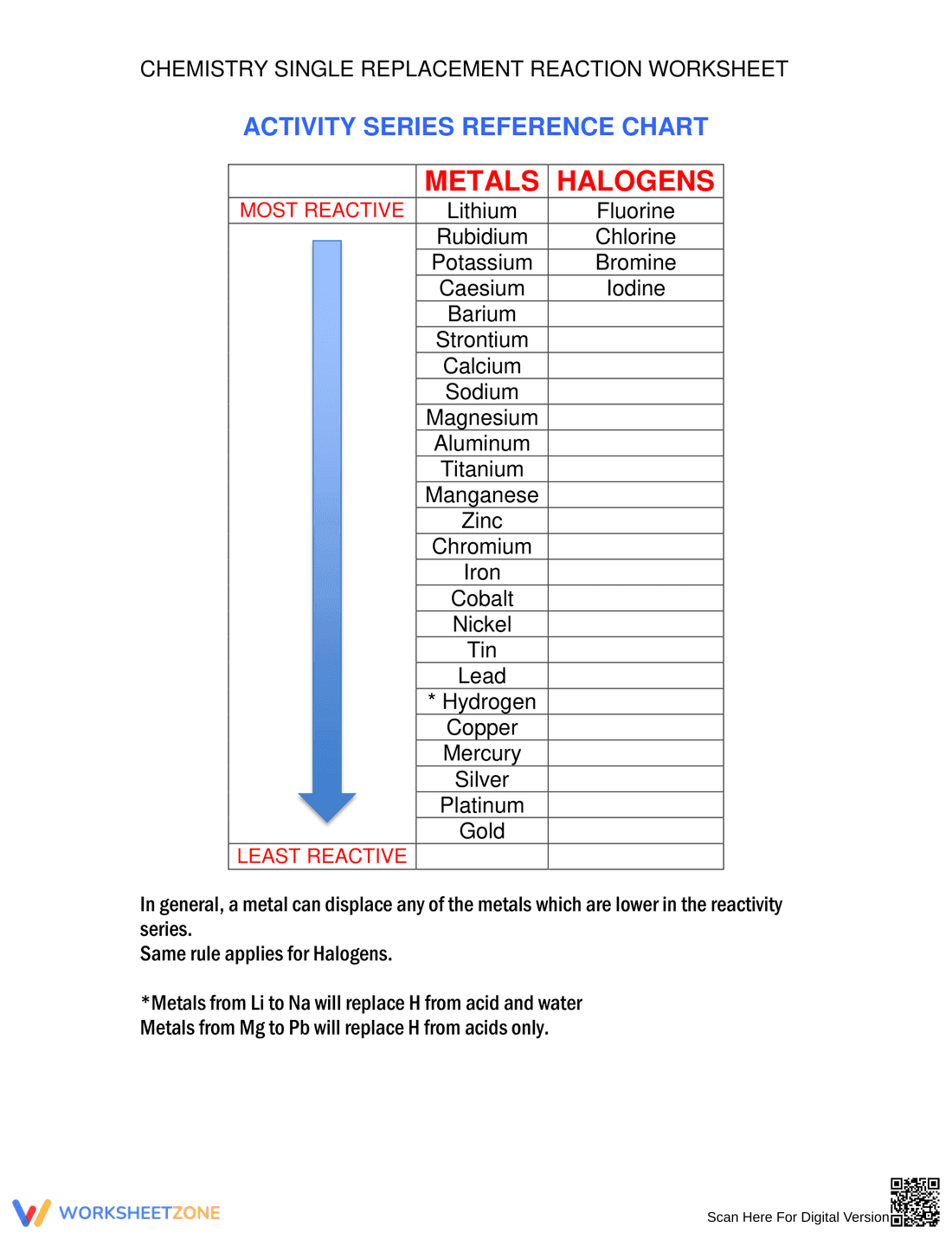
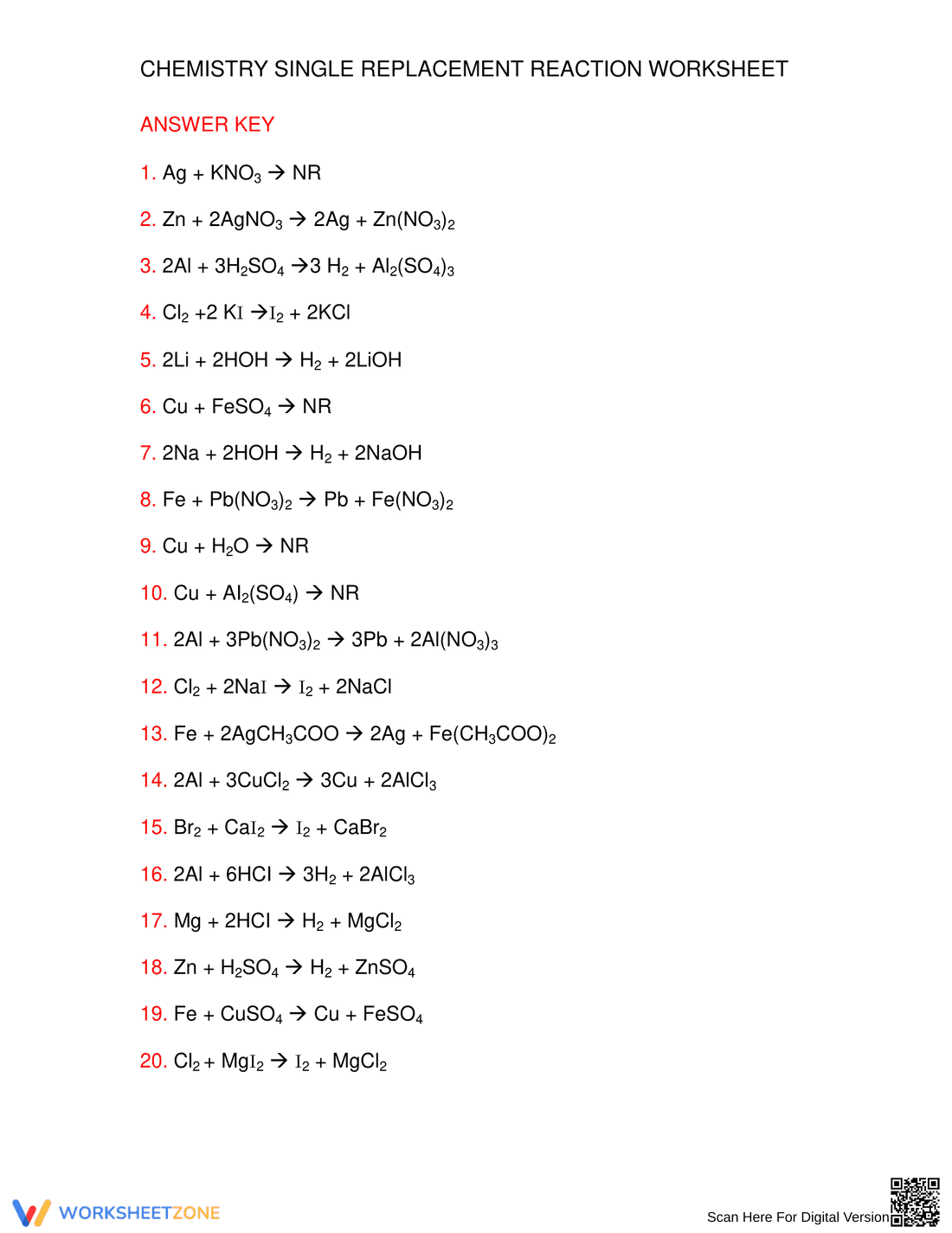
The packet contains a comprehensive 20-question problem set, a dedicated Activity Series Reference Chart for both metals and halogens, and a complete answer key. Students are required to evaluate reactants, consult the reactivity hierarchy, and formulate balanced products. The inclusion of "No Reaction" (NR) scenarios ensures students critically evaluate the activity series rather than simply following a repetitive pattern.
This resource is designed for immediate classroom implementation with a total teacher prep time of under 2 minutes. Simply print the 4-page PDF, distribute the problem set and reference chart to students, and use the provided answer key for rapid grading or self-correction. Its self-contained nature makes it an ideal emergency sub plan for chemistry units or a reliable homework assignment during the chemical reactions module.
The primary alignment is `HS-PS1-2`, which requires students to explain and predict the outcomes of simple chemical reactions. This worksheet specifically addresses the "patterns of chemical properties" by using the activity series as a predictive tool for displacement. Both standard codes can be copied directly into lesson plans, IEP goals, or district curriculum mapping tools to ensure compliance with state and national frameworks.
Assign this worksheet as a summative check after a lecture on the activity series and types of chemical reactions. It works best during the independent practice phase of a 5E lesson model. For formative assessment, observe if students correctly identify "NR" for reactions where the lone element is less active than the one in the compound. Expected completion typically takes 30 to 45 minutes depending on student familiarity with balancing.
This is tailored for high school chemistry students learning about stoichiometry and reaction types. It provides necessary scaffolding for students who struggle with memorization by providing the reference chart directly. It pairs naturally with a periodic table or a laboratory demonstration of metal reactivity in aqueous solutions to bridge the gap between theory and observation.
This chemistry resource aligns with HS-PS1-2 by focusing on the predictive nature of chemical reactivity through single replacement reactions. According to research from EdReports (2024), high-quality science materials must provide students with opportunities to apply patterns to predict phenomena, such as using an activity series to determine reaction feasibility. This worksheet facilitates that application across 20 distinct chemical equations, including halogen and metal displacements. By requiring students to balance equations and identify non-reactive pairs, the material reinforces the Law of Conservation of Mass and the specific chemical properties of elements. The inclusion of a reference chart supports cognitive load management, allowing students to focus on the logic of the reaction rather than rote memorization of reactivity ranks. This structured approach is essential for developing mastery in chemical literacy and preparing students for advanced laboratory work or college-level chemistry courses.


