




























1 / 2
0
Views
0
Downloads

0.0
0
Save
0 Likes
Share
Single Replacement Reaction Worksheet
0 Views
0 Downloads

Paste this activity's link or code into your existing LMS (Google Classroom, Canvas, Teams, Schoology, Moodle, etc.).
Students can open and work on the activity right away, with no student login required.
You'll still be able to track student progress and results from your teacher account.
Information
Description
What It Is:
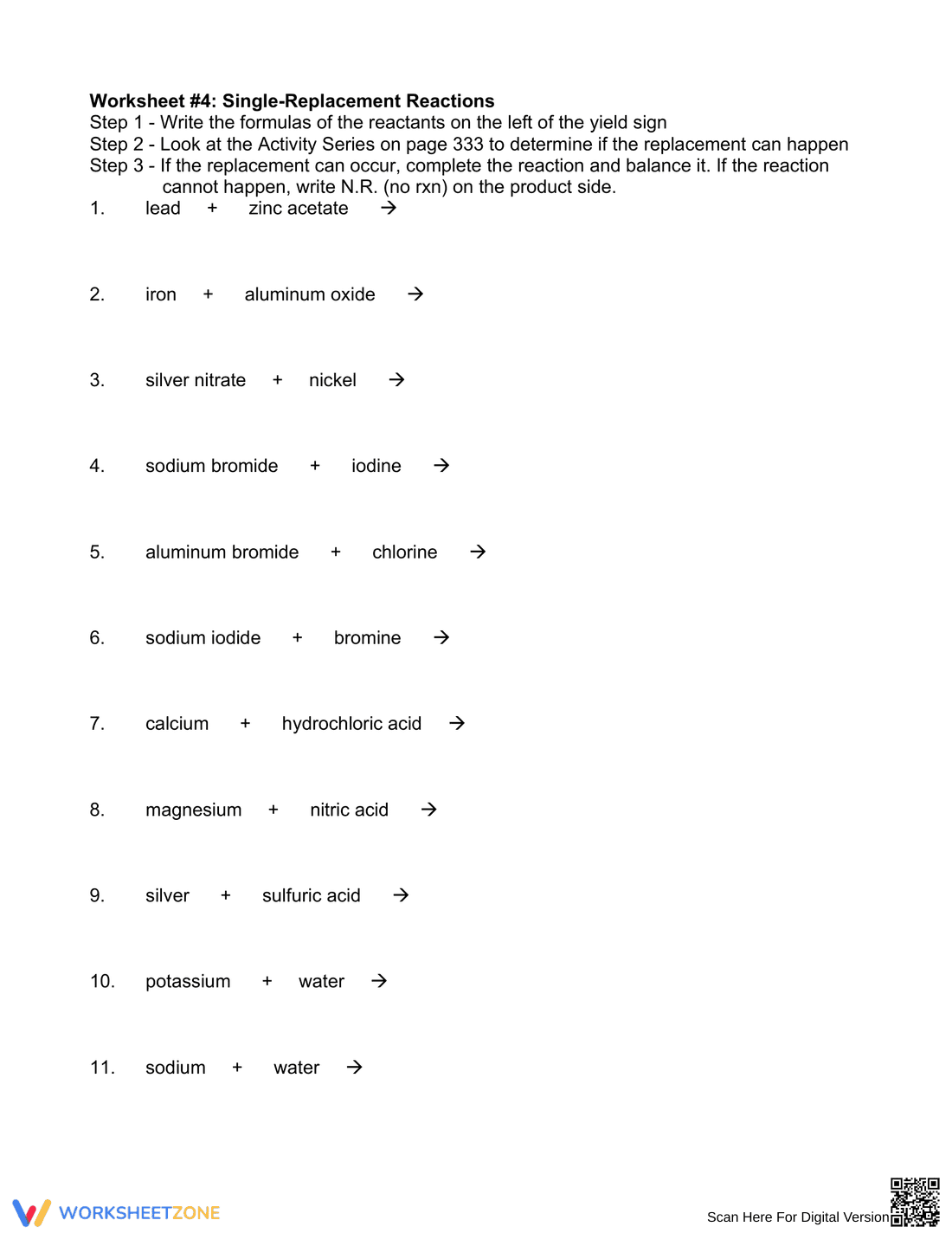
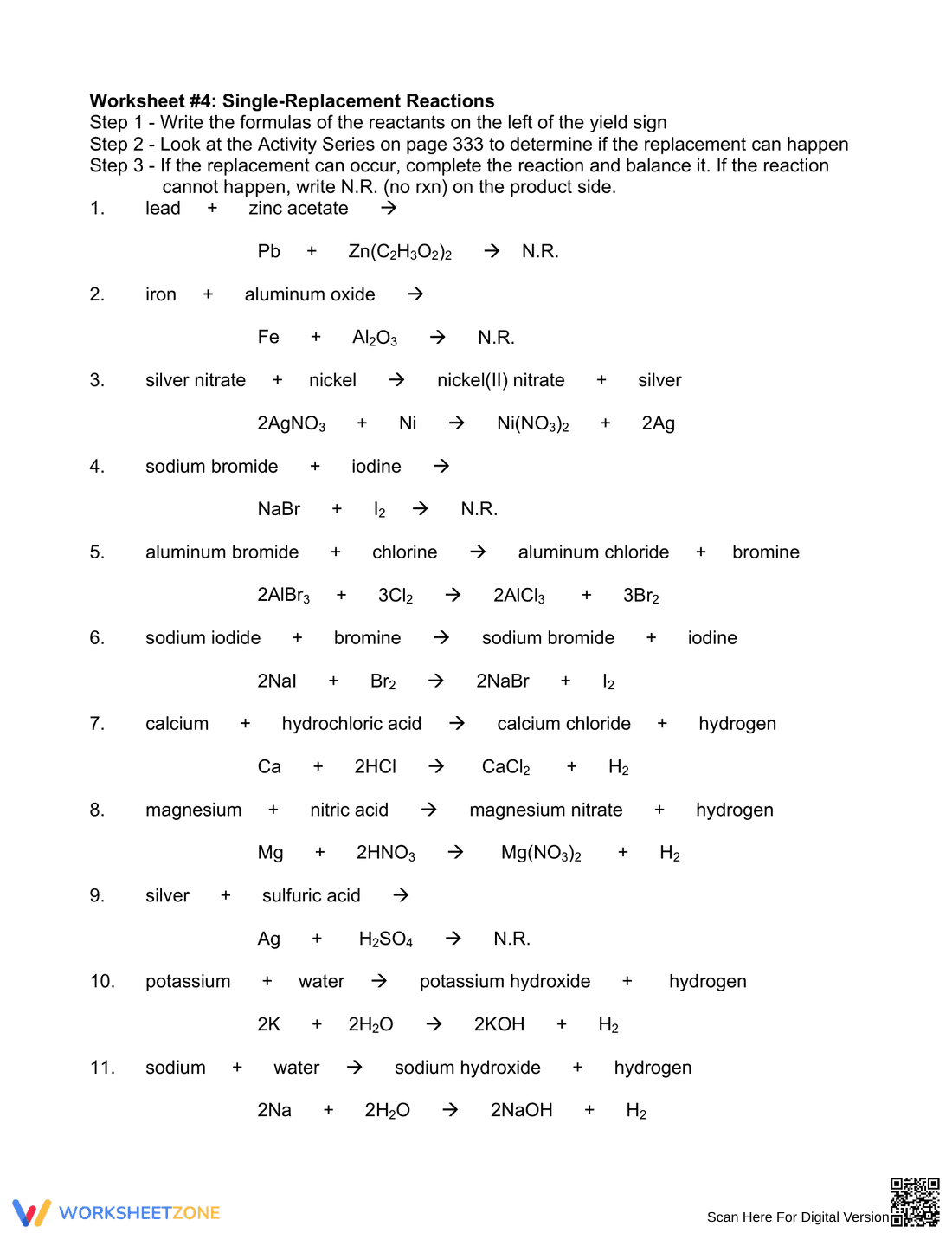
This is a chemistry worksheet focused on single-replacement reactions. It provides a series of chemical reactants (e.g., lead + zinc acetate, iron + aluminum oxide) and asks the student to predict the products and balance the resulting chemical equation, or indicate if no reaction occurs (N.R.). The worksheet includes instructions to write the formulas of the reactants and to consult an activity series (page 333) to determine if a replacement reaction is possible.
Grade Level Suitability:
This worksheet is suitable for high school chemistry students, typically grades 10-12. It requires knowledge of chemical formulas, balancing equations, and the concept of activity series in predicting reaction outcomes.
Why Use It:
This worksheet reinforces understanding of single-replacement reactions, helps students practice writing and balancing chemical equations, and develops skills in using the activity series to predict reaction feasibility. It allows students to apply theoretical knowledge to practical problems.
How to Use It:
Students should first write the chemical formulas for the reactants listed on the left side of the yield sign. Then, they should consult an activity series chart to determine if the single replacement reaction is possible. If it is, they should write the products of the reaction and balance the equation. If no reaction occurs, they should write 'N.R.' on the product side.
Target Users:
The target users are high school chemistry students and teachers who are covering the topic of single-replacement reactions. It can be used for in-class practice, homework assignments, or review activities.
This is a chemistry worksheet focused on single-replacement reactions. It provides a series of chemical reactants (e.g., lead + zinc acetate, iron + aluminum oxide) and asks the student to predict the products and balance the resulting chemical equation, or indicate if no reaction occurs (N.R.). The worksheet includes instructions to write the formulas of the reactants and to consult an activity series (page 333) to determine if a replacement reaction is possible.
Grade Level Suitability:
This worksheet is suitable for high school chemistry students, typically grades 10-12. It requires knowledge of chemical formulas, balancing equations, and the concept of activity series in predicting reaction outcomes.
Why Use It:
This worksheet reinforces understanding of single-replacement reactions, helps students practice writing and balancing chemical equations, and develops skills in using the activity series to predict reaction feasibility. It allows students to apply theoretical knowledge to practical problems.
How to Use It:
Students should first write the chemical formulas for the reactants listed on the left side of the yield sign. Then, they should consult an activity series chart to determine if the single replacement reaction is possible. If it is, they should write the products of the reaction and balance the equation. If no reaction occurs, they should write 'N.R.' on the product side.
Target Users:
The target users are high school chemistry students and teachers who are covering the topic of single-replacement reactions. It can be used for in-class practice, homework assignments, or review activities.


