


























1 / 2
0
Views
0
Downloads


Save
0 Likes
Share
Naming Covalent Molecules
0 Views
0 Downloads
Paste this activity's link or code into your existing LMS (Google Classroom, Canvas, Teams, Schoology, Moodle, etc.).
Students can open and work on the activity right away, with no student login required.
You'll still be able to track student progress and results from your teacher account.
Information
Description
What It Is:
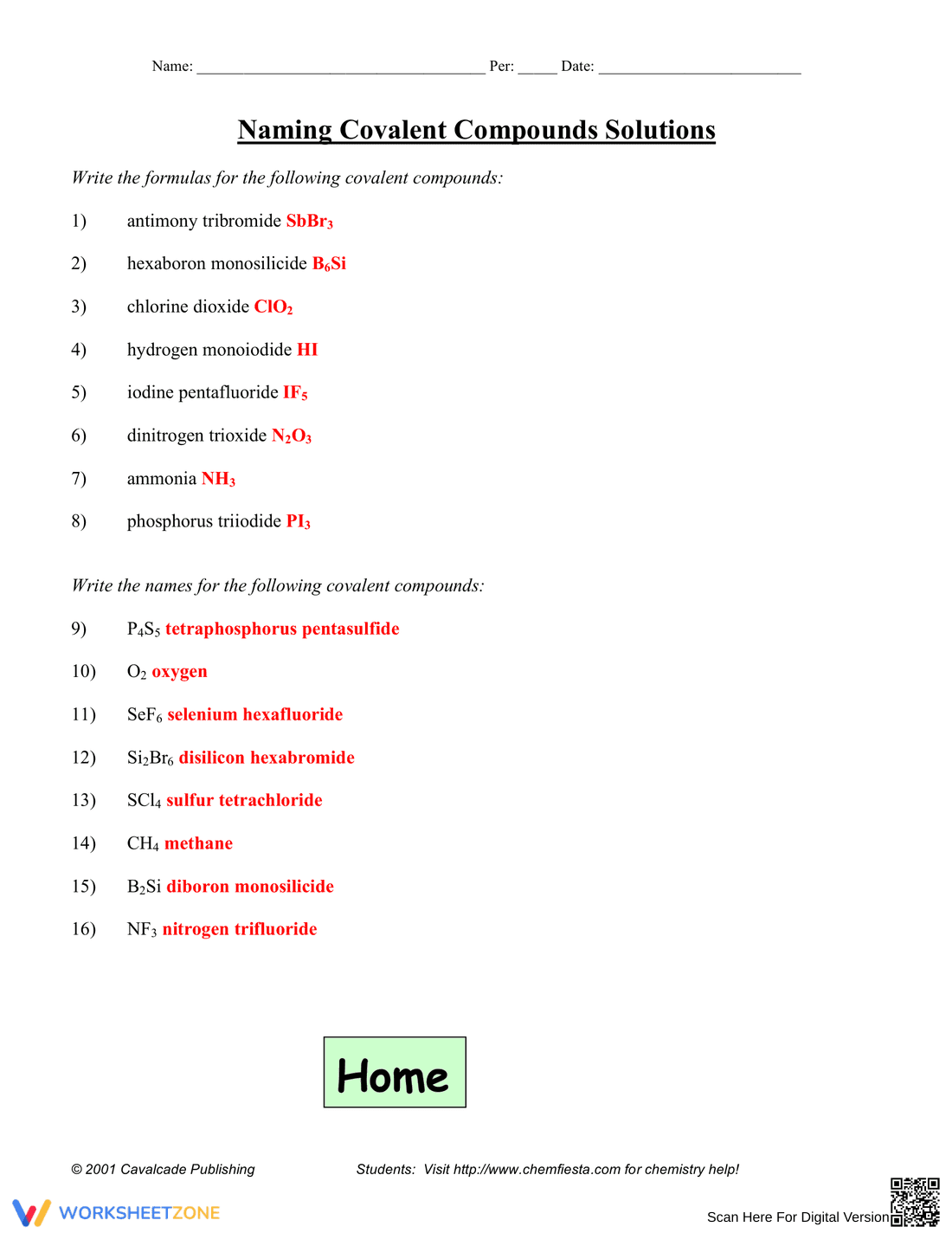
This is a chemistry worksheet titled 'Naming Covalent Molecules Worksheet.' It includes two sections. The first section provides the names of eight covalent compounds, such as 'antimony tribromide' and 'hexaboron monosilicide', and requires the student to write the corresponding chemical formulas. The second section lists eight chemical formulas of covalent compounds, such as 'P₂S₅' and 'O₂', and asks the student to write the corresponding names.
Grade Level Suitability:
This worksheet is suitable for high school chemistry students, specifically grades 9-12. It requires an understanding of chemical nomenclature and the ability to translate between chemical names and formulas, concepts typically covered in high school chemistry courses.
Why Use It:
This worksheet reinforces the rules for naming covalent compounds and writing their chemical formulas. It helps students practice and master these essential chemistry skills, improving their understanding of chemical compounds and their properties. It provides practice in both directions: from name to formula and from formula to name.
How to Use It:
Students should read the name of each covalent compound in the first section and write its corresponding chemical formula on the provided line. In the second section, students should read the chemical formula of each compound and write its name on the provided line. Students can use their textbook or notes as a reference.
Target Users:
The target users are high school chemistry students learning about chemical nomenclature, as well as teachers who need practice worksheets for their students. It is also useful for students reviewing chemistry concepts.
This is a chemistry worksheet titled 'Naming Covalent Molecules Worksheet.' It includes two sections. The first section provides the names of eight covalent compounds, such as 'antimony tribromide' and 'hexaboron monosilicide', and requires the student to write the corresponding chemical formulas. The second section lists eight chemical formulas of covalent compounds, such as 'P₂S₅' and 'O₂', and asks the student to write the corresponding names.
Grade Level Suitability:
This worksheet is suitable for high school chemistry students, specifically grades 9-12. It requires an understanding of chemical nomenclature and the ability to translate between chemical names and formulas, concepts typically covered in high school chemistry courses.
Why Use It:
This worksheet reinforces the rules for naming covalent compounds and writing their chemical formulas. It helps students practice and master these essential chemistry skills, improving their understanding of chemical compounds and their properties. It provides practice in both directions: from name to formula and from formula to name.
How to Use It:
Students should read the name of each covalent compound in the first section and write its corresponding chemical formula on the provided line. In the second section, students should read the chemical formula of each compound and write its name on the provided line. Students can use their textbook or notes as a reference.
Target Users:
The target users are high school chemistry students learning about chemical nomenclature, as well as teachers who need practice worksheets for their students. It is also useful for students reviewing chemistry concepts.


