




























Views
Downloads


Naming Molecular Compounds Printable | Grade 9-12 Chemistry

Paste this activity's link or code into your existing LMS (Google Classroom, Canvas, Teams, Schoology, Moodle, etc.).
Students can open and work on the activity right away, with no student login required.
You'll still be able to track student progress and results from your teacher account.
This comprehensive chemistry worksheet helps high school students master naming molecular compounds and writing chemical formulas. By analyzing patterns in prefixes and suffixes, students will confidently translate between chemical formulas and compound names, building a strong foundation for advanced chemistry concepts and chemical reaction equations.
At a Glance
- Grade: 9-12 · Subject: Chemistry
- Standard:
HS-PS1-1— Predict properties of elements based on periodic table patterns- Skill Focus: Naming molecular compounds
- Format: 6 pages · 21 problems · PDF
- Best For: Guided inquiry and collaborative learning
- Time: 45–60 minutes
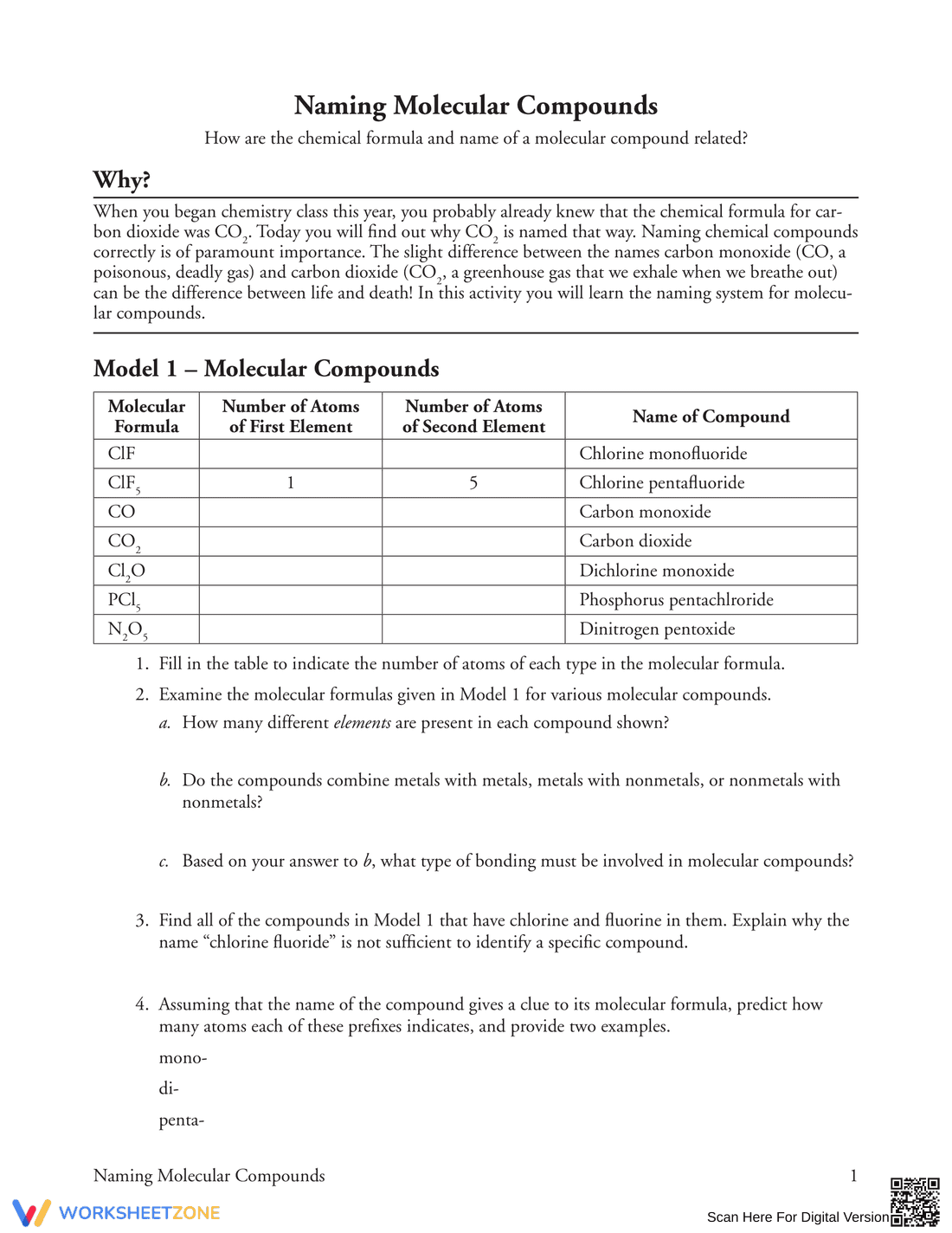
This six-page guided inquiry activity features 21 structured tasks designed to build conceptual understanding step-by-step. Students will analyze data tables containing molecular formulas and names, identify patterns in prefixes (like mono-, di-, and penta-), and formulate their own rules for chemical nomenclature. The resource includes extension questions that challenge learners to compare molecular and ionic compounds, ensuring deep comprehension of chemical bonding principles.
- Guided practice: Students begin by examining provided models of molecular compounds, counting atoms, and identifying the relationship between subscripts and prefixes in chemical names.
- Supported practice: Learners apply their observations to fill in missing numerical values for prefixes and collaboratively draft a set of rules for naming binary molecular compounds.
- Independent practice: The final sections require students to independently name new compounds, write formulas from given names, and differentiate between ionic and covalent naming conventions. This gradual-release approach ensures mastery.
Aligned to HS-PS1-1: Use the periodic table as a model to predict the relative properties of elements based on the patterns of electrons in the outermost energy level. This foundational skill supports students in understanding how nonmetals combine to form covalent bonds. Both standard codes can be copied directly into lesson plans, IEP goals, or district curriculum mapping tools.
This activity is ideal for introduction during direct instruction or as a collaborative group work assignment. Teachers can place students in small groups to work through the models, fostering peer discussion and consensus-building around naming rules. As a formative assessment tip, observe how students handle compounds with the "mono-" prefix on the first element to quickly gauge their grasp of the specific nomenclature exceptions. Expected completion time is 45 to 60 minutes.
Designed for high school chemistry students in grades 9 through 12, this resource is perfect for learners encountering chemical nomenclature for the first time. The structured models provide built-in scaffolding for students who struggle with abstract concepts, while the extension questions offer rigor for advanced learners. It pairs excellently with an anchor chart on Greek prefixes or a hands-on molecular modeling kit activity.
Mastering chemical nomenclature is a critical threshold concept in high school science. Aligned with HS-PS1-1, this resource helps students predict properties of elements based on periodic table patterns by explicitly teaching how to name molecular compounds. According to a ScienceDirect TpT Analysis, guided inquiry worksheets that require students to derive rules from data models significantly improve long-term retention of abstract chemistry concepts compared to traditional rote memorization. By actively engaging with the patterns of prefixes and suffixes, learners develop a robust mental framework for chemical bonding. This structured approach reduces cognitive overload and builds the precise academic vocabulary necessary for success in advanced STEM coursework. Educators can rely on this evidence-based format to foster deep conceptual understanding and scientific literacy in the classroom.


