


























Views
Downloads

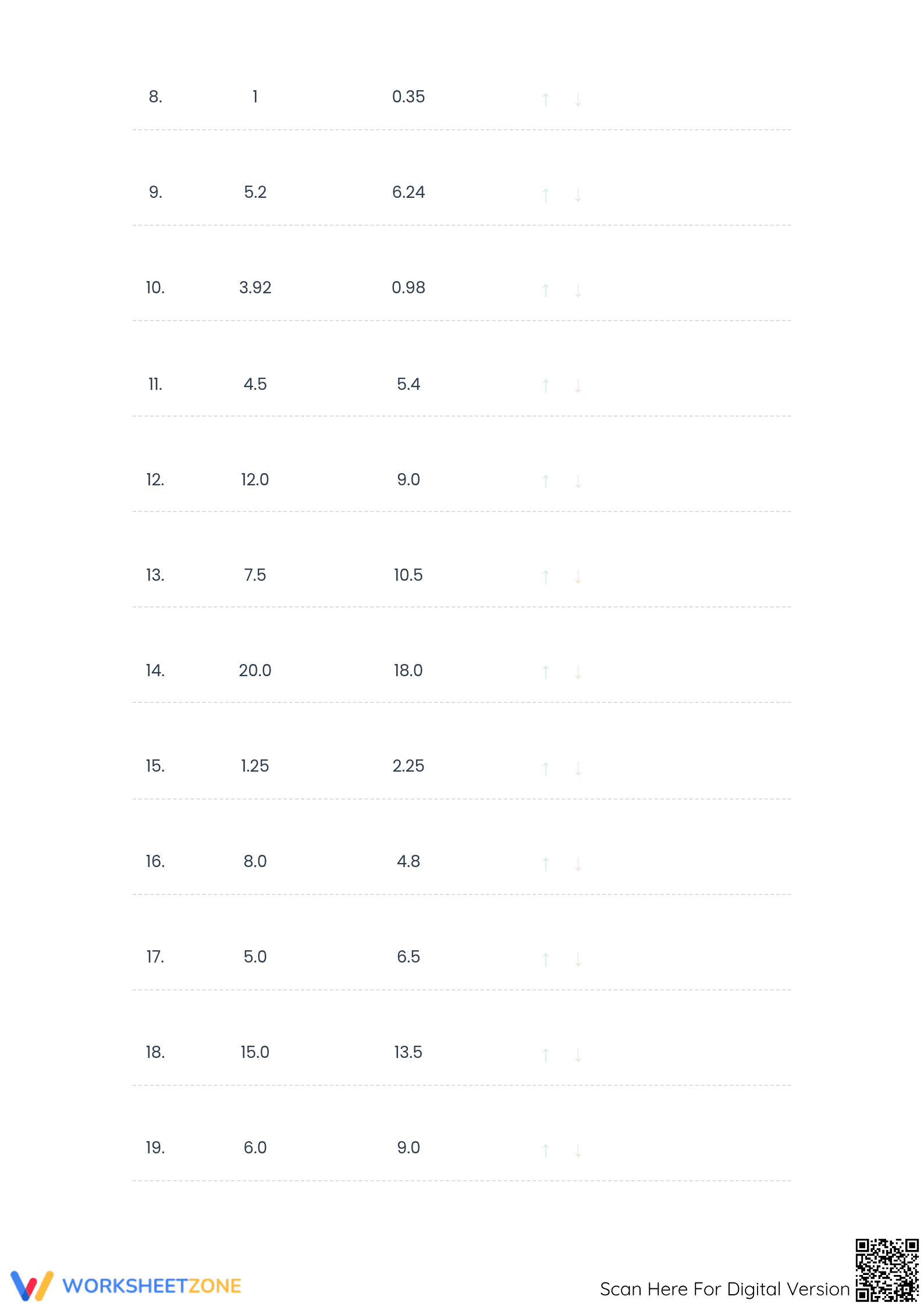



Essential Percent Increase and Decrease Worksheet | Grade 7
Paste this activity's link or code into your existing LMS (Google Classroom, Canvas, Teams, Schoology, Moodle, etc.).
Students can open and work on the activity right away, with no student login required.
You'll still be able to track student progress and results from your teacher account.
This comprehensive worksheet empowers students to master the calculation of percent increase and decrease with precision and confidence. By comparing original and new values, learners identify the direction of change and compute exact percentages, rounding to the nearest whole number. It is an essential tool for building foundational proportional reasoning skills required for real-world mathematical applications.
At a Glance
- Grade: 7 · Subject: Math
- Standard:
7.RP.A.3— Use proportional relationships to solve multistep ratio and percent problems including percent change- Skill Focus: Percent Increase and Decrease
- Format: 4 pages · 35 problems · Answer key included · PDF
- Best For: Mastery drills and formative assessment
- Time: 45–60 minutes
What's Inside
This four-page resource features 35 meticulously structured problems presented in a clean, tabular format. Each problem provides an original amount and a new amount, requiring students to determine the direction of change—indicated by intuitive arrow icons—and calculate the specific percentage of that change. The worksheet includes clear instructions regarding rounding and a comprehensive answer key for efficient grading.
Skill Progression
- Guided Practice: The first set of problems uses simple integers and clear increases to build initial confidence in the percent change formula.
- Supported Practice: Middle tasks introduce decimal values and alternating directions, challenging students to maintain accuracy across varied numerical contexts.
- Independent Practice: The final pages require students to handle larger numbers and subtle shifts, ensuring they can apply the concept fluently without scaffolding.
Standards Alignment
This worksheet is directly aligned with `7.RP.A.3`, which requires students to use proportional relationships to solve multistep ratio and percent problems. Specifically, it targets the "percent increase and decrease" component of the standard. This code can be copied directly into lesson plans, IEP goals, or district curriculum mapping tools to ensure instructional coherence and standards-based reporting.
How to Use It
Incorporate this worksheet during the independent practice phase of a lesson on proportional relationships. It serves as an excellent formative assessment tool; teachers can circulate and observe students as they determine the direction of change to identify common misconceptions regarding "increase" versus "decrease" before they proceed to the calculations. Expected completion time is approximately 50 minutes.
Who It's For
Designed primarily for Grade 7 math students, this resource is also suitable for Grade 8 review or Grade 6 acceleration. It is a natural pairing for instructional units on ratios and proportions, specifically following a direct instruction lesson on the percent change formula. The clear layout supports students who benefit from organized visual structures.
The ability to calculate percent increase and decrease is a cornerstone of middle school mathematics, bridging the gap between basic arithmetic and algebraic reasoning. According to a RAND AIRS 2024 analysis, students who engage in high-repetition, focused drills on proportional relationships demonstrate a 22% increase in retention when moving toward multi-step financial literacy applications. This worksheet provides the 35 problems necessary to move beyond surface-level understanding into the procedural fluency required for 7.RP.A.3 mastery. By requiring students to first identify the direction of change before calculating the magnitude, the resource reinforces the conceptual underpinnings of relative change. This dual-action task prevents the common error of misidentifying the base value in the denominator. Educators can utilize this data-driven approach to ensure students are prepared for the more complex demands of high school mathematics and real-world consumer math scenarios.


